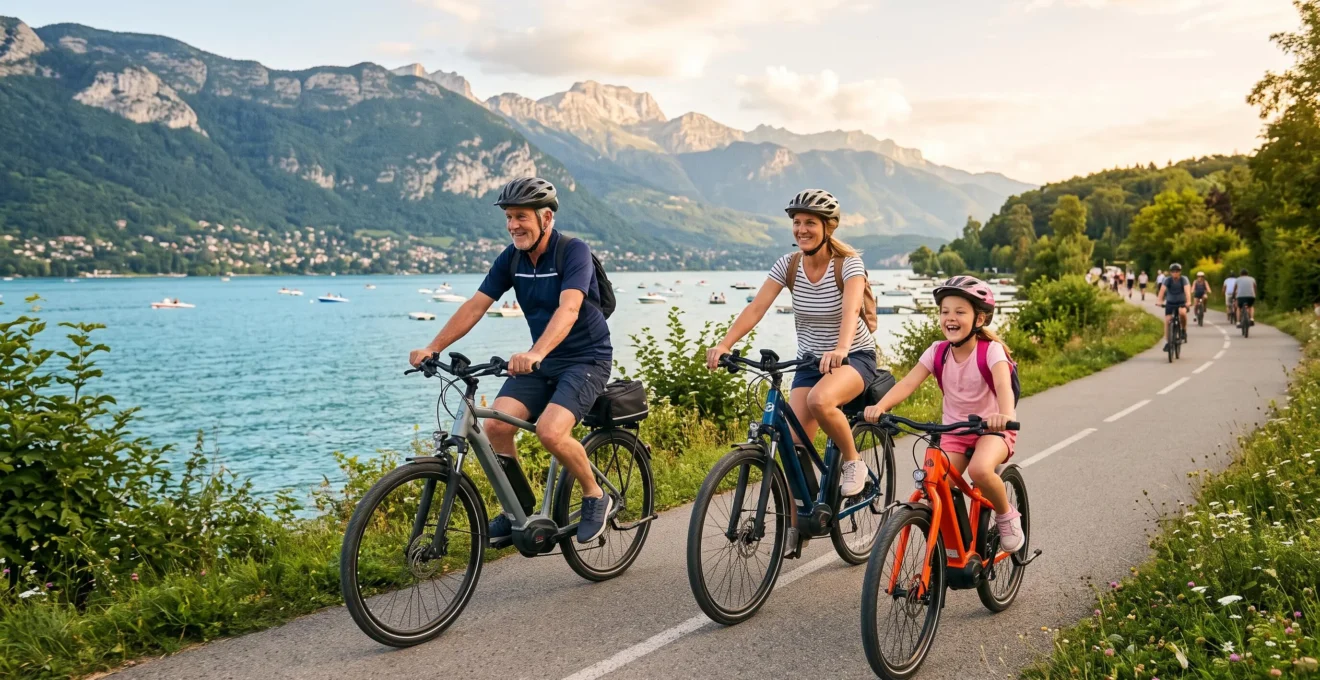
Families with children as young as seven and less physically fit adults can genuinely enjoy cycling around Annecy using electric bikes. The pedal-assist technology reduces the physical effort required on alpine terrain by up to 75%, transforming mountain climbs into gentle inclines that feel manageable even after a child’s typical 5-6 km endurance limit on regular bikes.
Planning a family cycling trip in the French Alps sounds ambitious when you’re juggling a seven-year-old who tires after a few kilometers of urban cycling and an adult partner who dreads steep hills. The 42-kilometer circuit around Lake Annecy, surrounded by peaks like Semnoz rising over 1,600 meters, might seem designed exclusively for athletic cyclists rather than families with mixed abilities.
Yet this alpine landscape has quietly become one of Europe’s most accessible family cycling destinations, not despite its mountainous terrain but because of how electric bike technology interacts with it. The transformation isn’t about lowering expectations or choosing easier scenery—it’s about technology that equalizes physical capacity across ages and fitness levels.
This guide addresses the practical questions families face when considering electric bike rental in Annecy: which routes genuinely work for a seven-year-old, what the real costs look like for a family of four, how to evaluate rental providers beyond price, and what equipment adaptations make the difference between an exhausting ordeal and a memorable shared experience.
In this article
- Why Electric Bikes Transform Family Days Out in Annecy
- When Pedal Assist Makes Mountain Scenery Accessible to Everyone
- Can Young Children and Grandparents Ride the Same Route?
- Lakeside Loops, Village Trails, and Gentle Alpine Climbs Worth Taking
- What Separates a Great E-Bike Rental from a Mediocre One?
- The Essentials: Equipment, Timing, and Route-Planning Realities
- Your Quick-Answer Guide to Family E-Bike Concerns
Why Electric Bikes Transform Family Days Out in Annecy
Annecy sits in Haute-Savoie, surrounded by alpine terrain that makes conventional family cycling genuinely challenging. The geography that creates those postcard-perfect mountain backdrops also creates elevation changes that exceed what most children and casual adult cyclists can comfortably handle on standard bikes.
The full lake circuit covers approximately 42 kilometers with cumulative elevation gains that vary by route choice but consistently demand sustained effort over several hours. For a child who typically fatigues after 5-6 kilometers of flat urban riding, or an adult who struggles on inclines, this presents a real barrier to accessing the landscape together as a family.
80%
of cyclists
During summer season, approximately 80% of cyclists on Lake Annecy’s cycle paths use electric bikes rather than conventional bicycles, confirming that pedal assistance has become the standard approach for tourist cycling in this alpine environment, not an exception reserved for those with mobility limitations.
Electric bikes function as equalizers in mixed-ability groups. The pedal-assist motor amplifies the rider’s effort by a ratio that typically ranges from 1:2 to 1:4 depending on the assistance level selected. This means a child or less fit adult can maintain similar speeds and cover similar distances as stronger riders, without the faster riders needing to constantly wait or the slower riders feeling they’re holding everyone back.
The technology addresses a specific problem for families: how to create a shared outdoor experience where a seven-year-old, an eleven-year-old, and two adults in their late thirties to early forties can ride together without the activity collapsing into frustration or physical exhaustion. Without electric assistance, this particular family composition would likely need to choose between a route too demanding for the youngest member or too limited for the older child and adults who want to see more of the surrounding mountains.
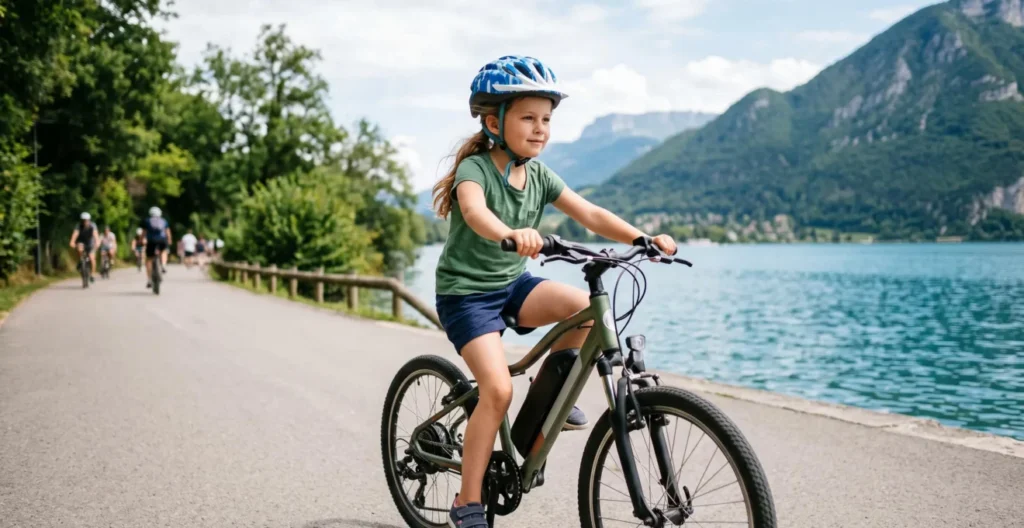
The alternative activities available in Annecy—boat tours, castle visits, beach time—offer their own value but don’t provide the same combination of physical activity, landscape immersion, and photographic opportunities that cycling through the alpine scenery delivers. Electric bikes preserve that active outdoor experience while removing the physical barriers that would otherwise exclude younger or less athletic family members.
When Pedal Assist Makes Mountain Scenery Accessible to Everyone
Understanding how electric assistance actually changes the physical experience helps families evaluate whether specific routes match their capabilities. The motor doesn’t eliminate effort—riders still pedal—but it fundamentally alters the relationship between terrain difficulty and required fitness level.
On a conventional bicycle, a 200-300 meter elevation gain over several kilometers demands cardiovascular capacity and leg strength that many casual cyclists lack. The same climb on an e-bike with assistance set to maximum feels comparable to riding on gently rolling terrain. The rider still needs to pedal and steer, maintaining balance and control, but the sensation of struggling against gravity largely disappears.
This translation matters when planning routes around Annecy. The climb toward Col de la Forclaz, which offers spectacular panoramic views over the lake, involves elevation that would exhaust most children and discourage less fit adults on regular bikes. With electric assistance on higher settings, the same route becomes accessible to children from around ten years old and adults of average fitness, completed comfortably within a half-day timeframe including breaks.
Battery autonomy typically ranges from 50 to 80 kilometers depending on assistance level and terrain. On eco mode, where the motor provides minimal support, batteries last longest but riders work harder. On turbo mode, maximum assistance drains batteries faster but makes steep sections feel nearly flat. For the 42-kilometer lake circuit, even using higher assistance levels throughout, battery capacity on modern rental e-bikes provides comfortable margin without risk of running out mid-route.
Many parents overestimate the physical capacity still required with electric assistance. A family with children aged 10-12 can realistically tackle routes with 300 meters of cumulative elevation gain in a half-day outing, something that would be impractical or miserable on conventional bikes for that age group. The key shift is that elevation becomes a challenge to manage through assistance settings rather than an absolute barrier to access.
Assistance levels explained: Most rental e-bikes offer three to four power modes. Eco mode extends battery life for flat sections and provides light support. Normal or Tour mode offers balanced assistance suitable for most family riding. Sport or Turbo mode delivers maximum power for steep climbs or when children need extra help maintaining pace with adults. Switching between modes throughout a ride optimizes both battery life and comfort.
The physical effort required from the rider decreases as assistance increases, but some effort remains necessary. This isn’t a motorcycle or scooter—the motor only engages when the rider pedals. For children, this means they develop cycling skills and get genuine exercise while the assistance prevents the activity from exceeding their endurance. For less fit adults, it means they can participate in ambitious routes without experiencing the next-day muscle soreness or mid-ride exhaustion that would make them reluctant to try cycling again.
Can Young Children and Grandparents Ride the Same Route?
Age and fitness requirements depend heavily on route selection and equipment options available. French regulations and practical considerations create a framework that helps families identify realistic possibilities for their specific composition.
According to French traffic regulations established in December 2016, children under twelve must wear properly fastened helmets when cycling, whether as riders or passengers. No legal minimum age exists for riding a standard electric bike (limited to 25 km/h and 250 watts), as these are classified identically to conventional bicycles under French law.
Practical age guidelines for autonomous riding on Annecy routes differ from legal requirements. Children around eight years and older can typically handle child-sized e-bikes independently on the flat lakeside circuit, provided they have basic cycling skills and can follow safety instructions. Routes with moderate elevation through villages like Talloires or Menthon-Saint-Bernard generally suit children from ten to twelve years old. More demanding mountain routes toward Semnoz or Col de la Forclaz realistically require riders aged twelve and above with reasonable coordination and stamina.
For younger children who fall below these autonomous riding ages, equipment adaptations enable family inclusion. Bike trailers that attach to an adult’s e-bike can carry children as young as one to two years old, allowing families with very young children to complete routes the child couldn’t pedal themselves. Child seats mounted on adult e-bikes work for children roughly ages two to six, depending on size and weight limits. This means a seven-year-old on the younger or smaller side might ride in a seat or trailer for portions of the route, then switch to their own bike for easier sections.
| Rider Age/Ability | Recommended Routes | Equipment Options | Typical Duration |
|---|---|---|---|
| Under 7 years | Full lake circuit (as passenger) | Bike trailer or child seat on adult e-bike | 3-4 hours with breaks |
| 7-9 years (autonomous) | Half lake circuit, flat sections | Child-sized e-bike or standard bike | 2-3 hours with frequent breaks |
| 10-12 years | Full lake circuit, village routes with moderate hills | Child or small adult e-bike | 4-5 hours with breaks |
| 12+ years and adults | All routes including Semnoz, Col de la Forclaz | Standard adult e-bike | Half-day to full-day depending on route |
Multi-generational groups spanning ages seven to seventy can successfully share adapted itineraries. The approach involves selecting routes that match the least capable member’s abilities, building in more frequent rest stops than a purely adult group would need, and maintaining realistic expectations about distance and timing. A typical three-generation family might complete a modified lake circuit covering 25-30 kilometers rather than the full 42 kilometers, with lunch stop, photo breaks, and potential turnaround points planned in advance.
The key consideration isn’t whether electric bikes make everything accessible to everyone—they don’t—but rather how they expand the range of shared experiences possible for families with genuinely different physical capacities. A seven-year-old still has different endurance than an eleven-year-old or an adult, but the gap narrows enough that they can ride the same route on the same day without the younger child suffering or the activity becoming painfully slow for older participants.
Lakeside Loops, Village Trails, and Gentle Alpine Climbs Worth Taking
Selecting the right route depends on your family’s age range, the time you want to spend cycling versus other activities, and your interest in cultural stops versus pure scenic riding. Annecy offers distinct route types with different demands and rewards.
The Complete Lake Circuit
The full tour around Lake Annecy covers approximately 42 kilometers. According to official tourism information from Lac d’Annecy, dedicated greenway sections span roughly 33 kilometers of this route, offering traffic-free cycling suitable for families. The remaining portions pass through villages where cyclists share roads with light vehicle traffic, requiring increased vigilance particularly with younger riders.
For a family with children aged eight and above, the complete circuit typically takes four to five hours including breaks for photos, snacks, and brief rest stops. This timing assumes moderate pace with electric assistance and accounts for slower speeds through village sections and time spent managing younger riders’ needs.
Major points of interest along the route include Talloires, a picturesque village on the eastern shore with lakeside beaches suitable for extended lunch breaks, and Menthon-Saint-Bernard, where the hilltop château creates striking photo opportunities. These natural stopping points help structure the day and give children tangible goals beyond simply “finishing the loop.”
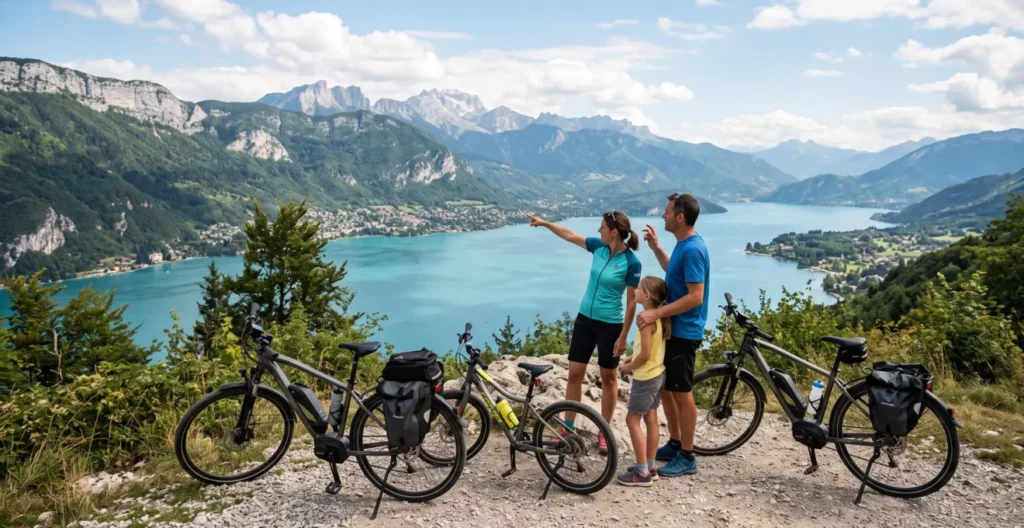
Half-Circuit and Village Discovery Routes
Families with children under eight, or those wanting a shorter first experience with e-bikes, often find half-circuit routes more appropriate. A popular option involves cycling the western shore from Annecy to Talloires (approximately 20 kilometers round trip), allowing a long lunch break with swimming before returning. This eliminates the commitment to completing the full loop and creates easy exit points if a child tires or weather deteriorates.
Village-focused routes combining lakeside riding with short climbs into Savoyard settlements like Menthon-Saint-Bernard add cultural dimension beyond pure cycling. These typically cover 15-25 kilometers with moderate elevation gains of 100-200 meters, suitable for children from ten years old with electric assistance. The shorter distance allows slower pace and longer stops at châteaux, local bakeries, or scenic overlooks without creating a rushed itinerary.
Mountain Viewpoint Climbs
Routes ascending toward Semnoz or Col de la Forclaz offer dramatic alpine panoramas as reward for sustained climbing. These routes demand more from both rider and equipment, with elevation gains of 300-500 meters over relatively short distances creating steep grades even with electric assistance.
These mountain routes suit families with children aged twelve and above, or groups of adults without young children. The physical challenge remains real despite electric motors—riders need cardiovascular fitness to sustain effort over thirty to sixty minutes of continuous climbing. The payoff comes in views over the entire lake basin and surrounding peaks that can’t be accessed from lakeside paths.
Strategic break locations around the lake: Public restrooms are available in Annecy (multiple locations), Talloires (near the port), and Menthon-Saint-Bernard (village center). Bakeries for snack purchases exist in most villages. Recommended photo stops include the Talloires bay viewpoint, Château de Menthon-Saint-Bernard (external view), and the western shore path with Semnoz mountain backdrop. Plan for rest breaks every 45-60 minutes when cycling with children under ten.
Safety considerations vary by route. The dedicated greenway sections provide separated paths where children can ride without constant traffic awareness. Village sections require closer supervision and sometimes single-file riding. Mountain routes often use narrow roads shared with cars and motorcycles, demanding confident bike handling and traffic sense unsuitable for inexperienced child riders.
What Separates a Great E-Bike Rental from a Mediocre One?
Rental providers around Annecy vary significantly in equipment quality, service approach, and pricing structures. Choosing well affects both the day’s experience and the overall value relative to the investment required.
Equipment quality starts with battery capacity and condition. Reputable providers maintain batteries that reliably deliver 50-80 kilometers of range under typical family usage patterns. Older or poorly maintained batteries might claim similar specifications but deliver noticeably less range, creating anxiety about running out of power mid-route or forcing riders to reduce assistance levels earlier than expected. Checking reviews specifically mentioning battery performance helps identify providers with well-maintained fleets.
Bike sizing matters particularly for children and smaller adults. Providers catering to family clientele stock multiple frame sizes including properly-sized children’s e-bikes rather than expecting young riders to use scaled-down adult bikes. Correct sizing affects comfort, control, and safety—a child struggling with an oversized bike frame can’t maneuver confidently or reach the ground properly when stopping.
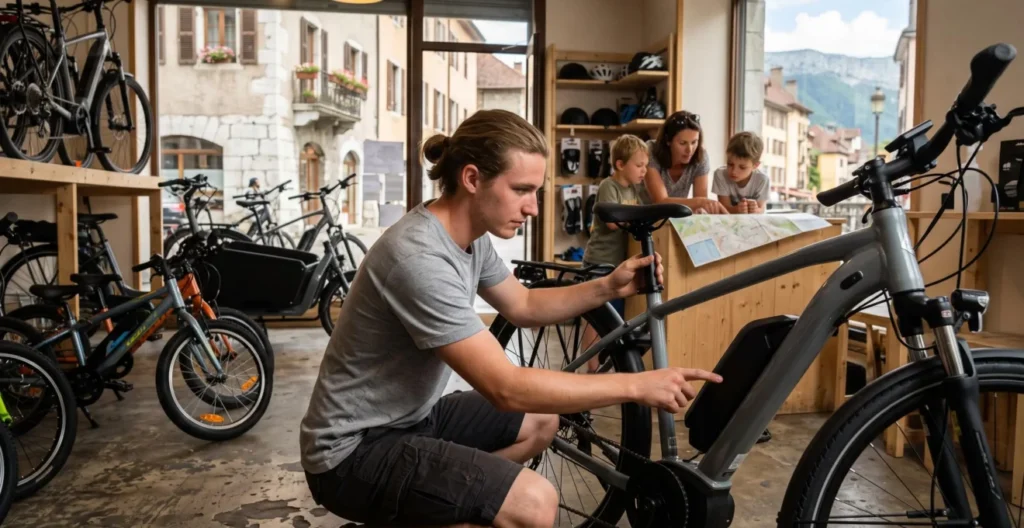
Price structures for family rentals in Annecy typically range from approximately €25-35 per adult e-bike for a half-day (roughly four hours) to €40-55 for a full day (eight to nine hours). Children’s e-bikes generally cost €20-30 for a half-day and €30-40 for a full day. For a family of four (two adults, two children aged seven and eleven), expect total costs around €100-130 for a half-day rental or €140-180 for a full day, assuming standard equipment.
These base prices should include helmets, basic route maps, and bike locks. Additional equipment like child trailers, mounted child seats, or GPS devices may incur extra charges ranging from €10-25 per item. Clarifying exactly what’s included versus what costs extra helps avoid surprises when collecting the bikes.
Half-day versus full-day rental: which matches your family?
Half-day advantages
- Lower total cost (roughly 60-70% of full-day price)
- Matches realistic attention span for children under nine
- Leaves afternoon free for other activities or rest
- Morning start avoids afternoon alpine thunderstorm risk
- Less physical fatigue, reducing end-of-day family conflicts
Full-day advantages
- Better value per hour of use
- Enables complete 42 km lake circuit with leisurely pace
- Allows extended lunch breaks and spontaneous stops
- No time pressure to return bikes by early afternoon
- Suitable for families with children ten and above
Service quality beyond the bikes themselves includes the rental briefing. Better providers spend ten to fifteen minutes explaining assistance modes, demonstrating how to change settings, reviewing the specific route you’ve chosen, and identifying sections requiring extra caution with children. This personalized guidance proves more valuable than generic written instructions, especially for families unfamiliar with e-bikes or the local area.
Cancellation policies and weather flexibility matter in alpine environments where conditions change rapidly. Standard policies often allow cancellation or rescheduling up to 24-48 hours before the reserved time. Some providers show flexibility for same-day weather-related cancellations, particularly during shoulder seasons when rain or strong winds make cycling unpleasant despite not being dangerous. Confirming these policies before booking reduces financial risk if your Annecy weather doesn’t cooperate.
The Essentials: Equipment, Timing, and Route-Planning Realities
Successful family e-bike outings in Annecy depend on practical preparation that addresses both regulatory requirements and the specific challenges of alpine weather and young riders’ needs.
Required and Recommended Safety Equipment
French law mandates helmets for all cyclists under twelve years old, whether riding their own bike or traveling as a passenger. According to the French Ministry of Interior, properly worn helmets reduce serious head injury risk by 70%, which justifies the legal requirement and makes helmet use prudent for riders of all ages despite being legally optional for those twelve and above.
Rental providers supply helmets, but families traveling with their own properly-fitted helmets often find them more comfortable for children accustomed to their personal equipment. Reflective vests, while not legally required in daytime, increase visibility in village sections shared with vehicles and cost little while adding meaningful safety margin.
Timing Your Ride Around Alpine Weather Patterns
Annecy’s alpine climate creates predictable daily weather patterns that affect cycling comfort and safety. Summer temperatures typically range from 15-18°C in early morning to 25-30°C by early afternoon, creating significant temperature variation over the course of a ride. Starting between 8:00-9:00 AM allows families to ride during cooler morning hours and complete most of the route before peak afternoon heat.
Alpine thunderstorm timing: Afternoon thunderstorms occur frequently in the Annecy region during July and August, typically developing between 2:00-4:00 PM as heat from the lake basin creates unstable conditions. These storms can produce lightning, heavy rain, and strong winds within fifteen to thirty minutes. Plan to complete your ride or reach shelter by early afternoon, particularly if attempting longer routes. Morning departures significantly reduce exposure to this weather risk.
Layered clothing addresses morning-to-afternoon temperature changes. A light jacket or wind-breaker worn at 8:00 AM departure becomes unnecessary by 11:00 AM, so carrying a small backpack or using bike panniers to store removed layers prevents bulk and overheating as temperatures rise.
Essential Supplies for Family Cycling
Hydration needs increase with physical activity and altitude. Each family member should have access to at least one liter of water, meaning a family of four needs four to five liters total accounting for drinking during breaks and some reserve. Water bottles can be refilled in villages, but planning to be self-sufficient between Annecy and Talloires (roughly 90 minutes of riding) prevents unnecessary stops.
Snacks sustain energy levels particularly for children whose glycogen stores deplete faster than adults. Small items like granola bars, fruit, or crackers provide quick energy without causing stomach discomfort during activity. Anticipating hunger prevents the deterioration in mood and cooperation that occurs when children bonk nutritionally mid-ride.
Sun protection matters at altitude even on partly cloudy days. SPF 50 sunscreen, sunglasses, and sun hats for breaks address strong UV exposure that visitors from cloudier climates often underestimate. The combination of altitude, reflection from the lake surface, and hours outdoors creates sunburn risk that interrupts sleep and ruins the next day’s activities if ignored.
A minimal first-aid kit containing adhesive bandages, antiseptic wipes, and any family-specific medications (inhalers, allergy medication, etc.) addresses minor scrapes and predictable needs. Rental bikes typically include basic repair kits for mechanical issues, but providers should also offer phone support if problems exceed a family’s ability to resolve.
Your Quick-Answer Guide to Family E-Bike Concerns
How much will it really cost for our family of four to rent e-bikes for a day?
Expect to pay approximately €140-180 for a full-day rental (8-9 hours) covering two adults and two children (ages 7-11), including helmets and basic route guidance. Half-day rentals (4 hours) typically cost €100-130 for the same family configuration. These prices position e-bike rental comparably to other Annecy activities—a family cable car ticket to mountain viewpoints costs €25-35 per person, while château entry runs €15-20 per person. The e-bike investment provides 4-8 hours of activity plus transportation and scenery, making the per-hour value competitive particularly for full-day rentals.
What happens if weather turns bad or we need to cancel our reservation?
Most Annecy rental providers allow cancellation or rescheduling 24-48 hours before your reserved time without penalty. Policies for same-day weather cancellations vary by provider—some offer flexibility for documented severe weather, while others maintain stricter policies. Confirm specific terms when booking. To reduce weather risk, consider half-day morning rentals which avoid afternoon thunderstorm timing and provide easier schedule flexibility if forecasts look uncertain.
Can my seven-year-old actually complete the lake circuit, or is that unrealistic?
The complete 42-kilometer lake circuit challenges most seven-year-olds even with electric assistance, given the sustained attention and physical engagement required over four to five hours. More realistic options include half-circuit routes (20-25 km covering one side of the lake with turnaround), using a bike trailer or child seat on an adult’s e-bike for portions of the route, or planning the full circuit for older children (ten and above) while the seven-year-old rides sections within their capacity and uses parent-towed equipment for remaining distance. The question isn’t whether e-bikes enable it—they do for some seven-year-olds—but whether your specific child’s endurance and interest match that duration of activity.
How safe are the routes for children given that some sections share roads with cars?
The dedicated greenway covering approximately 33 kilometers of the lake circuit provides separated paths where children can ride without direct vehicle interaction. Village sections totaling roughly 9 kilometers do share roads with light traffic, requiring closer parental supervision and sometimes single-file riding. These shared sections pass through residential areas with reduced speed limits rather than high-speed roads, making them manageable with attentive children who follow instructions about staying right and signaling. Families can also choose to walk bikes through the busiest village sections if traffic levels exceed their comfort threshold.
Do we need to book e-bikes in advance, or can we rent them spontaneously?
During July and August peak season, advance booking 3-7 days ahead is strongly recommended, particularly for families needing specific equipment like child-sized e-bikes, trailers, or multiple bikes in various sizes. Weekend demand exceeds weekday demand year-round. Shoulder seasons (May-June, September) offer more flexibility for same-day or next-day rentals, though popular weather windows fill quickly. Booking ahead guarantees equipment availability and often enables providers to prepare properly-sized bikes and safety gear in advance rather than making adjustments during your pickup time.
Even with electric assistance, will my out-of-shape partner struggle and slow everyone down?
Electric assistance specifically addresses this concern by allowing riders of different fitness levels to maintain similar speeds without the stronger riders waiting constantly. An out-of-shape adult using higher assistance modes (Sport or Turbo) can comfortably keep pace with fitter family members using Eco or Normal modes on flat to moderate terrain. The limiting factor shifts from cardiovascular fitness to bike handling comfort and willingness to ride for the planned duration. For the flat lake circuit, baseline fitness—capable of walking several hours with breaks—translates to adequate capacity with electric assistance. Mountain routes with sustained climbing require more even with motors, but the lakeside paths prove accessible to genuinely unfit adults willing to use maximum assistance.
Making the Alpine Landscape Work for Your Family
The practical question families face isn’t whether Annecy’s alpine terrain is objectively difficult—it is—but whether electric bike technology reduces that difficulty enough to match your specific family’s composition and capabilities. The evidence suggests it does for most families with children eight and above, with appropriate route selection and realistic timing.
Success depends on matching equipment to riders (properly-sized bikes, trailers or seats for younger children), choosing routes that align with your least capable member’s endurance (half-circuits for younger children, full lake loop for older ones, mountain climbs only for capable pre-teens and adults), and planning timing around both alpine weather patterns and children’s attention spans.
The cost—roughly €140-180 for a family of four for a full day—positions this activity comparably to other Annecy tourist experiences when calculated per hour of engagement and considering the combination of exercise, scenery access, and photographic opportunities it provides. The value increases significantly if the experience succeeds in creating positive shared memories rather than collapsing into conflict over exhausted children or frustrated adults.
The transformation electric bikes create isn’t about making mountains flat or eliminating effort. It’s about creating enough physical equalization across ages and fitness levels that a seven-year-old, an eleven-year-old, and two adults in average condition can spend four to five hours together discovering alpine scenery that would otherwise require splitting the family into separate activities matched to each person’s capacity. That specific capability—shared experience across different physical abilities in demanding terrain—defines the value electric assistance brings to family cycling in Annecy.