
Structural heterogeneity and high molecular weight make polysaccharides among the most analytically challenging biomolecules in pharmaceutical development, food science, and biotechnology research. Unlike proteins or nucleic acids, carbohydrate polymers exhibit branching patterns, varying glycosidic linkages, and compositional complexity that demand specialized separation, spectroscopic, and mass-based techniques. Validated quantification protocols directly determine whether formulations meet regulatory standards, research findings remain reproducible, and quality control systems function reliably.
Polysaccharide diversity stems from multiple structural variables operating simultaneously: monosaccharide composition, anomeric configuration, linkage position, branching frequency, and post-synthetic modifications. A single analytical technique cannot capture this multi-dimensional complexity. Chromatographic methods resolve molecular weight distributions but provide limited structural detail. Spectroscopic approaches elucidate linkage patterns yet typically require larger sample quantities. Mass spectrometry achieves exceptional sensitivity but demands careful optimization for each polysaccharide class.
The regulatory landscape now mandates validated analytical procedures across pharmaceutical, food safety, and biotechnology applications. Recent guideline updates extend validation requirements to spectroscopic data, eliminating distinctions between separation-based and non-separation techniques. Laboratories must balance analytical objectives—structural characterization, purity assessment, or regulatory compliance—against practical constraints including sample quantity, instrumentation access, and timeline requirements.
Your polysaccharide analysis strategy in five decisions
- High-throughput chromatographic methods now enable simultaneous quantitation of nine distinct polysaccharides with 5–25% accuracy bias
- Spectroscopic techniques (NMR, FTIR) provide structural elucidation complementary to separation-based purity assessment
- ICH Q2(R2) guidelines—effective June 2024—mandate validation for all analytical procedures including spectroscopic data
- Authenticated reference standards form the essential foundation for method validation and reliable quantification
- Method selection depends on analytical objective balanced against sample constraints and equipment access
Selecting appropriate methodology requires understanding how technique capabilities map to specific analytical questions. Pharmaceutical quality control prioritizes reproducible quantitation with validated reference materials, while structural research emphasizes linkage determination and compositional analysis. Food safety applications must account for matrix interference from co-extracted proteins and lipids. Each context demands different technique combinations and validation rigor.
This analysis examines established laboratory methods for polysaccharide characterization, compares their performance characteristics, and provides decision frameworks for matching analytical approaches to your specific requirements. The focus remains on practical implementation: which techniques deliver the information you need within your resource constraints, and how validation requirements vary across regulatory contexts.
Why precise polysaccharide quantification matters in research and industry
Polysaccharide structural diversity exceeds that of any other biopolymer class. A single polymer chain may contain multiple monosaccharide types, alpha or beta linkages at varying positions, branching points, and post-synthetic modifications—each parameter influencing biological activity and material properties. This molecular complexity translates directly into analytical challenge: no single technique captures complete structural and quantitative information.
Pharmaceutical formulations containing heparin, hyaluronic acid, or bacterial exopolysaccharides face stringent regulatory scrutiny because batch-to-batch variability can alter efficacy or trigger immune responses. Food manufacturers monitoring dietary fiber content or detecting adulteration in plant extracts require reproducible quantitation methods resistant to matrix interference. Research laboratories characterizing novel polysaccharide structures from marine algae or microbial fermentation depend on validated protocols to ensure findings translate across institutions and instrumentation platforms.
Current analytical practice demonstrates that structural ambiguity creates quantification risk. Validated protocols consistently show that combining orthogonal techniques—for example, chromatographic purity assessment alongside spectroscopic structural confirmation—reduces the probability of mischaracterization compared to reliance on a single method.
Established laboratory techniques for polysaccharide analysis
Analytical approaches for polysaccharides organize around three complementary principles: separation by physical properties, structural interrogation via spectroscopy, and molecular mass determination through ionization.
Chromatographic separation and quantification
High-performance liquid chromatography (HPLC) and gel permeation chromatography (GPC) separate polysaccharides based on molecular weight, hydrodynamic volume, or functional group interactions. In a validated HPLC-QTOF-MS protocol published in 2023, nine polysaccharides—including starch, cellulose, β-glucan, mannan, galactan, arabinan, xylan, and chitin—were simultaneously quantitated with accuracy bias between 5 and 25 percent across all targets, demonstrating the maturation of multiplexed carbohydrate analysis.
Detection limits for HPLC-based quantification typically reach the low microgram range when coupled with refractive index, evaporative light scattering, or mass spectrometry detectors. Chromatographic methods require authenticated reference standards for accurate quantitation—a constraint that becomes critical when analyzing novel or commercially unavailable polysaccharides.
Spectroscopic characterization methods
Nuclear magnetic resonance (NMR) spectroscopy and Fourier-transform infrared (FTIR) spectroscopy interrogate polysaccharide structure through interaction with electromagnetic radiation. A recent peer-reviewed Applied Sciences review (May 2025) documented significant progress in both solution-state and solid-state NMR techniques for polysaccharide characterization, with solid-state approaches enabling analysis in native cellular contexts—a capability unavailable to solution-phase methods.
NMR provides linkage position determination, anomeric configuration assignment, and detection of substituents such as sulfate or acetyl groups. FTIR complements NMR by offering rapid compositional screening with minimal sample preparation. The ICH Q2(R2) guideline effective June 2024 explicitly extends validation requirements to spectroscopic data, making these techniques subject to the same rigor as separation-based assays for regulatory applications.
Mass spectrometry for precise molecular analysis
Matrix-assisted laser desorption/ionization time-of-flight (MALDI-TOF) and electrospray ionization (ESI) mass spectrometry determine polysaccharide molecular mass with precision exceeding other techniques. This selectivity enables sequence determination for oligosaccharides, detection of post-synthetic modifications, and confirmation of covalent conjugation in glycoconjugate synthesis.
Mass spectrometry achieves detection limits in the nanogram range for certain polysaccharide classes, surpassing chromatographic sensitivity by one to two orders of magnitude. Industry consensus favors combining mass spectrometry with chromatographic separation—LC-MS or GPC-MS configurations—to leverage the complementary strengths of both approaches.
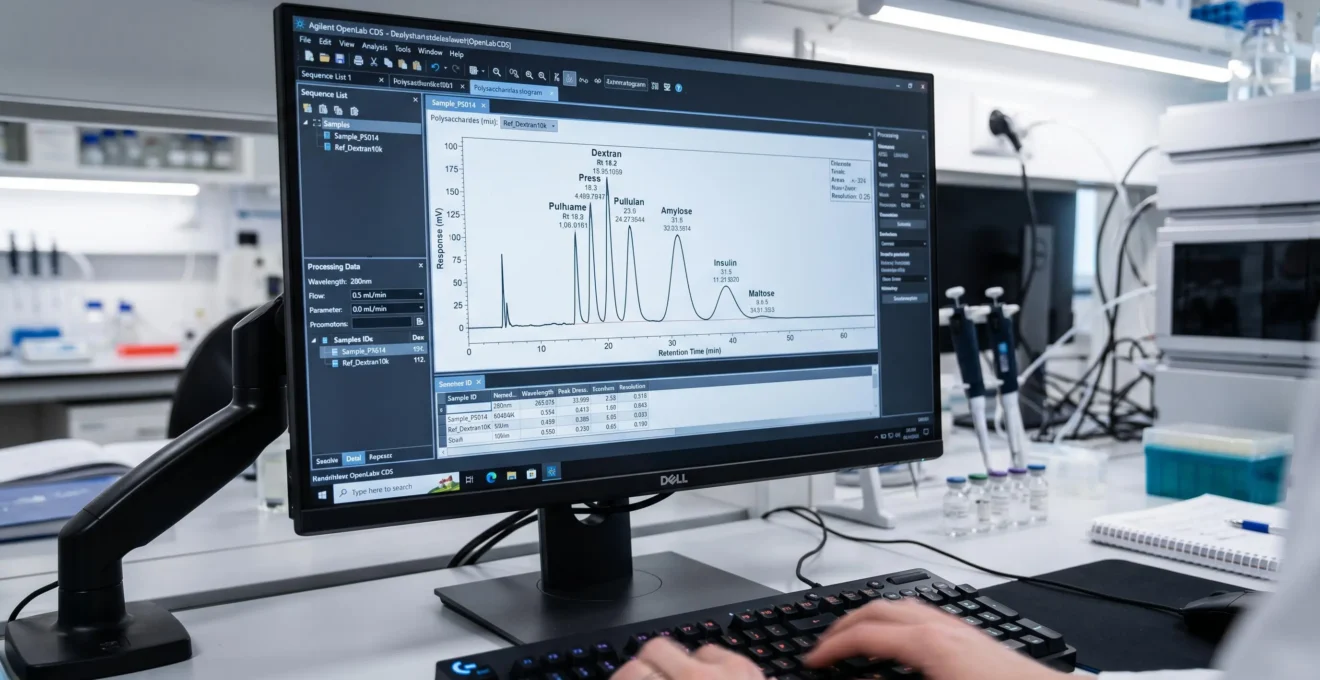
The multiplexed HPLC-QTOF-MS method referenced earlier represents this integration strategy: chromatographic separation resolves individual polysaccharides from complex matrices, while mass detection provides molecular specificity and quantitative accuracy. Orthogonal technique combinations reduce mischaracterization risk compared to single-method reliance, particularly when analyzing structurally similar polysaccharides.
| Technique | Detection Limit | Structural Information | Sample Throughput | Expertise Required |
|---|---|---|---|---|
| HPLC/GPC | Low μg range | Molecular weight distribution, purity, homogeneity | Moderate to high | Intermediate |
| NMR | High μg to mg range | Linkage position, anomeric configuration, substituents | Low | High (specialist interpretation) |
| FTIR | μg range | Functional groups, gross composition | High | Intermediate |
| MALDI-TOF / ESI-MS | ng range | Molecular mass, sequence (oligosaccharides), modifications | Moderate | High (ionization optimization) |
Selecting analytical approaches for your polysaccharide type
The practical decision pathway for method selection begins with defining the analytical objective: purity quantification for quality control, structural characterization for research publication, or regulatory compliance demonstration. Each objective maps to different technique priorities and validation requirements.
Consider a biotechnology laboratory isolating a novel exopolysaccharide from bacterial fermentation. Initial characterization demands structural information—NMR spectroscopy provides linkage and branching data, supplemented by mass spectrometry to confirm monosaccharide composition. Once the structure is established, method development shifts to HPLC-based purity assessment using a purified batch as an in-house reference standard.
Sample quantity constraints significantly influence method selection. A researcher with 10 milligrams of purified polysaccharide possesses sufficient material for comprehensive NMR characterization and multiple HPLC analyses. In contrast, trace polysaccharides isolated from plant extracts (100 micrograms) may only permit high-sensitivity mass spectrometry and FTIR screening, but insufficient for conventional NMR.
Regulatory context imposes additional selection criteria. Pharmaceutical applications require validated methods with documented accuracy, precision, specificity, linearity, and range—parameters formalized in the ICH Q2(R2) framework. Food safety applications may accept less rigorous validation but demand matrix-matched calibration. Research publication typically requires method description sufficient for reproducibility.
-
If your goal is regulatory submission or quality control:
Prioritize HPLC with validated reference standards, supplement with orthogonal technique (MS or NMR) for identity confirmation, budget weeks to months for full method validation
-
If your goal is structural elucidation of unknown polysaccharides:
Begin with NMR for linkage and branching data, use MS for monosaccharide composition and sequence (if oligosaccharide), confirm with FTIR functional group screening
-
If sample quantity is limited (sub-milligram):
Select high-sensitivity techniques: MALDI-TOF or ESI-MS as primary methods, FTIR for complementary data, reserve NMR only if cryoprobe or microprobe available
-
If analyzing complex matrices (food, environmental):
Implement chromatographic separation (HPLC or GPC) before detection to resolve target polysaccharide from interferents, validate with matrix-matched standards
-
If high-throughput screening is required:
Favor FTIR or HPLC-MS with automated sample handling, establish calibration curves using authenticated reference materials, implement statistical process control
Critical resources: reference standards and validated protocols
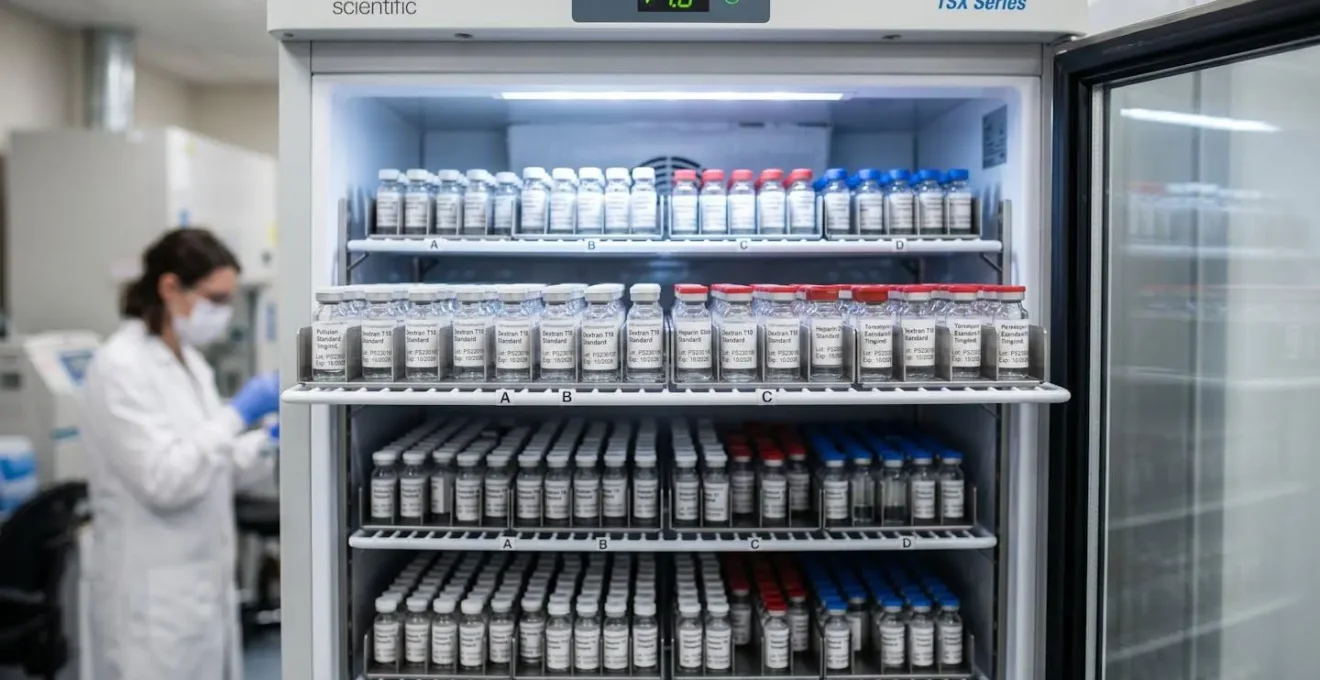
Authenticated reference standards constitute the foundational requirement for accurate polysaccharide quantification. A reference standard serves three essential functions: calibration of detector response to enable concentration determination, confirmation of analyte identity through retention time or spectral matching, and validation of method performance through recovery studies. Without authenticated standards, quantitation becomes semi-quantitative estimation rather than validated measurement.
The challenge intensifies for structurally complex or commercially unavailable polysaccharides. A pharmaceutical laboratory validating an assay for a proprietary bacterial polysaccharide must purify and extensively characterize an in-house standard, documenting purity by multiple orthogonal techniques, assigning concentration by gravimetric or elemental analysis, and establishing stability under defined storage conditions.
Sourcing authenticated polysaccharide standards demands attention to purity certification, structural verification, and traceability. Reputable suppliers provide certificates of analysis documenting analytical methods used for characterization, purity assessment results, and storage recommendations. For regulatory applications, reference standards should ideally trace to pharmacopeial materials or internationally recognized reference collections.
-
Verify reference standard authentication: minimum two orthogonal techniques confirming structure and purity
-
Establish linear calibration range covering expected sample concentrations with minimum five calibration levels
-
Document precision through replicate analysis: repeatability (same day) and intermediate precision (multiple days/analysts)
-
Demonstrate accuracy via recovery studies using matrix-matched spiked samples at multiple concentration levels
-
Assess specificity by analyzing potential interferents individually and in combination with target polysaccharide
Validated protocols provide the procedural framework transforming analytical techniques into reliable measurement systems. Regulatory guidance documents including the ICH Q2(R2) standard establish performance criteria, but implementation requires adaptation to specific polysaccharide types and matrices. The investment in proper analytical methodology repays itself through reduced experimental variability, faster troubleshooting when results appear anomalous, and defensible data supporting publications or regulatory submissions.
Regulatory validation requirements vary by jurisdiction and application: Pharmaceutical polysaccharide analysis intended for regulatory submission requires compliance with ICH Q2(R2) and jurisdiction-specific guidance (FDA, EMA, PMDA). Food safety applications may reference AOAC validated methods or regional standards. Research applications lack universal validation requirements but benefit from documented method performance to ensure reproducibility. Consult regulatory affairs specialists or analytical chemistry experts when developing methods for compliance-critical applications.
This content provides general overview of analytical methods and does not constitute validated protocols for specific applications. Method selection and validation must be adapted to your specific polysaccharide type, purity requirements, and regulatory context. Analytical techniques require proper training, calibrated equipment, and quality control procedures. Regulatory applications (pharmaceutical, food safety) require compliance with jurisdiction-specific validation standards. For application-specific guidance, consult analytical chemistry specialists, equipment manufacturers’ technical support, or regulatory affairs consultants.