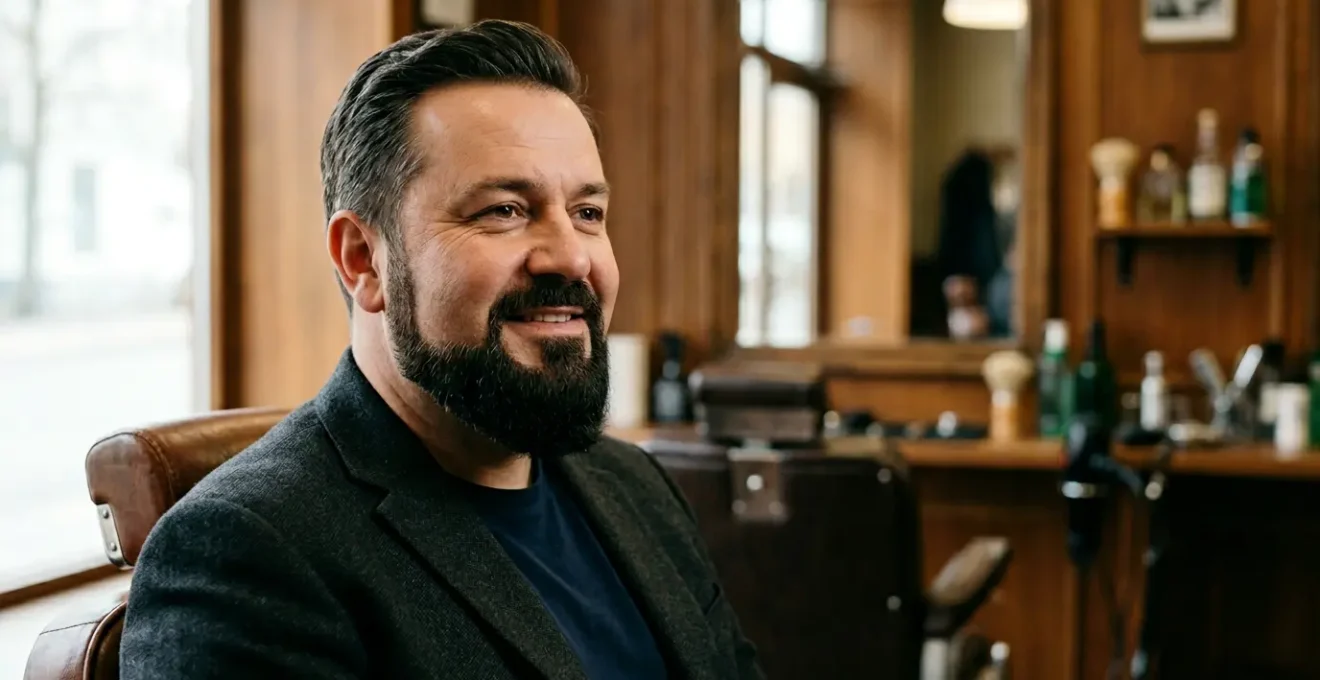
Choosing the right beard isn’t about copying a style; it’s about understanding facial architecture to actively sculpt your features.
- The most effective change comes from using your beard to create strong vertical lines and sharp angles that counteract roundness.
- The clean-shaven areas (« negative space ») are just as crucial as the beard itself for creating definition and the illusion of a stronger jawline.
Recommendation: Stop searching for a ‘beard style for a round face’ and start using these aesthetic principles to design a beard that is architecturally correct for you.
The quest for a more angular, defined jawline is a common one. Many men with softer, rounder facial contours look in the mirror and feel their face lacks a certain structural authority. The most common advice they receive is a confusing jumble of tips: grow it long, keep the sides short, try a goatee, avoid a full beard. These suggestions, often pulled from celebrity photos, treat beards like hats—something you simply put on. This approach is fundamentally flawed and leads to frustration when the desired effect isn’t achieved.
The truth is far more nuanced and powerful. A beard is not a mask or a simple accessory; it is an architectural tool. The secret to transforming a round face into one that appears more angular and masculine lies not in picking a pre-defined « style, » but in mastering the corrective geometry of facial hair. It’s about understanding the interplay of vertical lines, the strategic use of negative space, and the principles of volumetric balance. It is a discipline of addition and subtraction to create an illusion of bone structure that nature may not have provided.
This guide will deconstruct the art and science of facial hair aesthetics. We will move beyond generic advice and empower you with the consultant’s eye. First, we will establish the critical foundation: accurately diagnosing your unique facial geometry. From there, we will explore specific techniques to create length and angles, address common but critical mistakes, and finally, learn to harmonize your ideal beard with the demands of your professional life. You will learn to see your face not as it is, but as it could be.
This article provides a complete framework for making an informed, strategic choice. To help you navigate these principles, the following summary outlines the key stages of our aesthetic consultation.
Summary: Which Beard Style Will Make a Round Face Look More Angular and Masculine?
- Square, Oval, or Heart: How to Determine Your True Face Shape in 2 Minutes?
- How to Use a Goatee to Create the Illusion of a Stronger Jaw?
- Full Beard or Stubble: Which Style Shortens a Long Face Visually?
- The ‘Viking Beard’ Mistake That Overwhelms Small Faces
- Beard Styles for Bald Men: How to Balance a Shaved Head?
- Why a Clean-Shaven Face Signals Authority in Traditional Finance?
- Where Should Your Neckline Actually Stop to Avoid the ‘Double Chin’ Look?
- How to Choose a Beard Style That Balances Your Face Shape and Professional Image?
Square, Oval, or Heart: How to Determine Your True Face Shape in 2 Minutes?
Before any corrective work can begin, a precise diagnosis is essential. Attempting to sculpt a face without first understanding its fundamental geometry is like tailoring a suit without taking measurements. The terms « round, » « square, » or « oval » are not just labels; they are architectural blueprints that dictate every grooming decision. For men with a round face, the key characteristic is that facial width and length are nearly equal, with a softer, less-defined jawline. The goal, therefore, is to use facial hair to introduce the missing angles and verticality.
There are two effective methods for an accurate assessment. The traditional approach involves simple measurements. By comparing the width of your forehead, cheekbones, and jawline to the overall length of your face, you can objectively categorize your shape. A round face is typically defined when the cheekbone width and face length are very similar, without sharp corners at the jaw. Alternatively, modern technology offers an instant solution. AI-powered tools can analyze a photograph to detect facial landmarks and provide an immediate, data-driven conclusion.
Case Study: AI-Powered Face Shape Detection
Tools like FaceShapeAI offer instant face shape detection using advanced technology. Users upload a clear front-facing photo, and the tool analyzes facial landmarks to determine their face shape. The system can provide personalized hairstyle and beard recommendations based on the detected shape, helping men make informed grooming decisions without the need for manual measurements or guesswork, effectively taking the first step in strategic grooming.
Whether you choose the tactile method of a tape measure or the efficiency of an algorithm, this step is non-negotiable. It is the foundational data point upon which your entire facial architecture will be built. Knowing your shape is the difference between random guessing and intentional design.
How to Use a Goatee to Create the Illusion of a Stronger Jaw?
For a round face, the goatee is a powerful surgical tool. Its effectiveness lies in the principle of corrective geometry. By focusing hair growth on the chin and leaving the cheeks clean-shaven, you create a strong vertical line that visually elongates the face and draws the eye downward. This interrupts the horizontal width of the cheekbones and adds a much-needed focal point, creating the illusion of a more prominent chin. The « negative space » on the cheeks becomes as important as the beard itself, as it carves out the jawline through contrast.
The extended goatee, which connects the mustache to the chin beard, is particularly effective. This style creates two additional vertical lines that frame the mouth and further enhance the lengthening effect. However, execution is paramount. The lines must be sharp, and the length must be controlled. For round faces, an optimal length is crucial; too short, and it loses its impact, too long, and it can look disconnected. For instance, style experts recommend maintaining a length of 14-16mm to achieve the perfect balance of presence and structure.
This image perfectly demonstrates the power of negative space. Notice how the clean-shaven area creates a stark, defined line against the goatee. This contrast is what sculpts the jaw. The extended goatee of Leonardo DiCaprio is a masterclass in this technique; it introduces sharp angles to his naturally rounder features while the full coverage allows for strategic shaping, enhancing his facial structure. Regular trimming every 3-4 days is essential to maintain these clean lines and defined angles.
Full Beard or Stubble: Which Style Shortens a Long Face Visually?
Just as a round face requires vertical emphasis to create length, a long or oblong face requires the opposite: horizontal emphasis to create an illusion of width. Men with long faces should avoid styles that add length to the chin, as this will only exaggerate their facial structure. The goal is to build volume on the sides of the face and keep the chin area relatively shorter. A common mistake is to grow a long, pointed beard, which further elongates the face.
The solution lies in the « Horizontal Line Strategy. » This involves several key tactics. First, keep the cheek lines of the beard higher than you normally would. This creates a strong horizontal line across the face. Second, maintain fuller growth on the sides and cheeks rather than trimming them tight. This adds the necessary width. Finally, the neckline can be set slightly lower to provide a more solid anchor. The use of beard balm is essential here, not just for conditioning, but to actively control the shape and maintain width throughout the day.
The choice between a full beard and stubble depends on how aggressively you need to add width. A full beard, kept wider on the sides and shorter on the chin, is the most powerful tool for this correction. However, even carefully managed stubble can help by creating a shadow that breaks up the vertical length of the face.
This comparative table shows how different styles impact facial length. For a long face, the goal is to minimize the « Face Lengthening Effect » by focusing on styles with more equal cheek and chin lengths.
| Beard Style | Cheek Length | Chin Length | Maintenance Frequency | Face Lengthening Effect |
|---|---|---|---|---|
| Stubble Contouring | 5mm | 3mm | Every 3-4 days | Moderate |
| Short Boxed Beard | 8-10mm | 12-14mm | Weekly | High |
| Full Beard | 15mm+ | 20mm+ | Bi-weekly | Very High |
The ‘Viking Beard’ Mistake That Overwhelms Small Faces
The rise of rugged, voluminous beard styles, often dubbed the « Viking beard, » has become a major trend, with recent market research showing that over 61% of urban men maintain facial hair styles. While this look can project an image of strength and masculinity, it is a stylistic trap for men with smaller or narrower facial features. The principle at play is volumetric balance. When a beard’s volume is disproportionately large compared to the face it sits on, it ceases to be a feature and becomes a costume. It overwhelms the natural bone structure, making the face appear smaller and the features less distinct.
The mistake is assuming that « more is more. » A massive beard on a small face can obscure the jawline entirely, swallow the neck, and create a bottom-heavy, unbalanced silhouette. The beard wears the man, not the other way around. This doesn’t mean the rugged aesthetic is entirely off-limits. The key is adaptation and proportion. The « Corporate Viking » style is an excellent compromise, offering a corrective solution.
The ‘Corporate Viking’ Alternative
This style maintains the rugged aesthetic without the overwhelming bulk. It works by keeping significant length at the chin while tightly trimming and fading the sides (8-10mm). The chin length can reach 15-20mm maximum. This creates a strong, angular shape that elongates the face without adding excessive width or volume. The key is maintaining impeccable, sharp edges, which signals that the ruggedness is intentional and well-groomed, making it suitable even for professional settings.
This approach allows a man with a smaller face to borrow the authority of the Viking aesthetic while respecting the architectural realities of his own features. It’s a testament to the principle that good style is not about adopting trends, but about adapting them intelligently.
Beard Styles for Bald Men: How to Balance a Shaved Head?
When the head is shaved, the beard’s role in defining facial architecture is magnified tenfold. It is no longer just one component of a man’s look; it becomes the primary frame for the entire face. For a bald man, the cheek lines and neckline of his beard carry the same visual weight and importance as a hairline. There is no hair on top to balance the composition, so the beard must do all the structural work. This requires an even higher level of precision and intentionality in grooming.
The choice of style becomes a critical strategic decision based on the shape of both the face and the cranium. For a bald man with an already strong, angular jaw, a simple, well-defined goatee can serve as an effective focal point. However, for a bald man with a round face, a full beard is not just an option—it becomes essential. It is the only tool available to redraw the lower third of the face, adding the necessary length and creating the illusion of a stronger jaw where none exists. The beard literally becomes the jawline.
The key principles for a bald man are clarity and definition. Since there is no distracting hairline, any imperfections in the beard’s shape are immediately obvious. Edges must be kept sharp, lines must be crisp, and the shape must be deliberate. A style like the Extended Goatee or an Anchor Beard can be particularly effective for a round-faced bald man, as they introduce sharp angles and a strong central point that breaks up the facial roundness and balances the smooth dome of the head.
Why a Clean-Shaven Face Signals Authority in Traditional Finance?
While a well-sculpted beard is a tool of aesthetic correction, in certain professional environments, its absence can be a strategic choice. In high-stakes, traditional sectors like corporate finance or law, the clean-shaven face has long been the default standard. This is not merely a matter of tradition; it is rooted in the subconscious psychology of trust and transparency. A beard, by its nature, obscures the lower part of the face. This can unintentionally mask micro-expressions around the mouth, which are critical for gauging sincerity and intent during negotiations.
A clean-shaven face, in this context, sends a signal of « no surprises. » It suggests discipline, consistency, and a willingness to be fully « read » by others. This can build a foundation of subconscious trust in environments where billions are at stake and personal credibility is paramount. However, this cultural norm is evolving. The beard is no longer a universal sign of rebellion or non-conformity. The new paradigm is not about the presence or absence of facial hair, but about the level of intentional grooming.
Successful executives with beards have navigated this by adopting impeccably maintained, conservative styles. A short, boxed beard or a tidy corporate beard, paired with formal attire, demonstrates that the grooming is just as deliberate and disciplined as being clean-shaven. It proves that the individual is making a conscious choice to manage their appearance to a high standard. In the end, it is the visible effort and intentionality of the grooming that signals professionalism, not the specific style itself.
Where Should Your Neckline Actually Stop to Avoid the ‘Double Chin’ Look?
Nothing undermines a well-sculpted beard faster than a poorly defined neckline. This is the most common and damaging mistake in beard grooming. A neckline that is too high makes the jaw look weak and can create the illusion of a double chin, even on a lean face. A neckline that is too low looks unkempt and messy, suggesting a lack of care. The correct neckline acts as the foundation of the beard, providing a clean, intentional border that sharply defines the jaw from the neck. It is the finishing touch that separates an amateur effort from a professional look.
Finding the perfect placement is not a matter of guesswork; there is a definitive method. The « Head Tilt Test » is a simple, foolproof technique. By tilting your head down towards your chest, you can identify the natural crease where your chin meets your neck. The ideal neckline should be defined just above this crease, typically about one to two fingers’ width above the Adam’s apple. This placement ensures the line is high enough to be clean but low enough to remain visible and define the jaw when your head is in a neutral position.
Once this point is established, the line should curve gently upwards from this central point towards the back of each ear, following the natural line of the jaw. This creates a soft ‘U’ shape. Everything below this line should be cleanly shaved. This single act of precision grooming does more to make a beard look sharp and deliberate than almost any other step.
Your Action Plan: Defining the Perfect Neckline
- Tilt your head down to find the natural crease where your neck meets your chin.
- Define the neckline just above this crease for a perfect look from every angle.
- Create a gentle U-shaped curve from behind each ear following the jaw’s natural line.
- For patchy neck growth, define the line slightly higher where hair is denser.
- Trim everything below your Adam’s apple for a polished, intentional appearance.
Key takeaways
- Diagnosis is everything: You cannot correct your facial geometry until you have accurately identified your face shape.
- Think like a sculptor: Use your beard’s lines, angles, and volume to create the illusion of the bone structure you want.
- Grooming is non-negotiable: Sharp lines and a defined neckline are what separate an intentional style from a simple lack of shaving.
How to Choose a Beard Style That Balances Your Face Shape and Professional Image?
The ultimate goal of this aesthetic consultation is to find the equilibrium between two critical factors: the corrective power of a beard style for your unique face shape and the professional context in which you operate. A style with high corrective power, like a long, full beard for a round face, might be perfectly sound from an architectural standpoint but may be inappropriate for a conservative corporate environment. Conversely, a clean-shaven face, while professionally impeccable, offers zero corrective power for a weak jawline. The ideal choice lies in the sweet spot between these two poles.
This requires an honest self-assessment. What is your primary goal? If it is purely aesthetic, you can choose the style with the highest corrective power. If your professional image is paramount, you must select a style that signals discipline and neatness, even if it offers less dramatic facial sculpting. The « Corporate Beard, » for example, offers a medium level of facial correction while maintaining a high degree of professional formality. It’s a balanced compromise. The Extended Goatee offers stronger correction but may be seen as less formal in very traditional settings.
Your choice is a strategic one, and it can be mapped. The following matrix helps visualize the trade-offs between different popular styles, weighing their ability to alter facial perception against their professional acceptance and the daily commitment they require.
This Beard-Job Matrix provides a clear framework for making a strategic choice that considers both aesthetic goals and professional demands.
| Beard Style | Facial Correction Power | Professional Formality | Daily Maintenance Time |
|---|---|---|---|
| Clean Shaven | None | Very High | 5 minutes |
| Corporate Beard | Medium | High | 10 minutes |
| Extended Goatee | High | Medium | 15 minutes |
| Full Beard | Very High | Low-Medium | 20 minutes |
| Van Dyke | High | Low | 15 minutes |
Ultimately, armed with the principles of facial architecture, corrective geometry, and professional context, you can move beyond simply choosing a beard and begin to truly design your face. Start today by applying these strategies to transform your appearance with intention and precision.