Navigating men’s fashion trends isn’t about chasing every new fad; it’s about strategic integration. The secret lies in understanding a trend’s core principles—its silhouette, texture, and proportion—and translating them into your existing wardrobe architecture. This approach allows you to evolve your style and look modern, not merely fashionable, by making intelligent choices about when to invest and when to experiment, ensuring every piece reinforces your personal brand.
The line between looking current and looking like you’re trying too hard is perilously thin. Every season, runways and retailers present a deluge of new ideas: wider trousers, bolder patterns, unexpected textures. For the style-conscious man, the challenge is immense. You want to project an image of relevance and sophistication, but the fear of miscalculation—of becoming a « fashion victim »—is real. This fear often leads to one of two outcomes: a retreat into an overly safe, static uniform, or a clumsy adoption of trends that feel alien and inauthentic.
The common advice is often simplistic: « start with accessories » or « only wear one trend at a time. » While not entirely wrong, this guidance fails to address the fundamental issue. It treats trends as decorative afterthoughts rather than integral components of a dynamic personal style. It misses the nuance required for a man who navigates a professional world where credibility is paramount, but a modern edge is a distinct advantage.
But what if the key wasn’t about which specific trendy item to buy, but about developing a framework for *thinking* about trends? The true art lies in deconstructing a trend to its essence and strategically weaving that essence into your established wardrobe. It’s the difference between copying a look and translating a principle. This guide is built on that philosophy: to provide you with the strategic tools to decode trends, adapt them with intelligence, and build a wardrobe that is both timeless and unequivocally of the moment.
We will explore the cyclical nature of fashion, learn to integrate bold ideas into conservative settings, and establish a clear methodology for deciding between a fleeting purchase and a long-term investment. This is your roadmap to mastering modern menswear with confidence and discernment.
Summary: Mastering Modern Menswear Trends
- Why Do Certain Men’s Fashion Trends Return Every 20 Years?
- How to Integrate Bold Trends Into a Conservative Office Wardrobe Without Breaking the Dress Code?
- Fast Fashion vs. Investment Pieces: Which One to Choose for Trendy Items?
- The Over-Accessorizing Mistake That Ruins 70% of Trendy Outfits
- When to Start Wearing Fall Collections: The 3 Temperature Signals to Watch
- Navy Blazer or Grey Suit: Which Should Be Your First Major Investment?
- Why Are Pleated Pants Making a Comeback in Modern Menswear?
- How to Build a ‘Promotion-Ready’ Wardrobe with Only 15 Items?
Why Do Certain Men’s Fashion Trends Return Every 20 Years?
The recurring nature of fashion is not a random phenomenon; it’s a predictable cycle driven by psychology and data. The so-called « 20-year rule » suggests that trends resurface approximately two decades after their peak. This is often attributed to a new generation discovering the styles of their youth, now viewed with nostalgia and a fresh perspective. What once felt dated to one generation becomes novel and exciting to the next, which has no firsthand memory of its original context. Designers and brands tap into this collective memory, reinterpreting past styles for a contemporary audience.
This isn’t just anecdotal. The pattern is so consistent that it can be mathematically modeled. A fascinating piece of recent Northwestern University research confirms this cyclical behavior by analyzing vast datasets of fashion imagery. The study highlights a fundamental tension in human behavior: the desire to conform while simultaneously wanting to stand out. Trends emerge, become saturated, and then fall out of favor as people seek newness. After a « cooling-off » period of about 20 years, those styles are far enough in the past to feel fresh again.
The bell-bottom trouser is a perfect case study. It surged in the 1970s, became a caricature in the 1980s, re-emerged in a new form in the late 1990s, and is once again influencing modern trouser silhouettes. Understanding this cyclical pattern is the first step toward strategic trend adoption. It allows you to anticipate shifts and recognize that most « new » ideas are reinterpretations of old ones. This perspective transforms you from a passive consumer into a discerning observer who can identify the underlying currents of style.
How to Integrate Bold Trends Into a Conservative Office Wardrobe Without Breaking the Dress Code?
The conservative office is the ultimate test of sartorial intelligence. Here, blatant trend-chasing is a liability, but a complete lack of modern sensibility can make you look dated. The solution is not to avoid trends, but to integrate them through subtle, sophisticated channels: texture, silhouette, and color. Instead of a loud, graphic-print shirt, consider a trend through the lens of fabric. A move toward more textured materials, for instance, can be expressed through a finely-waled corduroy blazer in a traditional navy or a pair of moleskin trousers in charcoal.
These pieces adhere to the conservative color palette of a professional environment but introduce a layer of contemporary interest that a standard worsted wool suit lacks. The key is that the trend is felt rather than shouted. It’s a detail appreciated by the discerning eye, not an announcement to the entire floor. This approach allows you to participate in the current fashion conversation without ever violating the implicit rules of the dress code.
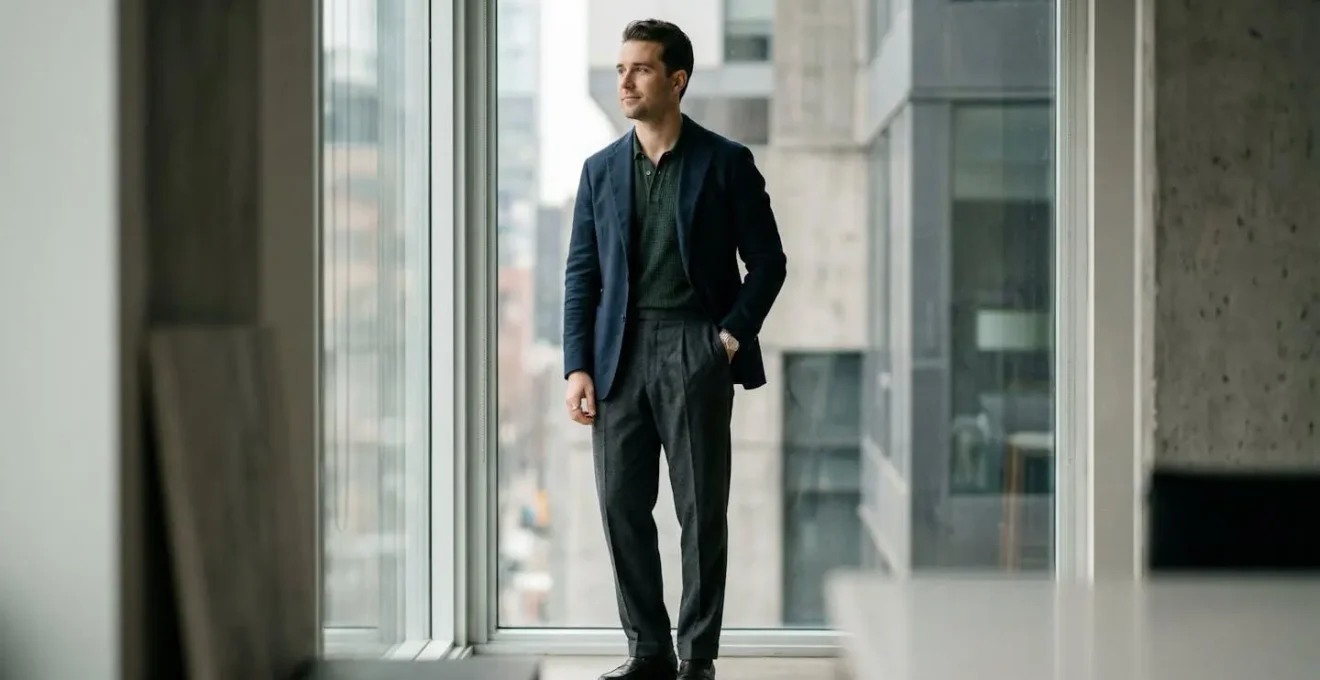
The image below illustrates this principle perfectly. Notice how the focus is on the rich texture of the fabrics and the clean, architectural lines of the setting. It’s an environment of professionalism, yet the clothing choices—a textured blazer, a refined knit—signal a clear awareness of modern menswear, all without a single ostentatious element.
Similarly, a shift in silhouette can be a powerful tool. If the current trend is a slightly wider leg, you don’t need to adopt voluminous, runway-style trousers. Instead, you can transition from a slim-fit to a straight-leg or gently tapered cut. This subtle adjustment provides more comfort and a more current line while remaining squarely within the bounds of professional attire. It’s about translating the trend’s principle—in this case, more volume—into a contextually appropriate form.
Fast Fashion vs. Investment Pieces: Which One to Choose for Trendy Items?
Not all trends are created equal, and your financial commitment should reflect their lifespan. The most effective way to approach this is by categorizing trends based on their « velocity. » High-velocity trends (or « micro-trends ») burn bright and fast, often disappearing within a single season. Think of specific graphic tees or a particular « it » color. For these, fast fashion is your ally. It allows you to experiment with a look for a minimal outlay, without the regret of a costly item gathering dust in a year’s time.
Conversely, low-velocity trends represent slower, more significant shifts in menswear—what we can call macro shifts. These are changes in silhouette (like the return to wider trousers) or the resurgence of a classic item (like the chore coat). These trends have a lifespan of 3-5 years or more. This is where you should direct your investment. A well-made piece of outerwear or a quality pair of shoes that taps into a long-term trend will deliver immense value. The cost-per-wear plummets over time, and the superior materials and construction will be evident in every wear. In fact, properly maintained investment pieces typically last for five to ten years, far outliving the trend they were purchased for.
The following table provides a clear decision matrix for navigating this choice. It’s a framework for allocating your resources intelligently, ensuring your wardrobe is both modern and built on a foundation of lasting quality.
| Factor | Fast Fashion | Investment Pieces |
|---|---|---|
| Best For | Velocity 1 trends (micro-trends lasting 3-6 months) | Velocity 3 trends (slow shifts lasting 3-5 years) |
| Cost Per Wear | $5-15 per wear (worn 3-10 times) | $0.50-3 per wear (worn 50-200 times) |
| Material Quality | Synthetic blends, thin fabrics | Natural fibers, substantial weight |
| Trend Categories | Graphic tees, statement accessories | Outerwear, quality denim, classic footwear |
| Environmental Impact | High (frequent replacement) | Lower (longevity reduces waste) |
Ultimately, the goal is a balanced portfolio: a core of high-quality, timeless investment pieces that form your « wardrobe architecture, » supplemented by a few, carefully chosen, and inexpensive trendy items that keep your look fresh and dynamic.
The Over-Accessorizing Mistake That Ruins 70% of Trendy Outfits
Accessories are the punctuation of a good outfit, but too much punctuation creates an incoherent mess. This is where many men, enthusiastic about embracing a trend, go wrong. A trendy necklace, a bold watch, several bracelets, and a statement ring all worn together create visual noise. Instead of complementing the outfit, the accessories compete with each other, and the overall effect is chaotic, not stylish. The guiding principle should be curation, not collection. Each accessory should have a purpose and room to breathe.
To move beyond the vague advice of « less is more, » a practical framework is needed. The « Visual Weight System » is a simple but effective method for achieving balance. It forces a conscious, deliberate approach to accessorizing, preventing the accidental pile-on that can undermine an otherwise great look. This system helps you quantify your choices and adapt them to the specific context, from a conservative office to a creative evening out.
As seen in the image above, true elegance in accessorizing comes from restraint and attention to detail. The interplay of textures—brushed steel against grained leather—creates interest without overwhelming the eye. This is the goal: a composition where each element is chosen with intent. The following checklist provides a concrete plan for applying this system.
Your Action Plan: The Visual Weight System for Balanced Accessorizing
- Assign Points: Assign a point value to each accessory you consider wearing: Watch (3 points), Statement ring (2 points), Chain necklace (2 points), Bracelet (1 point), Simple band (1 point).
- Calculate Your Total: Adhere to a maximum total based on the setting: Office (5 points max), Casual weekend (7 points max), Evening/Creative (9 points max).
- Audit Finish Families: Group like with like. Strive to keep your metals in the same family (e.g., all brushed steel or all polished gold) for maximum cohesion.
- Use a ‘Bridge Piece’: If you must mix metals, use one item that intentionally incorporates both (e.g., a two-tone watch) to unify the look.
- Perform the Mirror Test: Before leaving, glance in the mirror. If your eye can’t rest and instead bounces between accessories, you’ve gone too far. Remove one piece and check again.
When to Start Wearing Fall Collections: The 3 Temperature Signals to Watch
The transition from summer to fall is one of the most awkward periods in menswear. You’re eager to wear the new season’s richer textures and deeper colors, but the lingering afternoon heat can make a flannel shirt or wool blazer feel like a costume. The key to a seamless transition is to let the environment, not just the calendar, dictate your wardrobe choices. Forget specific dates and instead pay attention to three critical temperature signals that tell you it’s time to evolve your attire.
The first signal is the morning temperature. When the mercury consistently dips below 15°C (60°F) in the early hours, it’s time to switch out your base fabrics. This is the moment to retire your lightweight cotton chinos and poplin shirts. Replace them with fabrics that have more substance and texture, such as moleskin, corduroy, or oxford cloth. These materials provide a subtle nod to the coming season and offer a bit more insulation for crisp mornings without being overly warm later in the day.
The second signal is the angle of the sun. As fall approaches, the sun sits lower in the sky, and the quality of light changes. This is your cue to begin introducing fall’s color palette, even if the temperatures are still mild. You can start wearing colors like burgundy, olive, rust, and mustard, but in summer-weight fabrics. A rust-colored linen shirt or an olive polo maintains seasonal comfort while visually aligning you with the new season. This allows for a gradual, sophisticated color story transition.
Finally, the third and most definitive signal is what can be called the « third-layer rule. » This comes into play when you can no longer sit outside comfortably after sunset without needing an extra layer. This is the green light to fully embrace fall layering. Chore coats, light jackets, denim jackets, and cardigans should now become a regular part of your rotation. They provide the necessary warmth for fluctuating temperatures and add visual depth and interest to your outfits.
Navy Blazer or Grey Suit: Which Should Be Your First Major Investment?
When building the foundation of a promotion-ready wardrobe—your core « wardrobe architecture »—the first major investment is a critical decision. For many men, it comes down to two classic choices: a navy blazer or a charcoal grey suit. While a grey suit is undeniably useful, a detailed analysis reveals that the navy blazer is the superior strategic investment for its unparalleled versatility. A suit is largely a fixed entity, whereas a blazer is a powerful multiplier.
The core of the argument lies in the sheer number of outfit combinations each option unlocks. A suit can be worn as a full set or, with some skill, as separates. However, a navy blazer can be paired with almost anything: grey wool trousers, tan chinos, dark denim, and even olive or burgundy cords. It seamlessly bridges the gap between smart casual and business formal in a way a suit jacket rarely can. This versatility drastically lowers its effective cost-per-wear, delivering far more value in the first year of ownership.
As the Wessi Style Guide notes in its list of essential investment pieces:
If you could own only one suit, make it navy. This versatile powerhouse works for interviews, weddings, business meetings, and formal dinners.
– Wessi Style Guide, Top 10 Men’s Wardrobe Investment Pieces 2026
The following table, based on a comparative analysis of wardrobe staples, breaks down the strategic advantages of the navy blazer. The data makes a compelling case for it being the cornerstone of any fledgling professional wardrobe.
This data is further supported by an in-depth guide to wardrobe investment pieces that emphasizes versatility as the primary measure of an item’s worth.
| Criteria | Navy Blazer | Grey Suit |
|---|---|---|
| Versatility Multiplier | 15+ outfit combinations | 5-7 outfit combinations |
| Formality Range | Smart casual to business formal | Business to formal only |
| Pairing Options | Unlimited (jeans, chinos, wool trousers) | Limited (suit as set or separates) |
| Cost Per Wear (Year 1) | $3-5 (worn 2-3x weekly) | $15-25 (worn 1-2x monthly) |
| Second Purchase Synergy | High (grey trousers create classic combo) | Low (limited complementary options) |
Why Are Pleated Pants Making a Comeback in Modern Menswear?
The return of pleated trousers represents a significant pendulum swing in menswear. It signals a collective exhale after a 15-year tyranny of skinny/slim-fit jeans that prioritized a narrow silhouette above all else. But to dismiss the comeback as mere fashion fickleness is to miss the point entirely. The resurgence of pleats is driven by something far more fundamental: a renewed appreciation for comfort, function, and stylistic versatility.
For a generation accustomed to restrictive, stretch-infused denim, the functional benefits of a well-cut pleated trouser are a revelation. The pleats—those small folds of fabric at the waistband—are not merely decorative. They are an engineering solution, designed to provide extra room in the thigh and seat, particularly when sitting down. This practical advantage was lost for years, but as men seek more comfortable and accommodating clothing post-pandemic, the inherent logic of the pleat has become undeniable.
Beyond pure function, the modern pleated pant offers a unique versatility that its flat-fronted cousin struggles to match. It acts as a stylistic bridge, capable of being dressed down with a hoodie and sneakers for a sophisticated streetwear look, or elevated with a blazer and loafers for a classic, Ivy-inspired ensemble. This adaptability makes it a true wardrobe workhorse.
Case Study: The Functional Renaissance of the Pleat
The modern embrace of pleated pants highlights a shift in priorities. Men are rediscovering that style does not have to come at the expense of comfort. The added fabric from the pleats allows for a greater range of motion and a more graceful drape, whether standing or seated. This functional superiority is a key driver of their return. Furthermore, stylists and brands have demonstrated their incredible versatility, proving that pleated trousers can anchor both highly casual and formal looks, making them one of the most adaptable items in a contemporary wardrobe.
The comeback is not about reviving the baggy, oversized pleated trousers of the 1980s. Today’s iterations are smarter, with a higher rise and a clean taper from the knee down. They offer shape and structure, proving that comfort and a sharp silhouette are not mutually exclusive.
Key Takeaways
- Trend adoption is about translating principles (silhouette, texture) not copying looks.
- Distinguish between fast « micro-trends » and slow « macro shifts » to decide when to save and when to invest.
- Use a system like « Visual Weight » for accessorizing to ensure balance and avoid a cluttered look.
How to Build a ‘Promotion-Ready’ Wardrobe with Only 15 Items?
A « promotion-ready » wardrobe is not about having an endless collection of clothes. It’s about having a curated, strategic selection of high-quality, interchangeable pieces that project authority and competence. It’s a system, not an inventory. With just 15 core items, you can construct a powerful professional wardrobe that covers nearly any business scenario, from a standard day at the office to a critical presentation or a last-minute business dinner. This is the ultimate expression of your personal « wardrobe architecture. »
The foundation of this lean wardrobe is built on a core of versatile, high-quality staples. These are the workhorses that you will reach for day after day. The key is their ability to mix and match seamlessly, creating a multitude of distinct outfits from a minimal number of pieces. This matrix is built for maximum impact and minimum clutter.
The 15-Piece Professional Wardrobe Matrix consists of:
- Core Foundation (8 pieces): This is the engine of your wardrobe. It includes two blazers (one classic navy, one textured grey or tweed), two pairs of trousers (charcoal wool and a smart chino in tan or olive), two dress shirts (one crisp white, one light blue), and two pairs of quality dress shoes (a dark brown or black oxford and a versatile loafer).
- Authority Layers (4 pieces): These items add depth and signal a higher level of polish. They include a V-neck merino wool sweater in a neutral color like grey or navy, a quality trench or overcoat, a leather belt that matches your shoes, and a classic dress watch.
- Strategic Multipliers (3 pieces): These are not single items but small collections that dramatically expand your options. They are a set of 3-4 classic ties (solids, simple patterns), a curated collection of pocket squares, and a quality leather bag or briefcase.
There is also a hidden « 16th element » that is non-negotiable: regular tailoring. Even the most expensive item will look cheap if it doesn’t fit perfectly. A good tailor is the most important investment you can make, ensuring every piece in your 15-item arsenal is sculpted to your frame. This lean, strategic approach ensures you are always appropriately and impressively dressed, ready for the next step in your career.
Frequently Asked Questions About Seasonal Fashion Transitions
When should I switch from summer to fall fabrics?
When morning temperatures consistently drop below 15°C/60°F, transition from cotton chinos to moleskin or corduroy, and swap poplin shirts for flannel or oxford cloth.
How can I wear fall colors before the temperature drops?
Introduce fall colors (burgundy, olive, rust) in summer-weight fabrics like linen shirts or lightweight cotton, maintaining seasonal appropriateness while updating your palette.
What’s the best way to layer for unpredictable fall weather?
Start with the ‘third layer rule’: when you can’t sit outside comfortably after sunset without an extra layer, add chore coats, light jackets, and cardigans to your rotation.