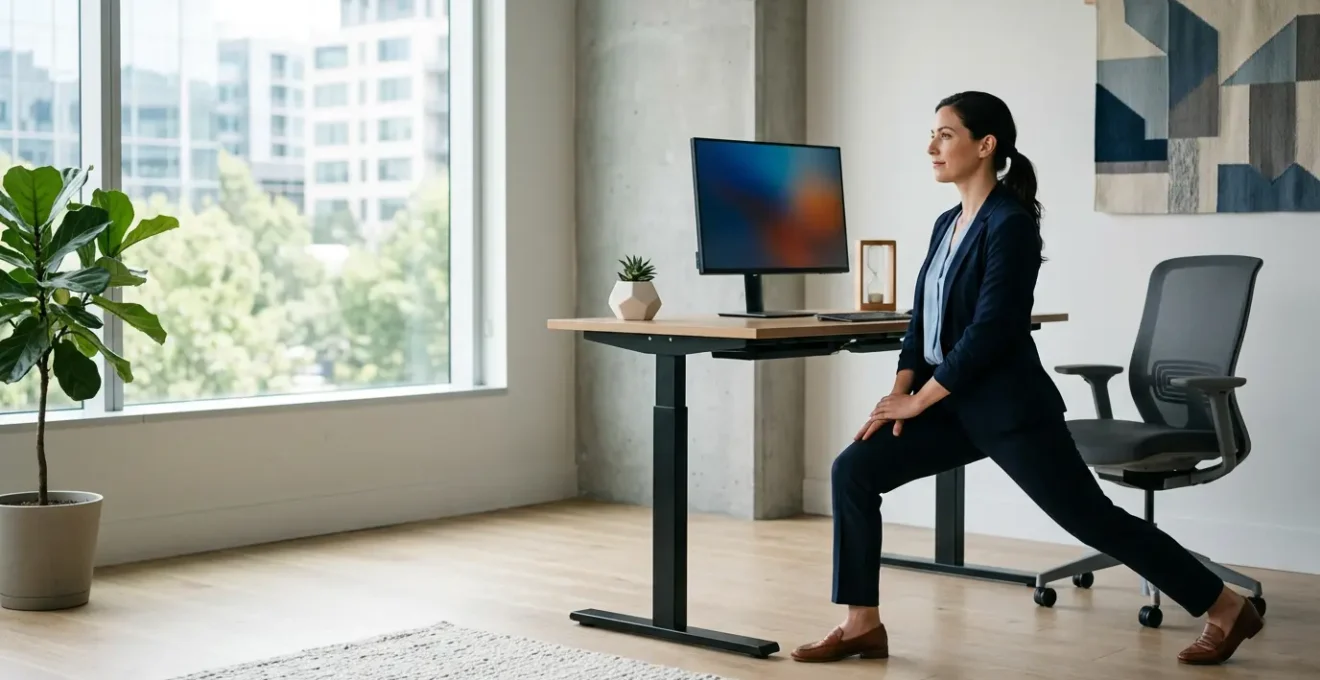
Your tight hips and lower back pain are not the real problem; they are symptoms of a collapsed postural chain caused by prolonged sitting.
- Most stretching routines fail because they target symptoms (like tight-feeling hamstrings) instead of the source: an anteriorly tilted pelvis.
- Effective relief comes from integrating small, corrective « movement snacks » throughout your day and prioritizing exercises that rebuild your posterior chain.
Recommendation: Stop performing random stretches and start implementing a system of corrective movements that address your posture from the pelvis up.
That persistent ache in your lower back and the frustrating stiffness in your hips feel like an inevitable consequence of a desk job. You’ve likely tried stretching your hamstrings or doing a few hip-opening yoga poses, only for the discomfort to return hours later. The common advice—stretch more, get a standing desk—often misses the fundamental issue. These approaches treat the pain as an isolated problem located in your hips or back, but they are merely the most audible alarms in a system-wide failure.
The root cause is not a single tight muscle, but a dysfunctional pattern programmed into your body by thousands of hours spent in a chair. Sitting forces your body into a compromised position that triggers a domino effect, a breakdown of your body’s natural « postural chain. » Your hip flexors shorten, your pelvis tilts forward, your glutes switch off, and your spine compensates, leading to pain from your lower back all the way up to your neck. Chasing these symptoms with isolated stretches is like repeatedly painting over a crack in a crumbling foundation.
But what if the solution wasn’t about stretching harder, but moving smarter? The key is to stop focusing on the site of the pain and start correcting the entire mechanical chain that creates it. This requires a shift in perspective: from seeing your body as a collection of parts to understanding it as an interconnected system. By re-establishing proper pelvic alignment and reactivating dormant muscles, you can dismantle the pattern of dysfunction and build lasting resilience against the physical toll of sedentary work.
This guide will provide a practical, corrective framework to do just that. We will deconstruct why conventional methods fail and provide a systematic approach to unlock your hips, fix your posture, and finally resolve the pain at its source. Prepare to move with intention.
Summary: Unlocking Your Hips by Correcting the Entire Postural Chain
- Why Tight Hamstrings Are Actually Causing Your Lower Back Pain?
- Which 3 Stretches Can You Do in a Suit Without Getting Sweaty?
- Before or After Workout: When Should You Hold a Static Stretch?
- The Hyper-Extension Mistake That Destabilizes Your Joints
- How to Design a 5-Minute Morning Stretch Routine for Energy?
- How to Fix ‘Tech Neck’ and Poor Posture in 10 Minutes a Day?
- Sitting vs. Standing: Does a Standing Desk Actually Help Weight Loss?
- How to Maintain a Gym Routine While Working 60 Hours a Week?
Why Tight Hamstrings Are Actually Causing Your Lower Back Pain?
The sensation of tight hamstrings is one of the most common complaints among desk workers, leading many to believe it’s the primary cause of their lower back pain. However, this is a classic case of mistaking a symptom for the source. For most people who sit for extended periods, the hamstrings are not the culprit; they are the victim of a dysfunctional pattern that begins at the hips. The real issue is an anterior pelvic tilt, a forward rotation of the pelvis driven by chronically shortened hip flexors.
When you sit, your hip flexors (the muscles at the front of your hips) are held in a shortened position. Over time, they adapt to this length and become tight. This chronic tightness pulls the front of your pelvis downward, forcing it into an anterior tilt. As the pelvis tilts forward, it pulls on the hamstrings from their attachment point, placing them under constant, low-grade tension. They feel tight not because they are short, but because they are perpetually over-lengthened and strained. Stretching them further often provides only temporary relief and can sometimes exacerbate the underlying imbalance.
This pelvic tilt is the direct cause of your lower back pain. As the pelvis rotates forward, it increases the arch in your lumbar spine (lumbar hyperlordosis), compressing the vertebrae and straining the surrounding muscles. The pain you feel is your lower back crying out under this compressive load. It’s a problem that intensifies for those in sedentary roles, where some research shows adults spend up to 70% of their waking hours sitting. Therefore, to fix your back pain and relieve your hamstrings, you must first correct the position of your pelvis by addressing the tight hip flexors.
Ultimately, chasing the sensation of tightness in your hamstrings is a futile effort. The path to relief starts with releasing the muscles at the front of your hips to allow your pelvis to return to a neutral position.
Which 3 Stretches Can You Do in a Suit Without Getting Sweaty?
The most effective strategy to counteract the damage of sitting is not one big workout, but a series of small, consistent « movement snacks » integrated throughout the day. These movements need to be discreet, effective, and require no change of clothes. The goal is to gently mobilize the hips and reverse the sitting posture without drawing attention or breaking a sweat. Here are three corrective stretches you can perform right at your desk.
1. The Seated Figure-4 Stretch: This is the single most valuable stretch for an office worker. While seated, cross one ankle over the opposite knee, creating a « figure 4 » shape. Keep your back straight and gently press down on the raised knee until you feel a stretch in your outer hip and glute. This directly targets the piriformis and other external rotators that become tight from sitting. Hold for 20-30 seconds on each side. The key is to maintain a professional, composed posture.
As you can see, this stretch is barely noticeable to colleagues. Research on office workers confirms that performing this stretch every 30-60 minutes provides immediate relief in hip tightness. It’s a simple, powerful tool for releasing tension without leaving your chair.
2. The Desk-Supported Hip Flexor Stretch: Stand facing away from your desk. Place the top of one foot on your chair or desk edge behind you (use a low desk or drawer if possible). Gently bend your standing leg and tuck your tailbone under until you feel a stretch in the front of the hip of the elevated leg. This directly counteracts the shortening of the hip flexors. Hold for 20-30 seconds.
3. The Standing Glute Squeeze: This isn’t a stretch, but an activation exercise, which is even more critical. While standing, simply squeeze your gluteal muscles as hard as you can for 5-10 seconds and then relax. Repeat 10 times. Prolonged sitting causes « gluteal amnesia, » where your brain’s connection to these powerful muscles weakens. This simple squeeze helps to wake them up, which is essential for maintaining a neutral pelvic position.
These three movements directly address the primary dysfunctions of sitting—tight external rotators, shortened hip flexors, and inactive glutes—making them a perfect corrective trio for any professional.
Before or After Workout: When Should You Hold a Static Stretch?
The question of when to perform static stretching—holding a stretch for an extended period—is a source of major confusion. The answer is not simply « before » or « after » a workout; it depends entirely on your goal. As an expert in corrective movement, my guidance is clear: the timing and type of stretch must align with the intended outcome. Using the wrong stretch at the wrong time can hinder performance and even increase injury risk.
Before a workout, prioritize dynamic movement. Static stretching before activity has been shown to temporarily decrease power output and may not reduce injury risk. Your pre-workout goal is to prepare tissues for load, not to lengthen them passively. This is best achieved with dynamic stretches (active movements that take a joint through its full range of motion) like leg swings, hip circles, and walking lunges. For a desk worker, a quick 15-30 second static stretch of the hip flexors can be beneficial to temporarily inhibit these overactive muscles before exercises like squats, but this should be followed by dynamic activation of the glutes and hamstrings.
After a workout and throughout the day is the time for static holds. When your muscles are warm and pliable post-exercise, static stretching is most effective for increasing long-term flexibility. This is the ideal window to hold stretches for the hip flexors, hamstrings, and piriformis for longer durations, such as 1-2 minutes. Furthermore, short « stretch snacks » are crucial for desk workers. These are 20-30 second static holds performed every hour to counteract the immediate effects of sitting. This frequent, low-intensity stretching is more effective at managing daily stiffness than a single, longer session.
Here is a simple protocol for optimal stretch timing:
- Morning Routine: Start with dynamic movements like 60 seconds of hip circles to warm up tissues before any static holds.
- Pre-Workout: Use dynamic stretches. A brief (15-30 second) hip flexor stretch is acceptable if immediately followed by glute activation.
- Throughout the Workday: Perform 20-30 second static « stretch snacks » every hour.
- Post-Workout: This is the prime time for longer static holds of 2 minutes or more to make lasting changes in tissue length.
In essence, think of dynamic stretching as waking your body up for work and static stretching as the restorative process that improves its fundamental structure over time.
The Hyper-Extension Mistake That Destabilizes Your Joints
In the quest to relieve tight hips, many people perform the classic lunge or kneeling hip flexor stretch with a critical, counterproductive flaw: they hyperextend their lower back. This common mistake not only negates the benefit of the stretch but also reinforces the very dysfunction you’re trying to correct. Instead of isolating and lengthening the hip flexors, you end up compressing your lumbar spine and destabilizing your core, trading one problem for another.
The mistake happens when you focus on pushing your hips as far forward as possible. To gain extra range of motion, the body cheats by arching the lower back and letting the rib cage flare up. This movement feels like a deep stretch, but the sensation is often just compression in the lumbar joints and tension in the abdominal wall, not a true lengthening of the target psoas and iliacus muscles. In fact, physical therapy observations reveal that over 70% of desk workers make this compensation error, effectively wasting their time and effort.
The key to an effective hip flexor stretch is pelvic control. To fix this, you must learn to perform a posterior pelvic tilt—actively tucking your tailbone under and engaging your glutes—*before* you initiate the forward movement. By locking your pelvis in this neutral position, you isolate the stretch precisely where it’s needed: high up in the front of the hip. The range of motion will feel significantly smaller, but the stretch will be exponentially more effective. When this proper form was taught, patients reported a 40% better stretch sensation in the target muscles.
Your Checklist for a Perfect Hip Stretch
- Start Position: In a kneeling lunge, ensure your back knee is directly under your hip, not far behind it. Your front shin should be vertical.
- Pelvic Position: Before moving, tuck your tailbone under as if trying to point your belt buckle toward your chin. This is the crucial posterior pelvic tilt. Squeeze the glute of the back leg.
- Core Engagement: Brace your abdomen by drawing your belly button toward your spine. This prevents your rib cage from flaring.
- Initiate Stretch: Gently shift your entire body forward an inch or two until you feel a clean stretch in the front of your back hip. Do not arch your back to go further.
- Final Check: The sensation should be a lengthening in the front of your hip, with absolutely no pinching or compression in your lower back.
.
Remember, the goal of a corrective stretch is not maximum range of motion, but maximum precision. A smaller, controlled movement is far superior to a larger, compensatory one.
How to Design a 5-Minute Morning Stretch Routine for Energy?
Waking up with stiffness is a clear sign that the postural patterns of your workday are carrying over into your sleep. A 5-minute morning routine is your opportunity to reset your body, reverse the effects of sitting before your day even begins, and prime your nervous system for energy. The goal is not to achieve deep, passive flexibility, but to use dynamic movement to increase blood flow, lubricate your joints, and awaken your neuromuscular system.
Your routine should focus on movements that take your body, especially your hips and spine, through their full range of motion. This is about re-introducing the movement variability that sitting steals from you. Forget about holding static poses; think about creating a continuous, gentle flow. This approach sends a powerful signal to your brain and body that it’s time to be active and mobile, which can be more energizing than a cup of coffee.
A perfect movement to anchor your routine is the « World’s Greatest Stretch. » This single exercise mobilizes the hips, hamstrings, and thoracic (mid) spine simultaneously. From a lunge position, place one hand on the floor and rotate your torso to reach the other arm toward the ceiling. Flowing through this on both sides addresses multiple planes of motion at once.
Here is a simple, effective 5-minute routine:
- Minutes 0-1: Cat-Cow. On all fours, gently flow between arching your back (Cow) and rounding it (Cat). This mobilizes the entire spine.
- Minutes 1-3: World’s Greatest Stretch. Spend 60 seconds on each side, flowing in and out of the rotational part of the stretch. Focus on deep breathing.
- Minute 3-4: Hip Circles and Leg Swings. Standing up, perform 10 large circles with each hip in both directions, followed by 10 forward-and-back leg swings.
- Minute 4-5: Glute Bridges. Lie on your back with knees bent. Perform 15-20 bridges, focusing on squeezing your glutes at the top to activate your posterior chain.
By making this routine a non-negotiable part of your morning, you are proactively fighting the sedentary lifecycle, ensuring you start your day from a position of strength and mobility, not stiffness and compression.
How to Fix ‘Tech Neck’ and Poor Posture in 10 Minutes a Day?
« Tech neck, » the forward-head posture that causes chronic neck and shoulder pain, is rarely a problem that originates in the neck itself. Like lower back pain, it is a predictable compensation at the top of a dysfunctional postural chain that begins at the hips. When you sit for prolonged periods, your pelvis tilts forward, your mid-back rounds to counterbalance (thoracic kyphosis), and to keep your eyes level with the horizon, your head must jut forward. Trying to fix tech neck by only stretching your neck is like trying to fix a leaning tower by polishing the windows at the top.
The evidence for this hip-to-neck connection is clear. With people now spending enormous amounts of time sitting—one study referenced by the European Heart Journal found an average of 10.4 hours daily—the integrity of the entire spine is compromised. Physical therapists consistently observe that when patients improve their hip flexibility and thoracic mobility, their neck pain often resolves without any direct treatment to the neck. One report noted that 73% of patients saw concurrent improvement in neck pain after focusing on their hips.
Therefore, a 10-minute daily routine to fix tech neck must be a full-chain correction. It should dedicate more time to the source (hips and mid-back) than the symptom (neck). A truly effective routine would allocate 5 minutes to hip flexor release and glute activation, 3 minutes to thoracic spine mobility (like foam rolling or cat-cow), and only 2 minutes to gentle chin tucks and neck stretches. This approach addresses the root cause for sustainable results.
The following table illustrates why targeting the source of the problem is a more effective long-term strategy than simply treating the symptoms.
| Treatment Approach | Time Investment | Effectiveness | Long-term Results |
|---|---|---|---|
| Neck stretches only | 5 minutes | Temporary relief | Problem returns within hours |
| Hip flexor release + thoracic mobility | 10 minutes | Addresses root cause | Sustained improvement |
| Full chain correction (hips, spine, neck) | 15 minutes | Comprehensive solution | Postural realignment |
To truly fix your posture, you must look beyond the site of the pain and embrace a whole-body approach that restores the natural, stacked alignment of your hips, spine, and head.
Sitting vs. Standing: Does a Standing Desk Actually Help Weight Loss?
The rise of the standing desk has been fueled by claims of health benefits, most notably weight loss. While it’s true that you burn slightly more calories standing than sitting, the difference is minimal—perhaps an extra 0.15 calories per minute. Over an entire workday, this adds up to less than a single apple. Therefore, if your primary goal is weight loss, a standing desk is not an effective tool. Its real, profound benefit lies not in calorie expenditure, but in its ability to break the static, flexed-hip posture that is so destructive to our bodies.
The core problem with a desk job is not sitting itself, but being locked in a single, unchanging posture for hours on end. A standing desk, when used improperly, can simply trade one static posture for another. Standing rigidly for hours can lead to its own set of problems, including foot pain, varicose veins, and lower back fatigue. The true solution is not to choose between sitting and standing, but to embrace a third option: constant, varied movement.
The most effective way to use a height-adjustable desk is to adopt a « Sit-Stand-Move » protocol. This dynamic approach ensures you are never in one position for too long, promoting metabolic health and preventing the adaptive shortening of muscles. A simple, repeatable cycle is the key to making this a sustainable habit.
Implement this protocol for a truly dynamic workday:
- Sit for 20 minutes: Use this time for focused work, ensuring you maintain proper ergonomic posture with feet flat on the floor and hips and knees at a 90-degree angle.
- Stand for 8 minutes: Raise your desk and continue working. Stand with soft knees, avoiding locking them out, and shift your weight periodically.
- Move for 2 minutes: Step away from your desk. Walk to get water, perform a few hip circles, or do a quick desk stretch. This is the most crucial part of the cycle.
By repeating this 30-minute cycle throughout the day, you use the standing desk not as a static alternative, but as a tool to facilitate movement. Using timers or app reminders can help build this powerful habit.
Ultimately, a standing desk is not a magic bullet for weight loss, but it is an invaluable tool for postural health when used to break up sedentary time and encourage a rhythm of consistent movement.
Key takeaways
- Your body is a « postural chain » where tight hips from sitting cause a domino effect leading to back and neck pain.
- Effective relief comes from fixing the source (pelvic alignment) with corrective movements, not just stretching the symptoms (tight-feeling muscles).
- Small, frequent « movement snacks » during the day are more effective than one long, isolated session for counteracting sedentary damage.
How to Maintain a Gym Routine While Working 60 Hours a Week?
For a busy professional working 60+ hours a week, the idea of a traditional 5-day-a-week gym routine is not just impractical, it’s often counterproductive. The key to building a resilient body that can withstand long hours of sitting is not about volume, but about precision and efficiency. You must adopt a « Minimum Effective Dose » (MED) approach, focusing on exercises that deliver the maximum corrective benefit in the minimum amount of time.
Your training should be designed specifically to counteract the sitting posture. This means prioritizing the posterior chain—the glutes, hamstrings, and back muscles that become weak and lengthened from being in a chair. A workout built around compound movements like deadlifts, kettlebell swings, rows, and pull-ups will do more to improve your posture and reduce pain in two 30-minute sessions per week than five hours of traditional bodybuilding splits that might overemphasize « pushing » muscles like the chest and shoulders.
Even your choice of cardio should be strategic. Activities like jogging or cycling, while good for cardiovascular health, can reinforce the hip flexion pattern you’re trying to escape. Instead, choose forms of cardio that promote powerful hip extension. This is where exercises like kettlebell swings or sled pushes are vastly superior for the desk-bound athlete. They train explosive hip power, strengthen the entire posterior chain, and offer a significant metabolic workout in just 10-15 minutes.
This table compares cardio options based on their postural benefit for a desk worker, highlighting why corrective choices are more efficient.
| Exercise Type | Time Required | Postural Benefit | Hip Extension Work |
|---|---|---|---|
| Treadmill jogging | 30-45 minutes | Minimal | Can reinforce hip flexion |
| Kettlebell swings | 10-15 minutes | High | Explosive hip extension |
| Sled pushes | 10 minutes | High | Full posterior chain activation |
| Rowing intervals | 15 minutes | Moderate-High | Hip drive with each stroke |
For the time-crunched professional, the goal is not to live in the gym; it’s to use the gym intelligently to build a body that thrives outside of it. Focus on strength, prioritize the posterior chain, and choose your exercises wisely.