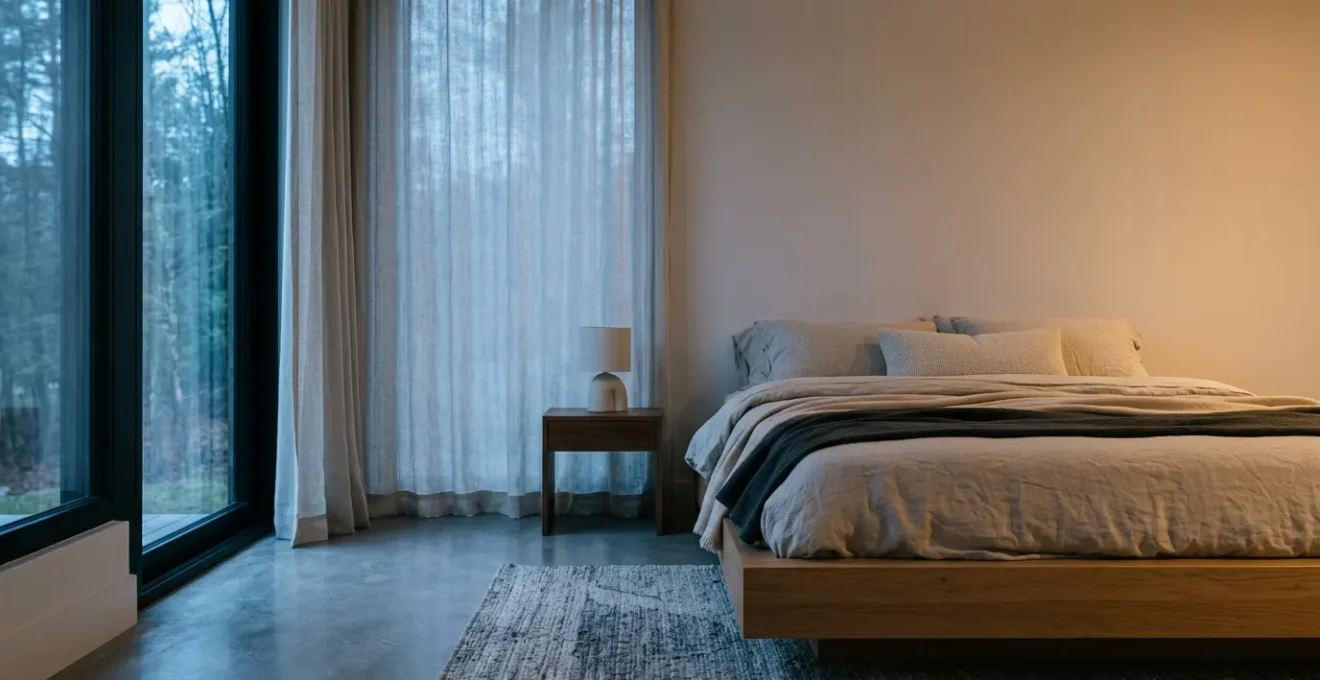
For a light sleeper, achieving deep rest isn’t about generic tips; it’s about systematically engineering your environment to eliminate sensory disruptions.
- This involves precise temperature control for REM cycles, total light blockade for melatonin, and targeted sound masking for external noise.
- It also requires selecting the right sleep surface for spinal alignment and creating strict digital boundaries to calm the mind.
Recommendation: Start by treating your bedroom not as a place to fall asleep, but as a dedicated recovery chamber you actively design.
For the light sleeper, every night can feel like a gamble. You follow the standard advice: you avoid caffeine, you try to relax, but the slightest noise, a sliver of light, or a subtle shift in temperature is enough to shatter your rest. You wake up feeling more drained than when you went to bed, wondering what you’re doing wrong. The conventional wisdom about « good sleep hygiene »—keeping the room dark, quiet, and cool—is a starting point, but for those with high sensory sensitivity, it’s profoundly insufficient.
The problem isn’t that the advice is wrong; it’s that it lacks precision. It treats the bedroom as a passive space rather than what it should be: a high-performance recovery chamber. True restorative sleep doesn’t happen by accident. It’s the result of environmental engineering, where every element is deliberately calibrated to support your body’s natural sleep architecture. But what if the key wasn’t just *following* the rules, but understanding the scientific mechanisms behind them to build a truly resilient sleep sanctuary?
This guide moves beyond generic tips. We will deconstruct the four pillars of your sleep environment—thermal, light, acoustic, and physical—from an architect’s perspective. We will explore the precise environmental inputs that govern your sleep cycles, how to automate your transitions from wakefulness to rest, and how to create a sensory lockdown that protects you from the disruptions that plague your nights. It’s time to stop hoping for good sleep and start engineering it.
To achieve this, we will systematically address the core components of your sleep environment. This structured approach will provide a clear roadmap to transforming your bedroom from a source of frustration into a true chamber for recovery.
Summary: A Blueprint for Your Sleep Recovery Chamber
- 65 vs 70 Degrees: What Is the Optimal Temperature for REM Cycles?
- Blackout Curtains or Eye Mask: Which Is More Critical for Melatonin?
- Memory Foam or Hybrid: Which Surface Reduces Back Pain Best?
- The Screen Mistake That Delays Your Sleep Onset by 1 Hour
- White Noise or Pink Noise: Which Sound Frequency Blocks Traffic Noise?
- How to Automate Your Morning Routine with Smart Home Assistant Routines?
- How to Increase Deep Sleep Percentage Without Medication?
- How to Slow Down Your Daily Pace Without Losing Productivity?
65 vs 70 Degrees: What Is the Optimal Temperature for REM Cycles?
The debate between a cool 65°F (18.3°C) and a comfortable 70°F (21°C) is not a matter of personal preference but of sleep science. The optimal temperature for sleep is a critical environmental cue for your body’s internal clock. To initiate sleep, your core body temperature needs to drop by a couple of degrees. A cooler room facilitates this process, acting as a catalyst for sleep onset. More importantly, it helps maintain the deeper, more restorative stages of sleep, including REM (Rapid Eye Movement).
This paragraph introduces a complex concept. To best understand, it’s useful to visualize the components. The illustration below captures the moment of precise thermal adjustment for sleep.
As the image suggests, this control is a deliberate act of environmental engineering. A room that is too warm forces your body to work harder at thermoregulation, which can lead to restlessness and fragmentation of your sleep architecture. While 70°F may feel cozy, research consistently points to a cooler range as superior. In fact, according to sleep researchers, the ideal temperature for sleep falls between 65 and 68 degrees Fahrenheit. This range creates the perfect thermal environment to support uninterrupted REM and deep sleep, making it a foundational element of your recovery chamber.
Blackout Curtains or Eye Mask: Which Is More Critical for Melatonin?
For a light sleeper, any light is a potential threat to sleep. The core issue is its effect on melatonin, the hormone that signals to your body that it’s time to rest. The question is not whether darkness is important, but which tool provides a more effective sensory lockdown against light. Blackout curtains aim to block external light at the source, while an eye mask creates a personal zone of darkness directly over your eyes. The choice depends on the nature of your light pollution.
The sensitivity of our circadian system to light is often underestimated. As experts from Harvard Health Publishing note, the impact is significant even at low levels:
Even dim light can interfere with a person’s circadian rhythm and melatonin secretion. A mere eight lux – a level of brightness exceeded by most table lamps and about twice that of a night light – has an effect.
– Harvard Health Publishing, Blue light has a dark side
Blackout curtains are the first line of defense, essential for blocking significant external sources like streetlights or early morning sun. However, they are rarely 100% effective, with light often leaking from the sides or top. Furthermore, they do nothing to combat light sources *inside* the room, such as charging indicators or digital clocks. This is where an eye mask becomes critical. It provides a complete and total light blockade, regardless of the ambient environment. For a true sensory lockdown, the ideal strategy is not a choice but a combination: use high-quality blackout curtains to eliminate the majority of external light, and a comfortable, contoured eye mask to ensure absolute darkness for your eyes, guaranteeing that melatonin production remains robust and uninterrupted throughout the night.
Memory Foam or Hybrid: Which Surface Reduces Back Pain Best?
The sleep surface is the foundation of your physical recovery. For those struggling with back pain, the choice between a memory foam and a hybrid mattress is pivotal. Memory foam is renowned for its pressure-relieving properties, contouring closely to the body’s curves. A hybrid mattress, conversely, combines foam layers with an innerspring coil system, aiming to offer both comfort and robust support. The best choice depends entirely on your specific support needs and sleeping position.
The following table breaks down the key differences to help guide your decision, based on a structural analysis of both mattress types and their impact on spinal alignment.
| Feature | Memory Foam | Hybrid |
|---|---|---|
| Pressure Relief | Excellent – contours closely to hips and shoulders | Good – foam layers provide cushioning |
| Lumbar Support | Moderate – may allow lower back to sink too deep | Excellent – coil base provides firm lumbar support |
| Best For Sleep Position | Side sleepers with hip/shoulder pain | Back and stomach sleepers needing spinal alignment |
| Responsiveness/Movement | Low – close conforming can feel restrictive | High – easier to change positions, reduces stiffness |
| Durability Under Weight | Moderate – can soften over time for heavier sleepers (180+ lb) | Excellent – coils maintain support longer |
| Recommended Firmness | Medium-firm for pain relief | Medium-firm with zoned support for targeted relief |
While memory foam excels at cradling joints, its deep contouring can sometimes allow the lumbar region to sink, misaligning the spine, especially for back or stomach sleepers. Hybrids mitigate this with their coil base, providing a « push-back » that keeps the lower back properly supported. This targeted support is often more effective for general back pain, as evidenced by user data. For instance, in a 2023 survey of hybrid mattress owners, 88% of participants with back pain reported reduced discomfort. For a light sleeper who also battles back pain, a medium-firm hybrid with zoned support often represents the superior engineering choice, providing both pressure relief and uncompromising spinal alignment.
The Screen Mistake That Delays Your Sleep Onset by 1 Hour
The most common advice about screens is to avoid their blue light before bed. While true, this is an incomplete picture. The biggest mistake is not just passive exposure to light, but active cognitive engagement. Scrolling through social media, answering emails, or playing a game on your phone is far more disruptive to sleep than passively watching a movie from a distance. This interactive use keeps your brain in a state of high alert, delaying the mental wind-down necessary for sleep initiation.
The quantitative impact of this habit is stark. A recent study highlights the risk, showing that just one hour of screen time at bedtime increases insomnia risk by 59% and shortens sleep. However, the type of engagement is the critical factor that many overlook, a distinction clarified in a recent scientific investigation.
Case Study: The Amplifying Effect of Interactive Screen Use
A 2024 repeated-measures cohort study captured the screen activity of youths before bed. The results were clear: every 10 additional minutes of interactive screen use (social media, gaming) delayed sleep onset by a staggering 10 minutes. In contrast, passive screen use (watching videos) had a much smaller impact, delaying sleep by only 4 minutes per 10-minute increment. This demonstrates that the cognitive stimulation from interaction is a powerful sleep disruptor, acting independently of blue light exposure.
This means an hour spent texting or scrolling before bed could directly delay your sleep onset by a full hour. To engineer a proper recovery chamber, the rule must be stricter than « no screens. » It must be a « no interactive devices » policy for at least 60-90 minutes before your intended sleep time. This creates a non-negotiable buffer that allows your brain’s prefrontal cortex to disengage, a prerequisite for transitioning into the early stages of sleep.
White Noise or Pink Noise: Which Sound Frequency Blocks Traffic Noise?
For an urban dweller or anyone living near a busy street, traffic noise is a primary sleep disruptor. The common solution is a white noise machine, but this is often a blunt instrument. White noise contains all audible frequencies at equal intensity, creating a « hissing » sound. While it can mask some noises, it’s often ineffective against the low-frequency rumbling of traffic or an airplane engine. For these specific sounds, a different color of noise is superior: brown noise.
Brown noise, also known as red noise, has more energy at lower frequencies. This deeper, « whooshing » sound is far more effective at masking the low-pitched, intrusive sounds that easily penetrate walls and windows. Pink noise is a middle ground, with more bass than white noise but less than brown. Therefore, engineering an effective acoustic shield isn’t about simply adding noise; it’s about matching the frequency of the masking sound to the frequency of the disruptive sound. For the light sleeper plagued by traffic, brown noise is the architect’s choice for a robust sound barrier.
Your Action Plan for Sound Masking
- Physical Barrier First: Before adding sound, reduce it. Use noise-blocking earplugs or install heavy, sound-dampening curtains to physically lower incoming sound levels by 20-30 decibels.
- Frequency Matching: Identify your primary disruptive noise. For low-frequency rumbles like traffic or construction, deploy brown noise. For higher-pitched sounds like voices or birds, white or pink noise may suffice.
- Volume Calibration: Set the masking sound volume just loud enough to cover the disruptive noises. It should blend into the background, not become a new distraction. This is typically around 50-60 dB.
- Ensure Consistency: Use a high-quality, non-looping sound file. A short, repeating loop can have subtle pattern breaks that your brain may detect, triggering a waking. The sound should be continuous for the entire sleep period.
- Layering Strategy: For extreme noise environments, combine methods. Use earplugs to lower the overall decibel level, then add a layer of brown noise to mask what remains.
By implementing this multi-layered strategy, you transform your bedroom from a space vulnerable to external noise into a protected acoustic sanctuary, a key feature of a true recovery chamber.
How to Automate Your Morning Routine with Smart Home Assistant Routines?
Waking up is as important as falling asleep. A jarring alarm clock can spike cortisol levels, throwing you into a « fight or flight » state before your day even begins. A true recovery chamber manages the transition out of sleep as carefully as the transition into it. This is where smart home automation becomes a powerful tool for aligning your wake-up process with your natural circadian rhythm.
The goal is to replace the sudden shock of an alarm with a series of gradual environmental cues that gently signal to your brain that it’s time to wake up. This « simulated sunrise » approach can be programmed through smart home assistants like Amazon Alexa or Google Home.
As this image beautifully illustrates, the process is gentle and natural. It involves slowly increasing light and sound to ease your body out of deep sleep. An effective sleep-to-wake automation sequence is about more than just lights; it’s a choreographed series of events that supports a low-stress awakening.
- 90 minutes pre-wake: A smart thermostat begins to gradually raise the bedroom temperature from 65°F to 68°F. This mimics the body’s natural pre-waking temperature rise and helps reduce sleep inertia.
- 30 minutes pre-wake: Smart lights start a ‘simulated sunrise,’ beginning at 1% brightness with a warm, red hue (2000K) and slowly transitioning to bright, cool-white light (5000K) over 30 minutes to naturally suppress melatonin.
- Alarm time: Instead of a blare, gentle audio fades in. This could be nature sounds, a calm playlist, or a news podcast, starting at 1% volume and increasing to a modest 15% over 5 minutes.
- Post-wake trigger: A single voice command like « Good Morning » can trigger a cascade of actions: turning off the sound machine, raising the blinds in the living room, and starting the coffee maker.
This automated sequence transforms your morning from a daily shock into a peaceful, supportive ritual, ensuring the benefits of your night’s recovery are carried into the day.
How to Increase Deep Sleep Percentage Without Medication?
While optimizing temperature, light, and sound are foundational, achieving a higher percentage of deep sleep (NREM stage 3) sometimes requires addressing more subtle environmental and physiological factors. This is the most physically restorative stage of sleep, where your body repairs tissues and consolidates memories. Increasing it without medication involves fine-tuning your environment and evening habits with surgical precision.
One of the most overlooked factors is air quality. As you sleep, you exhale carbon dioxide. In a poorly ventilated room, CO2 levels can build up overnight. While not dangerous, this accumulation is a significant sleep disruptor. In fact, research has shown that CO2 levels in poorly ventilated bedrooms can accumulate to levels that fragment sleep, specifically reducing time spent in deep sleep, and impair cognitive function the following day. Simply cracking a window or using an air purifier can prevent this buildup and protect your sleep architecture.
Beyond ventilation, several evidence-based protocols can further enhance deep sleep:
- Strategic Protein Timing: Consuming a small, carb-free protein snack (like a handful of almonds or a casein protein shake) 30-60 minutes before bed can provide a slow release of amino acids, which aids muscle repair and helps stabilize blood sugar to prevent middle-of-the-night awakenings.
- NSDR Protocol Integration: Practicing a 10-20 minute session of Non-Sleep Deep Rest (NSDR), such as Yoga Nidra, before sleep can help quiet the prefrontal cortex. This practice is designed to lower brainwave activity and has been shown to facilitate easier entry into deep sleep.
- Targeted Supplementation: While not medication, certain supplements have strong evidence for supporting deep sleep. Magnesium L-Threonate is known to cross the blood-brain barrier and can reduce sleep-onset anxiety, while the amino acid Glycine has been proven to help lower core body temperature, a key trigger for deep sleep.
These advanced techniques add another layer of engineering to your recovery chamber, addressing the physiological variables that govern the depth and quality of your rest.
Key Takeaways
- The primary goal is not just sleep, but engineered recovery; treat your bedroom as a high-performance chamber.
- Precise environmental control is non-negotiable: 65-68°F for temperature, absolute darkness for light, and frequency-matched noise for sound.
- The biggest threats are often subtle: interactive screen use (not just blue light), CO2 buildup, and a misaligned sleep surface can all fragment sleep.
How to Slow Down Your Daily Pace Without Losing Productivity?
The design of your recovery chamber is only half the battle. Your state of mind upon entering it is the other. Many light sleepers suffer from a « wired and tired » state, where their body is exhausted but their mind is racing, often with work-related thoughts. The solution is not to work less, but to implement a structured « wind-down » protocol that creates a hard psychological boundary between your productive day and your restorative night.
This process is about deliberately slowing your cognitive pace. It involves creating rituals that signal to your brain that the time for problem-solving is over. One of the most powerful rituals is the physical act of disconnecting from technology, creating a clear separation between your digital life and your sleep sanctuary.
This symbolic act of placing your phone outside the bedroom is a cornerstone of a circadian-aligned wind-down. It removes the temptation and decision fatigue associated with « one last check. » This is part of a larger protocol designed to lower cortisol and quiet the mind long before your head hits the pillow.
- Digital Shutdown Ritual: At the end of your workday, create a 30-minute non-negotiable buffer. Turn off all work notifications and perform a distinct transition activity, like a short walk or listening to one album, to psychologically disconnect.
- Cognitive Offload Practice: To prevent work rumination, write down the 2-3 most important tasks for tomorrow on a physical notepad. This « closes the loop » in your brain, giving it permission to let go.
- Caffeine Quarter-Life Management: Understand that a quarter of the caffeine from a 3 PM coffee can still be in your system at 3 AM. For a 10 PM bedtime, establish a hard caffeine cutoff of 12 PM to protect deep sleep.
- Physical Tech Barrier: At a predetermined time (e.g., 9 PM), all interactive devices must be plugged in to charge *outside* the bedroom. This makes the sleep sanctuary a non-negotiable, tech-free zone.
By implementing these strategic disengagement practices, you slow your daily pace where it matters most—in the hours leading up to sleep—without sacrificing daytime productivity. You arrive in your recovery chamber mentally prepared for rest.
Transforming your bedroom into a recovery chamber is an ongoing process of refinement. It requires you to become an architect of your own environment, paying close attention to the sensory inputs that either support or sabotage your rest. By systematically addressing temperature, light, sound, and your pre-sleep rituals, you move from being a victim of your sensitivity to an empowered engineer of your own recovery. The next logical step is to begin auditing your current environment and implementing one change at a time.