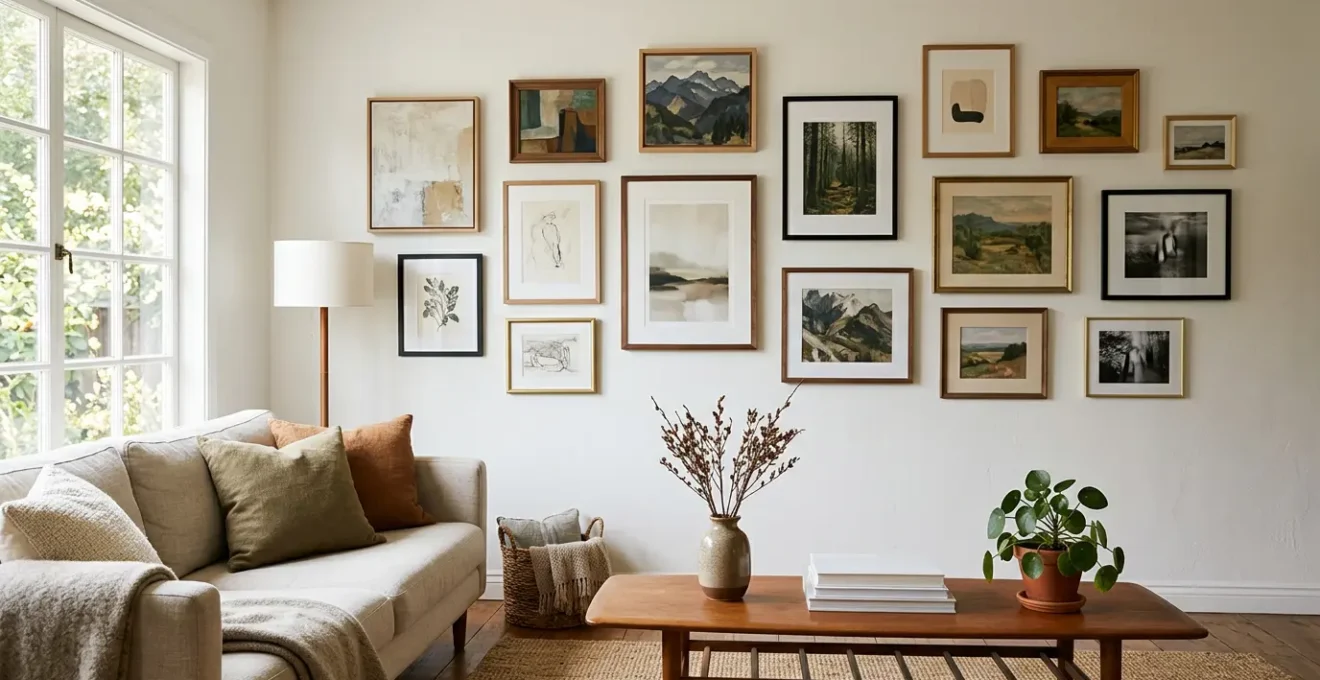
Building a valuable art collection on a budget starts not with money, but by cultivating a ‘Collector’s Mindset’—an intellectual framework for seeing and appreciating the world.
- Discover how to train your aesthetic sensibilities through diverse cultural experiences, from music to literature.
- Learn to distinguish authentic personal taste from pretension, making your collection a true reflection of your identity.
Recommendation: Focus on building your cultural knowledge and training your eye first; the right art will naturally follow.
The desire to collect art often stems from a deeper ambition: to cultivate a more sophisticated, well-rounded identity. Yet, the art world can feel opaque and prohibitively expensive, leading many to believe that a meaningful collection is beyond their reach. The common advice—to buy affordable prints or scout student shows—is practical but misses the fundamental point. It treats art collecting as a mere shopping activity, a matter of budget and opportunity. This approach often leads to a disjointed assembly of objects, rather than a cohesive and personal collection.
But what if the key to starting an art collection wasn’t about what you can afford to buy, but about who you are becoming? The secret of the world’s most discerning collectors, even those with modest means, lies not in their bank accounts but in their cultivated perspective. They possess a « Collector’s Mindset, » an ability to see value, narrative, and beauty where others do not. This mindset is a muscle, and it can be trained. True collecting is an intellectual project, an act of curation that extends beyond the walls of your home and into every facet of your cultural life.
This guide will not give you a list of cheap art to buy. Instead, it will show you how to build the foundational framework of a true collector. We will explore how seemingly unrelated pursuits—from learning an instrument to planning a museum date—are essential exercises in « aesthetic fitness. » By developing your eye, empathy, and intellectual curiosity, you will learn to collect with an intelligence and authenticity that money cannot buy. You will be curating not just art, but a richer, more meaningful life.
This article explores the essential pillars for developing this collector’s mindset, transforming your approach from simple acquisition to profound personal curation. The following sections will guide you through the process of training your aesthetic senses and intellectual curiosity.
Summary: Cultivating the Mindset of a True Art Collector
- Why Learning Guitar After 30 Is Good for Your Neuroplasticity?
- Fiction or Non-Fiction: Which Genre Builds More Empathy?
- Opera or Symphony: Which Is Better for Beginners?
- The Shallow Knowledge Mistake That Makes You Look Pretentious
- How to Plan a Museum Visit That Isn’t Boring for Your Date?
- How to Choose a Hobby That Has Zero Connection to Your Career?
- Why Do You Feel Uncomfortable When You Dress for Others?
- Where to Go for a Digital Detox Trip That Actually Forces You to Unplug?
Why Learning Guitar After 30 Is Good for Your Neuroplasticity?
At first glance, learning a musical instrument seems entirely separate from collecting visual art. However, the discipline required to master the guitar is a perfect metaphor for developing a collector’s eye. Both activities are forms of aesthetic fitness that strengthen your brain’s ability to recognize patterns, appreciate structure, and understand composition. Learning chords, scales, and song structures trains your mind to deconstruct complexity and find harmony, much like an art connoisseur learns to analyze an artist’s use of color, form, and balance. This is not just about mental acuity; it’s about building a framework for appreciation.
Engaging in a structured artistic practice like music builds the patience and dedication essential for thoughtful collecting. It teaches you that true appreciation is earned through consistent effort, not passive consumption. A collector doesn’t just buy art; they learn to see it. The weekly discipline of practicing an instrument mirrors the regimen required to train your eye. You learn to listen for nuance in a melody just as you learn to look for an artist’s unique brushstroke or conceptual signature. This cross-disciplinary training develops a more holistic and sophisticated taste.
Ultimately, learning an instrument after 30 does more than just boost neuroplasticity; it cultivates the very patience and structural understanding needed for art collecting. You are not just learning to play music; you are learning the language of artistic creation itself, a language that is universally applicable across all art forms and is the foundation of the collector’s mindset.
Fiction or Non-Fiction: Which Genre Builds More Empathy?
A great art collection tells a story. Each piece is a chapter, and together they form a narrative that reflects the collector’s life and intellectual journey. To curate such a collection, one must possess a deep sense of empathy—the ability to connect with an artist’s intention and the human experience embedded within the work. While non-fiction provides facts, literary fiction is a powerful engine for building this emotional intelligence. It forces you to inhabit other minds, navigate complex social situations, and understand motivations different from your own. This practice directly translates to understanding the narrative resonance of a painting or sculpture.
The story of Herbert and Dorothy Vogel, a postal clerk and a librarian, is a powerful testament to this idea. They built one of the most important 20th-century art collections not with wealth, but with profound empathy and intellectual curiosity. As Herbert Vogel himself said of their approach to discovering new artists:
I knew something was new. I didn’t know how good or bad it was, I just knew it hadn’t been done before.
– Herbert Vogel, National Gallery of Art Archives
This « knowing » came from an intuitive, empathetic connection to the artist’s struggle and vision. They weren’t buying a product; they were supporting a story they believed in. This is the essence of authentic collecting, and it’s a skill honed by engaging with narratives, whether on a page or on a canvas.
Just as a great library contains both fiction and non-fiction, a sophisticated art collection can create a dialogue between different genres, such as the figurative and the abstract. Understanding the narrative power of fiction allows a collector to see the story even in non-representational art, appreciating the emotional weight behind a choice of color or the tension within a composition. This ability to read the « story » is what elevates a collector from a mere buyer to a true connoisseur.
Opera or Symphony: Which Is Better for Beginners?
Choosing between attending an opera or a symphony concert is an excellent parallel for the first major decision a new art collector faces: should you start with narrative, figurative art or with formal, abstract art? Neither is inherently « better, » but each offers a different entry point for developing your taste. Opera, with its clear story, characters, and dramatic arc, is much like figurative art. It is immediately accessible, and its emotional power is carried by a recognizable narrative. You can follow the plot and appreciate the skill of the performers even with little technical knowledge.
A symphony, on the other hand, is closer to abstract art. It is about pure form, structure, harmony, and texture. To fully appreciate it, you must develop an ear for its compositional elements—the interplay of melodies, the development of themes, the orchestral colors. It demands a more active, educated listening. This mirrors the challenge of abstract art, which requires an eye trained to appreciate balance, line, and form without the anchor of a recognizable subject. A symphony, like an abstract painting, asks you to feel the artist’s intent through pure aesthetics.
The following table illustrates how these different approaches can be mapped directly onto starting a collection, showing there is no single right path, only the one that aligns with your current sensibilities.
| Aspect | Opera Collecting (Narrative Art) | Symphony Collecting (Formal Art) |
|---|---|---|
| Entry Level Budget | $200-$1,000 for prints | $500-$2,000 for small originals |
| Learning Curve | Immediate – story-driven | Gradual – requires developing eye |
| Best Starting Point | Illustrative prints, figurative works | Abstract studies, minimalist pieces |
| Market Availability | Widely available online | Often requires gallery visits |
| Investment Potential | Moderate – popular appeal | Higher – collector focused |
Ultimately, engaging with both forms is ideal. Starting with the « opera » of figurative art can build your confidence, while challenging yourself with the « symphony » of abstract art will develop the cross-disciplinary taste that marks a truly sophisticated collector. The journey is about expanding your palate, not limiting it.
The Shallow Knowledge Mistake That Makes You Look Pretentious
In the quest for sophistication, nothing backfires more spectacularly than pretension. It is the hallmark of the insecure, the person who buys art to signal status rather than to express a genuine connection. This « shallow knowledge mistake » involves name-dropping famous artists without understanding their work, or repeating market trends without having a personal opinion. It’s the difference between knowing the price of everything and the value of nothing. A true collector’s confidence comes from deep, authentic, and personal knowledge, not from a script.
The antidote to pretension is sincere curiosity and dedicated research. It’s about falling in love with an artist’s process, understanding their place in art history, and forming a connection that goes beyond the surface. In fact, research shows that serious collectors invest significant time in learning before they buy; a recent market study found that 78% of millennial collectors spend over three months researching before making a major purchase. This is not about memorizing auction prices; it is about building a rich intellectual context around the art that interests you.
The legendary collectors Herbert and Dorothy Vogel embodied this authenticity. Their collection was deeply personal, built piece by piece based on genuine passion. As Dorothy Vogel simply stated, their philosophy was to « buy what we liked, simple as that. » This simple statement is a profound lesson. It’s a commitment to your own taste, honed through research and experience, over the fleeting opinions of others. When you can articulate *why* you love a piece—what it communicates to you, how it challenges you, where it fits into the artist’s journey—you will never appear pretentious. Your knowledge will be earned, and your passion will be undeniable.
How to Plan a Museum Visit That Isn’t Boring for Your Date?
A museum date can either be a sophisticated, engaging experience or a tedious, silent shuffle through endless galleries. The difference lies in the approach. Instead of a passive viewing, reframe the visit as an active mission: a training ground for your collector’s eye and a way to discover your shared tastes. This transforms the date from a test of cultural endurance into a collaborative adventure. It’s not about showing what you know; it’s about discovering something new together.
The goal is to move beyond aimless wandering. By giving your visit a purpose, you create focus and spark conversation. A great strategy is to treat the museum as a « scouting mission » for your future collection. You are not there to see everything, but to find the one or two pieces that truly resonate. This active engagement is far more impressive and enjoyable than passively absorbing information from wall labels. It’s a practical application of intellectual curation, where you actively filter and select what is meaningful to you.
To make this happen, you need a game plan. Instead of just walking in, propose a playful challenge or a specific focus. This creates a shared goal and makes the experience interactive and personal, ensuring that your time is spent connecting with each other and the art.
Your Museum Scouting Mission: A 5-Point Plan
- Play ‘The One-Piece Heist’: If you could steal one piece to start your collection, which would it be and why? This reveals personal taste immediately.
- Analyze Curator Groupings: Discuss why certain pieces are displayed together. What story is the curator trying to tell with this arrangement?
- Focus on Provenance: Look at the labels for the « provenance » section. Discover the artwork’s past life—who owned it, where it has been. It adds a layer of history and intrigue.
- Build a Visual Library: Take photos (where permitted) of pieces that spark joy or curiosity. This becomes a visual diary of your evolving preferences.
- Explore Acquisition Committees: For a deeper dive, research joining a museum’s young patrons or acquisition committee for behind-the-scenes learning opportunities.
How to Choose a Hobby That Has Zero Connection to Your Career?
In a world obsessed with productivity and career optimization, a hobby completely disconnected from your professional life is a radical act of self-definition. Art collecting, when approached with a personal vision, is the ultimate « non-career » pursuit. It’s a space where you are the sole arbiter of value, where the goal isn’t a promotion or a bonus, but the cultivation of your own spirit and intellect. This is where you can build an identity that is authentically yours, free from the pressures of your job title.
This pursuit of personal meaning is a growing trend, especially among younger generations who are redefining what it means to be a collector. For them, art is less about a financial portfolio and more about a personal one. A recent study highlights this shift, showing that 89% of Gen Z collectors are drawn to prints by emerging artists, with many citing access to markets and appreciation for the creative process as key motivators. They are not buying for investment; they are buying to participate in a culture and to own a piece of a story that resonates with them.
Choosing to start an art collection is to embark on a project of intellectual curation. You define the theme, you set the boundaries, and you make the connections. Your collection might focus on a specific medium, a particular region, or a conceptual idea that fascinates you. It becomes a physical manifestation of your curiosity. This act of building something that is purely for your own enrichment creates a powerful sense of self, separate and distinct from the person you are at work. It’s a declaration that your life is more than just your labor.
Why Do You Feel Uncomfortable When You Dress for Others?
The discomfort of wearing an outfit that doesn’t feel like « you » is a familiar feeling. It’s a subtle but persistent sense of being in a costume, of projecting an identity that isn’t your own. This exact feeling applies to art collecting. When you buy a piece of art primarily to impress others—because it’s by a famous artist or fits a current trend—you are « dressing your walls for others. » The result is a collection that feels hollow and inauthentic, just like an ill-fitting suit.
True style, both in fashion and in art, comes from a deep and confident understanding of oneself. It’s about trusting your own instincts over external validation. Emilya Colliver, a respected art director, captures this sentiment perfectly:
Always, always trust your gut — you have to live with the artwork! Choose the piece you instinctively love; there is a reason something inside you resonated with that work.
– Emilya Colliver, Art Pharmacy Director
This « gut feeling » isn’t random; it’s the culmination of your life experiences, your knowledge, and your unique perspective. It’s the voice of your authentic taste. A collection built on this foundation becomes a genuine extension of your personality. Each piece, like a favorite well-worn jacket, holds personal meaning and tells a story. As collector Mary Ta says of pieces bought on her travels, « it’s like taking a photograph of that experience… It reminds of who you were with and what you were doing. » This is the power of a collection built on narrative resonance, not on public approval.
Key Takeaways
- Collecting is an intellectual project, not a financial one. Your primary investment should be in knowledge and experience.
- Authentic taste is built through diverse cultural engagement—from music and literature to travel and conversation.
- The most valuable collections are a reflection of a personal story and a well-honed perspective, not market trends.
Where to Go for a Digital Detox Trip That Actually Forces You to Unplug?
In an age of endless digital feeds, our ability to see and appreciate the world with fresh eyes has atrophied. We experience art through a screen, flattened and decontextualized. A true digital detox, therefore, isn’t just about escaping emails; it’s an opportunity for « analog art discovery. » It’s about intentionally seeking out physical, tangible encounters with art to retrain your senses and rediscover the power of unmediated observation. This is the final and most crucial step in solidifying your collector’s mindset.
The digital world offers convenience, but the physical world offers texture, scale, and presence—qualities that are essential to truly understanding an artwork. Serious collectors know this; research from Art Basel reveals that 73% of VIP collectors still prefer to buy art in person through dealers. They value the handshake, the conversation, and the irreplaceable experience of standing in front of a piece and feeling its power. A digital detox trip should be planned around creating these kinds of analog moments.
Instead of a typical beach vacation, consider a trip to a city with a vibrant artist district, attend a regional art fair, or visit the open studios of local artists. These activities force you to engage your senses, have real conversations, and discover emerging talent before they appear on any website. This is where the real joy of collecting lies: in the hunt, the personal connection, and the story behind the discovery. This is how you move from being a passive consumer of digital images to an active participant in the art world.
- Visit local art school graduate shows to spot emerging talent at the source.
- Explore open studio weekends in artist districts for a behind-the-scenes look.
- Hunt for overlooked treasures at high-end flea markets and estate sales.
- Attend local art fairs and festivals to make direct connections with artists.
- Commission a small work directly from an artist you admire, creating a truly unique connection.
Frequently Asked Questions About How to Start an Art Collection with a Limited Budget?
How much should I budget annually for art collecting?
A good starting point is to set aside $500 or more per year. This is not an insignificant sum, but viewed over the long term, it allows you to build a meaningful collection. In ten years, you could have ten carefully chosen pieces, each with its own story and significance, forming the foundation of a collection you can be proud of.
Should I focus on investment potential or personal connection?
For a new collector, the focus should unequivocally be on personal connection. The best and most interesting collections are those that reflect an authentic, individual taste, not those that chase market trends. Buy what you love and want to live with. If a piece happens to appreciate in value, consider it a fortunate bonus, not the primary goal.
How do I develop a collector’s thesis statement?
A collector’s thesis provides focus and transforms your acquisitions from random purchases into a cohesive project. To develop one, try to define your core intellectual or aesthetic interest in a single sentence. For example: « My collection explores the theme of memory in post-industrial landscapes, » or « I collect works on paper by female artists that challenge traditional portraiture. » This statement will evolve, but it provides a crucial guide for your journey.
Now that you understand the principles of the collector’s mindset—from aesthetic fitness to analog discovery—the next step is to put them into practice. Your journey begins not at an auction house, but with the simple, deliberate act of looking. Start today by applying these lessons to begin building a collection that is a true and sophisticated reflection of you.