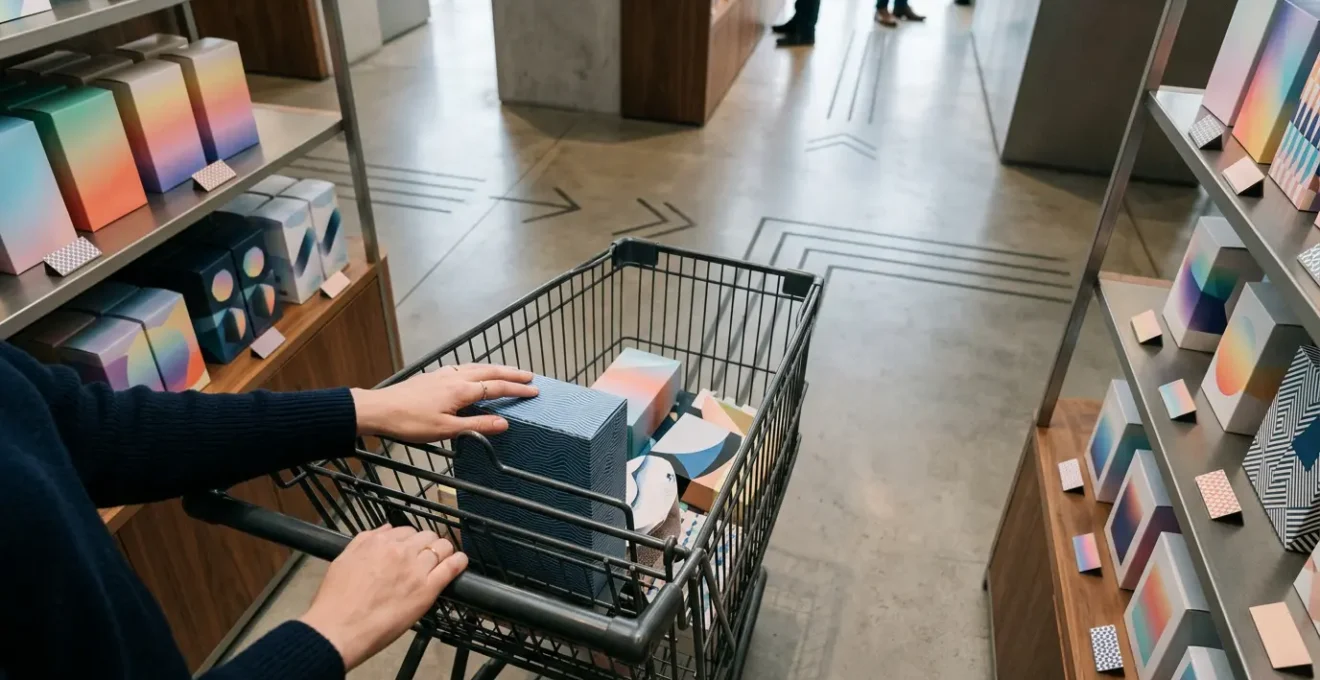
Retail stores are not neutral spaces; they are highly engineered environments designed to bypass your rational mind and encourage impulse spending.
- Store layouts are intentionally confusing to maximize your exposure to products, while pricing schemes use decoys to make you choose the more expensive option.
- Sensory cues like music and scents, combined with manufactured urgency, exploit deep-seated psychological biases like FOMO and decision fatigue.
Recommendation: Your most powerful defense is preparation. Creating and strictly adhering to a master shopping list is the single most effective strategy to reclaim control and resist manipulation.
You walk into a store for a single item—a carton of milk, perhaps—and walk out an hour later with a cart full of things you never intended to buy. It’s a familiar, frustrating experience that leaves you wondering what just happened. You might blame a lack of willpower, but the reality is far more complex. You’ve just navigated a carefully constructed battlefield where every aisle, every price tag, and even the air you breathe is a weapon designed to separate you from your money.
Most advice focuses on the obvious: make a list, set a budget. While true, this barely scratches the surface. These tips treat the symptom, not the cause. The real power lies not in simply knowing the tricks, but in understanding the deep-seated cognitive biases they are built to exploit. Retailers aren’t just organizing shelves; they are practicing a form of applied psychology, leveraging everything from decision fatigue to the fear of missing out (FOMO) to guide your hand toward your wallet.
But what if the key to immunity wasn’t just resistance, but awareness? What if, by understanding the psychological mechanism behind each trick, you could see the strings being pulled and consciously choose to cut them? This is the perspective of a retail anthropologist. It’s about deconstructing the environment to reveal the hidden architecture of persuasion. This guide will do more than list the traps; it will arm you with the knowledge of *why* they work, turning you from a passive consumer into a conscious, empowered shopper who walks out with exactly what they came for, and nothing more.
In the sections that follow, we will dissect the most common and effective retail strategies. We will explore the science behind store layouts, pricing decoys, sensory manipulation, and more, providing you with the insight needed to build an unbreakable defense against impulse spending.
Summary: Unmasking the Hidden Psychology of Retail Environments
- Why Is Milk Always at the Back of the Grocery Store?
- Small, Medium, or Large: How Pricing Decoys Force You to Buy the Large?
- ‘Only 2 Left’: Is the Scarcity Counter on Booking Sites Real?
- The Scent and Music Strategy That Makes You Linger in Shops
- How to Resist the ‘Point of Sale’ Candy and Gadgets?
- The Empty Stomach Mistake That Doubles Your Grocery Bill
- How to Select a Cologne That Lasts All Day on Dry Skin?
- How to Create a Master Shopping List That Saves You $500 a Month?
Why Is Milk Always at the Back of the Grocery Store?
The placement of essential items like milk and bread at the furthest point from the entrance is one of the oldest and most effective retail strategies. The common explanation is that it forces you to walk through the entire store, but the psychological goal is far more subtle. It’s not just about the journey; it’s about inducing a state of mild disorientation and increasing your cognitive load. This calculated inconvenience is the first step in a process known as the « Gruen Transfer, » named after the architect who designed the first modern shopping mall.
The Gruen Transfer is the moment a shopper’s original mission (e.g., « buy milk ») is replaced by a more aimless, receptive browsing state. By forcing you to navigate a maze of aisles filled with tempting displays, the store intentionally overwhelms your decision-making faculties. As your brain processes thousands of products, colors, and promotions, your focus wavers. This is no accident. In this state, you are far more susceptible to impulse buys, a fact supported by research indicating that more than 50% of purchases are unplanned. The long walk for milk isn’t designed to be a hassle; it’s a carefully orchestrated psychological primer.
This deliberate environmental design is engineered to hijack your attention. As experts on the Gruen Transfer have noted, the effect is potent:
The moment a customer enters a mall and is overwhelmed by the size, intentional clutter, and glitz of the mall, they forget their original goals and become susceptible to sales manipulation.
– Research on the Gruen Transfer, Wikipedia – Gruen transfer
Your defense is to recognize this tactic for what it is: an attempt to exhaust your focus. By consciously reminding yourself of your primary mission and treating the journey to the back of the store as a direct, unswerving path, you can maintain your executive function and resist the environmental hypnosis. See the aisles not as a wonderland of discovery, but as simple background noise on your way to your target.
Small, Medium, or Large: How Pricing Decoys Force You to Buy the Large?
You’re at the cinema, looking at the popcorn menu: Small for $3, Medium for $6.50, and Large for $7. The choice seems obvious. The medium is a terrible deal, making the large feel like an incredible bargain for just 50 cents more. You’ve just been influenced by the « decoy effect, » a powerful cognitive bias also known as asymmetric dominance. The medium popcorn was never meant to be sold; it’s a « decoy » option whose sole purpose is to make the « target » option (the large popcorn) look overwhelmingly superior in comparison.
This strategy works by framing the decision not as « Which size do I want? » but « Which option is the best value? » Our brains are not good at assessing absolute value, but we excel at making relative comparisons. The decoy is asymmetrically dominated because it is clearly worse than the target option in every respect (worse price-per-ounce) but not clearly worse than the other option (the small). This manipulates your perception of value and steers you toward the choice the retailer wanted you to make all along—the one with the higher profit margin.
This paragraph introduces a complex concept. To better understand this, the illustration below visualizes how a « less appealing » middle option makes the target option seem more attractive.
The effectiveness of this tactic is not just anecdotal; it is well-documented. Academic research has consistently shown how a strategically placed decoy can dramatically shift consumer preferences. A meta-analysis by Heath and Chatterjee (1995) found that the introduction of asymmetrically dominated alternatives increased the choice share of target options by an average of 11.3%. To protect yourself, always evaluate each option based on your actual needs, not on its perceived value relative to a decoy. Ask yourself, « Do I actually need the large size? » This grounds your decision in genuine need rather than manipulated perception.
‘Only 2 Left’: Is the Scarcity Counter on Booking Sites Real?
You’re browsing for a hotel room, and a flashing red banner announces: « Only 2 rooms left at this price! » A wave of urgency washes over you. This feeling is the result of scarcity marketing, a tactic that preys on our deep-seated Fear Of Missing Out (FOMO). Whether it’s a real-time inventory counter or a « limited edition » label, the message is the same: act now or lose out forever. This triggers a primitive part of our brain that associates scarcity with value, short-circuiting rational, price-sensitive decision-making.
While the inventory on a booking site might be genuinely low, the way this information is presented is designed for maximum psychological impact. The prominent, often colorful counters and urgent language are not just informational; they are emotional triggers. Retailers know that the fear of a potential loss is a much stronger motivator than the prospect of a potential gain. This is the essence of loss aversion. The thought of *missing* the perfect hotel room feels more painful than the pleasure of finding it would feel good, compelling you to make a snap decision.
This tactic is particularly effective in the digital age, where social proof and constant connectivity amplify our anxieties about being left behind. The data confirms our vulnerability to this manipulation. For instance, studies show that 60% of millennials make impulsive purchases because of FOMO. The pressure is immense, often leading to purchases that are not well-considered or even wanted. The key to resistance is to recognize this feeling of panic as a manufactured signal. When you see a scarcity counter, pause. Ask yourself: « Is this item genuinely rare and valuable to me, or am I just reacting to a marketing trigger? » Creating this mental space allows your rational brain to catch up with your panicked instincts.
The Scent and Music Strategy That Makes You Linger in Shops
When you walk into a high-end boutique or a cozy bookstore, what you experience is not random. The pleasant scent of vanilla or leather, the specific tempo of the background music—these elements are part of a deliberate strategy known as sensory architecture. Retailers are not just creating a nice « vibe »; they are engineering an environment to manipulate your mood, your perception of time, and ultimately, your purchasing behavior. This approach is powerful because it bypasses your conscious mind and targets your emotions directly.
Research has shown that slow-tempo music encourages shoppers to move more slowly and spend more time—and money—in a store. Fast-paced music can have the opposite effect, hurrying customers along in high-volume environments like fast-food restaurants. Similarly, specific scents can evoke powerful associations. The smell of freshly baked bread can make a house feel like a home, while a subtle citrus scent can make a space feel clean and energetic. These cues operate on a primal level, influencing how you feel about a brand and its products without you ever realizing it.
This paragraph explores how retailers manipulate the subconscious. The following image captures the abstract, textural nature of this sensory manipulation, focusing on light, texture, and atmosphere.
The science behind this is startling. It is widely acknowledged in consumer psychology that 95% of purchasing decisions are made subconsciously. Retailers know this. They are not decorating their store; they are setting a sensory trap. The goal is to make you feel so comfortable and detached from the outside world that you lose track of time and your original budget. To protect yourself, practice active awareness. When you enter a store, take a moment to notice the music and any distinct scents. By consciously identifying them, you pull the manipulation from your subconscious into your conscious mind, significantly reducing its power over you.
How to Resist the ‘Point of Sale’ Candy and Gadgets?
You’ve successfully navigated the store, stuck to your list, and are heading to the checkout. You feel a sense of accomplishment, but the final and most difficult challenge awaits you: the « point of sale » (POS) display. This gauntlet of candy, magazines, batteries, and cheap gadgets is the retail equivalent of an ambush. It is strategically placed to exploit a state of profound decision fatigue. After making dozens of choices throughout the store—paper or plastic, brand A or brand B, sale item or regular price—your brain’s capacity for rational thought is depleted.
At this moment, your willpower is at its lowest. The prefrontal cortex, the part of your brain responsible for executive functions like impulse control, is effectively tired. Retailers know this. They deliberately place low-cost, high-margin, emotionally appealing items at the checkout to tempt your exhausted mind. A chocolate bar or a glossy magazine requires no complex decision-making; it’s a simple, rewarding « yes » at a time when your brain is desperate to stop thinking. You aren’t weak for wanting it; you are a human whose cognitive resources have been systematically drained by the store’s environment.
Resisting this final trap requires a pre-planned defense, as your in-the-moment willpower is an unreliable ally. The key is to create a set of automatic behaviors for the checkout line. This can include putting on headphones, focusing on your phone, or engaging the cashier in conversation—anything that directs your attention away from the tempting displays. By having a plan, you offload the need to make yet another decision, preserving your last reserves of self-control. Awareness of your own mental state is your best protection.
Action Plan: Resisting Checkout Impulse Buys
- Recognize Your Vulnerability: Acknowledge that most buying decisions are subconscious. Simply being aware that you are being targeted at the checkout is your first line of defense.
- Implement the ‘Willpower Pause’: Force a 5-second pause before grabbing any unplanned item. Ask yourself two questions: « Was this on my list? » and « Why do I want this right now? »
- Understand the Placement: Be aware that checkout items are placed to exploit your depleted decision-making energy. See the display for what it is: a strategic trap, not a helpful reminder.
- Spot Pricing Tricks: Notice the use of « charm pricing » (e.g., $9.99 vs. $10). Acknowledge that this is a psychological trick to make the price seem significantly lower than it is.
- Use the HALT Principle: Avoid shopping when you are Hungry, Angry, Lonely, or Tired. These emotional and physical states make you exceptionally vulnerable to impulse decisions.
The Empty Stomach Mistake That Doubles Your Grocery Bill
The old advice « never go grocery shopping on an empty stomach » is more than just folk wisdom; it’s a profound behavioral and biological insight. Shopping while hungry doesn’t just make you crave food; it fundamentally alters your brain’s decision-making process, making you more susceptible to all forms of impulse buying, not just for edible items. This happens because hunger triggers a primal, acquisition-focused mindset that overrides rational planning.
When your blood sugar is low, your body releases hormones like ghrelin, which signals hunger to your brain. Simultaneously, stress hormones like cortisol can rise. This hormonal cocktail has a direct impact on your prefrontal cortex, the sophisticated « CEO » of your brain responsible for planning, impulse control, and long-term thinking. Its function becomes impaired, leaving more primitive, reward-seeking parts of the brain in control. You are literally thinking with your stomach, and your stomach wants one thing: immediate gratification.
This biological state makes every retail trick we’ve discussed exponentially more effective. The bright colors of junk food seem more appealing, the « deal » on a bulk package of cookies feels more urgent, and your ability to stick to your list diminishes. As behavioral psychology research explains, the mechanism is physiological:
High cortisol from stress or low blood sugar from hunger impairs the prefrontal cortex, the part of the brain responsible for rational decision-making.
– Behavioral Psychology Research, Intelligence Node – Consumer Behavior Report 2024
The solution is simple but non-negotiable: eat a healthy snack containing protein and complex carbohydrates before you go to the store. This stabilizes your blood sugar and keeps your prefrontal cortex fully online and in command. It’s the biological equivalent of putting on armor before heading into battle. You are not just satisfying your hunger; you are fortifying your mind against manipulation.
How to Select a Cologne That Lasts All Day on Dry Skin?
In an article about resisting manipulation, a guide to selecting cologne might seem out of place. But it serves as a perfect model for the ultimate counter-tactic: mindful, deliberate purchasing. Unlike grabbing a candy bar at checkout, choosing a personal fragrance is—or should be—a slow, considered, and personal ritual. It is the complete antithesis of an impulse buy. By adopting this mindful approach in other areas of shopping, you can build a powerful defense against retail tricks.
First, the practical advice for those with dry skin: fragrance molecules evaporate more quickly from dry surfaces. The key to longevity is hydration. Always apply cologne to well-moisturized skin. Use an unscented lotion first, let it absorb, and then apply the fragrance. Furthermore, focus on fragrances with higher concentrations of perfume oil. An « Eau de Parfum » (EDP) or « Parfum » will last significantly longer than an « Eau de Toilette » (EDT) or « Eau de Cologne » (EDC). Look for base notes like woods, amber, and musk, as these heavier molecules anchor the scent and evaporate more slowly.
This process of testing and selecting a fragrance is a valuable lesson in itself. It is a sensory evaluation that cannot be rushed, as this illustration of a contemplative moment shows.
The critical step is to always test a fragrance on your skin, not just a paper strip. A scent’s chemistry interacts uniquely with your own. Spray it on your wrist, and then—this is crucial—walk away. Do not make a decision for at least a few hours. A fragrance has a life cycle of top, middle, and base notes. The initial smell is not what it will smell like all day. This patient, methodical process of testing, waiting, and observing is the core of mindful purchasing. It reclaims the power from the seller and places it firmly with you, the buyer. It’s a decision based on personal experience and long-term satisfaction, not a fleeting, externally-triggered impulse.
Key Takeaways
- Retail environments are not passive spaces; they are actively designed to exploit cognitive biases like decision fatigue and FOMO.
- Awareness is your primary defense. Recognizing a tactic (like a pricing decoy or sensory manipulation) significantly reduces its psychological power over you.
- Your physical and emotional state (e.g., hunger, stress) directly impacts your brain’s ability to make rational decisions, making you more vulnerable to impulse buys.
How to Create a Master Shopping List That Saves You $500 a Month?
We have deconstructed the psychological traps laid by retailers, from store layouts that induce cognitive load to pricing schemes that manipulate your perception of value. The common thread is that they all rely on overwhelming your brain’s executive function in the moment. The single most powerful weapon to counter every one of these tactics is not better willpower, but better preparation: the master shopping list.
A master list is more than just a pre-shopping reminder; it is a strategic document. It is a « pre-commitment device » that you create in a calm, rational environment, far from the sensory assault of the store. By deciding what you need to buy *before* you are exposed to manipulation, you offload dozens of in-store decisions. This dramatically reduces decision fatigue, keeping your prefrontal cortex fresh and in control. When you encounter a tempting display, the question is no longer « Do I want this? » but a simple, binary « Is this on my list? »
To be effective, your list must be specific. « Snacks » is an invitation for impulse buys. « Two Granny Smith apples and one box of whole-grain crackers » is a command. Organize your list by store aisle to create a clear, efficient path, minimizing your exposure to tempting but unnecessary sections. This turns you from a wandering browser into a surgical operative on a mission. The list becomes your shield and your map, guiding you past the siren songs of « special offers » and point-of-sale temptations. Committing to buying only what is on the list removes ambiguity and makes resistance an automatic, low-effort process.
By transforming your shopping from a reactive browse into a proactive, mission-oriented task, you take back control. Take the time to build your master list today, and you will not only protect your wallet but also reclaim your agency as a conscious consumer.