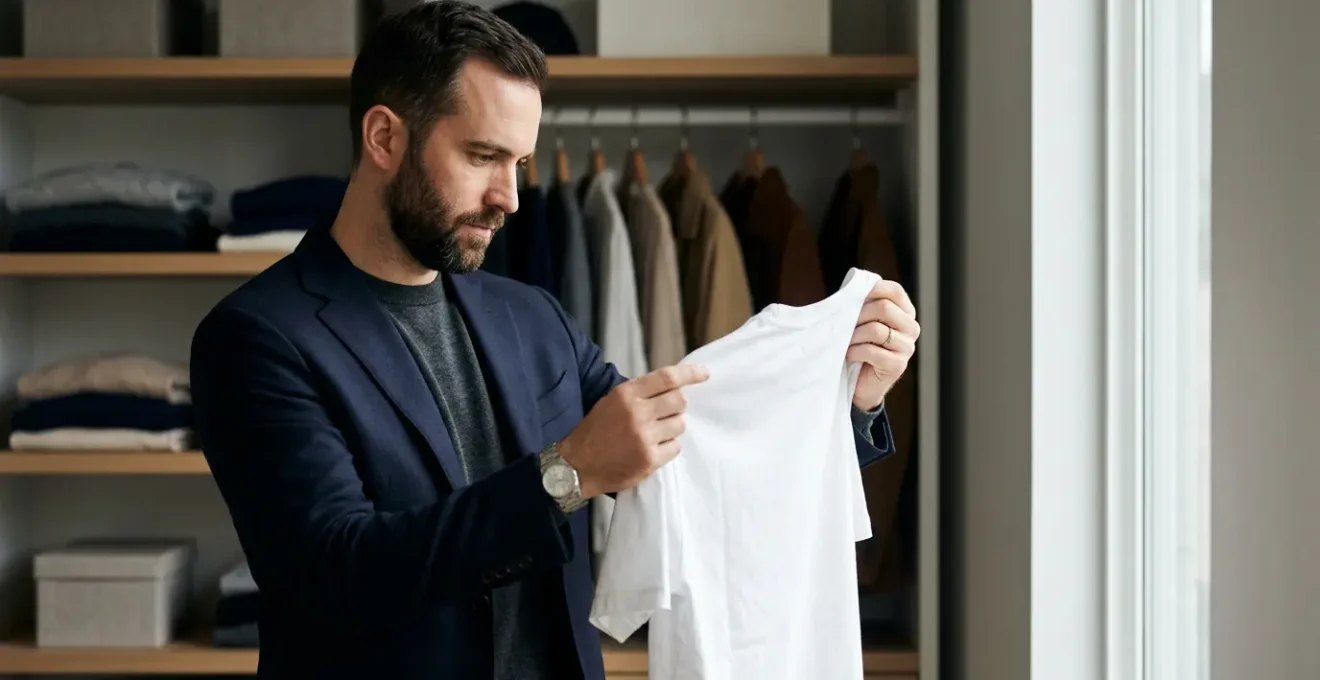
Contrary to popular belief, the « 100% Cotton » label is not a guarantee of quality; the invisible properties of the fiber determine if a garment will last.
- Garment longevity and shrink resistance depend on the cotton’s staple length (longer is better) and knit density, not just its weight.
- Deceptive labeling is common, with many products marketed as premium cotton actually being of a lower grade.
Recommendation: Shift your focus from brand logos and price tags to physical fabric tests you can perform in-store to assess fiber quality and construction.
The experience is frustratingly common for any man trying to build a reliable wardrobe: a new, perfectly fitting T-shirt or basic garment looks sharp for its first wear, only to emerge from the laundry twisted, shrunken, and misshapen. Many blame their washing machine or accept it as a reality of modern clothing. The conventional wisdom is to check for a « 100% Cotton » label and hope for the best, perhaps equating a higher price tag with durability. This approach, however, often leads to a cycle of disappointment and a closet full of sloppy, ill-fitting basics.
The problem isn’t the cotton itself, but a fundamental misunderstanding of what constitutes quality at a material science level. Most advice focuses on surface-level attributes, ignoring the critical factors that dictate a fabric’s structural integrity. The true measure of a garment’s longevity—its ability to resist pilling, shrinking, and warping—is determined long before it’s sewn. It lies in the length of the individual cotton fibers, the tension of the yarn, and the density of the knit.
But if the real indicators of quality are microscopic, how can you identify a superior garment on the shop floor? The answer is to stop reading the marketing and start reading the fabric itself. This guide moves beyond the platitudes. We will not just list what to look for; we will explain the technical reasons why certain attributes lead to durability. By adopting the mindset of a quality control expert, you can learn to identify the subtle-yet-definitive signs of superior construction, from the humble T-shirt to a major investment piece like a leather jacket.
This article provides a technical framework for assessing garment quality. You will learn to distinguish between different materials, understand the markers of durable construction, and apply proper maintenance to maximize the lifespan of your wardrobe.
Summary: A Technical Guide to Identifying High-Quality Menswear That Lasts
- Why Is a White Oxford Shirt the Swiss Army Knife of Menswear?
- Raw Denim vs. Washed: Which Jeans Offer the Best Longevity?
- Heavyweight or Lightweight Cotton: Which Is Better for Daily Wear?
- The ‘Designer Logo’ Markup That Adds $50 to a $10 T-Shirt
- How to Wash Your Dark Jeans to Prevent Fading for Years?
- Navy Blazer or Grey Suit: Which Should Be Your First Major Investment?
- 100% Cotton vs. Poly-Blend: Which Fabric Pilling Sign Should You Avoid?
- How to Maintain a Leather Jacket So It Lasts 20 Years?
Why Is a White Oxford Shirt the Swiss Army Knife of Menswear?
The white Oxford cloth button-down (OCBD) shirt is a foundational piece in menswear due to its unparalleled versatility. Its unique value lies in the fabric’s construction: a specific basketweave pattern, known as Oxford cloth, that blends durability with a soft texture. This allows it to bridge the gap between formal and casual wear effortlessly. It can be worn with a suit and tie, looking perfectly appropriate in a business context, yet it pairs just as naturally with jeans or chinos for a weekend outing. This adaptability is its core strength, making it a high-utility garment that reduces the need for multiple, occasion-specific shirts.
Unlike smoother poplin or broadcloth, the slightly more rugged texture of Oxford cloth gives it character and resilience. High-quality versions are made from long-staple cotton, which contributes to a softer feel and greater longevity. A key marker of a superior OCBD is an unfused collar. This construction allows the collar points to develop a natural, gentle curve known as the « S-roll, » a hallmark of classic American style that is impossible to achieve with stiff, fused collars found on cheaper shirts. The shirt’s durability and timeless appeal make it a prime example of a « buy it once, wear it for a decade » investment.
Furthermore, the OCBD is a canvas for other quality indicators. Details like genuine mother-of-pearl buttons, which have a deeper luster and unique patterns compared to plastic, signal a commitment to quality materials. High stitch density (more stitches per inch) along the seams indicates stronger, more durable construction. By understanding these technical points, the Oxford shirt becomes more than just a versatile garment; it becomes a case study in how to identify lasting quality in menswear.
This combination of versatility and discernible quality markers makes the white Oxford shirt one of the smartest investments for any man’s wardrobe, providing maximum value and style mileage.
Raw Denim vs. Washed: Which Jeans Offer the Best Longevity?
When assessing the longevity of jeans, the primary distinction is between raw (or ‘dry’) denim and washed (or ‘pre-distressed’) denim. From a purely structural standpoint, raw denim offers superior longevity. Raw denim is fabric that has not undergone any washing or distressing processes after being dyed. The cotton fibers retain their full, original tensional strength, and the indigo dye coats the threads completely. This means the garment starts its life at maximum durability, ready to be broken in by the wearer.
In contrast, washed denim has been subjected to industrial processes involving water, chemicals, lasers, and abrasion to simulate wear and create a softer feel from the start. While this provides immediate comfort, it fundamentally weakens the cotton fibers. Each « fade » or « whiskering » mark on a new pair of washed jeans represents a point of accelerated wear where the fabric’s integrity has been compromised. This pre-distressing significantly shortens the garment’s potential lifespan, making it more susceptible to rips and hardware failure at stress points like rivets and seams.
The trade-off is one of initial investment versus long-term value. Raw denim typically has a higher upfront cost and requires a break-in period, but it molds to the wearer’s body, creating unique fade patterns over time. With proper care, a pair can last for five to ten years or more. Washed denim is often cheaper and more comfortable off the rack but has a much shorter average lifespan, typically two to four years, as its journey towards disintegration has already begun before the first wear.
This table breaks down the key differences from a quality and longevity perspective:
| Factor | Raw Denim | Washed Denim |
|---|---|---|
| Initial Investment | Higher ($150-400) | Lower ($50-150) |
| Fiber Integrity | Unwashed fibers maintain full tensional strength | Pre-broken fibers from chemical/laser treatment |
| Lifespan | 5-10+ years with proper care | 2-4 years average |
| Fade Development | Natural, personalized wear patterns | Pre-determined, may fade unevenly |
| Hardware Failure Risk | Lower – less initial stress on rivets/seams | Higher – pre-distressing weakens stress points |
Ultimately, for a man seeking the best possible longevity and a garment that develops character over time, raw denim is the technically superior choice. It embodies the principle of starting with a high-integrity material and earning the wear, rather than buying it pre-fabricated.
Heavyweight or Lightweight Cotton: Which Is Better for Daily Wear?
The debate between heavyweight and lightweight cotton for daily wear often misses the most critical factor: fabric quality trumps fabric weight. A high-quality lightweight T-shirt will always outperform a low-quality heavyweight one. The quality is determined by two main factors: the staple length of the cotton fibers and the density of the knit. Long-staple (and extra-long-staple, or ELS) cotton has longer, smoother fibers that can be spun into stronger, finer yarn. This results in fabric that is soft, durable, and far less prone to pilling and developing holes, regardless of its weight.
As the magnified view above illustrates, high-quality, long-staple fibers are uniform and smooth, creating a resilient fabric. In contrast, short-staple fibers are irregular and fuzzy, leading to a weaker material that quickly breaks down. This microscopic difference is the root cause of why some T-shirts last for years while others lose their shape after a few washes. Untreated cotton fabrics inherently shrink; an industry study confirms that without treatment, you can expect shrinkage rates between 3% and 5%. Higher quality cotton that has been properly pre-shrunk (sanforized) will be stable, while cheap cotton will shrink dramatically.
Fabric weight, measured in Grams per Square Meter (GSM), is a matter of preference and climate rather than a direct indicator of quality. A good benchmark for a premium, versatile T-shirt is a GSM of 180 to 210. This range provides enough substance for the shirt to drape well and hold its structure without feeling overly thick or hot. Below 160 GSM, the fabric can feel flimsy and may be translucent, especially in white. Above 220 GSM, the T-shirt starts to feel more like a sweatshirt and may be too warm for everyday wear.
Therefore, instead of asking whether heavyweight or lightweight is better, the more precise question is: is this garment made from high-quality, long-staple cotton with a dense knit? A well-made 180 GSM shirt will offer an ideal balance of durability, comfort, and structure for daily use.
The ‘Designer Logo’ Markup That Adds $50 to a $10 T-Shirt
A prominent designer logo is a powerful marketing tool, but it is not a proxy for material quality. In many cases, the significant price markup on a logo T-shirt is paying for branding and perceived status, not for superior fabric or construction. The underlying garment is often a standard-issue blank T-shirt that costs a fraction of the retail price to produce. A discerning buyer must learn to evaluate the T-shirt itself, ignoring the logo, to determine if the price is justified by anything other than intellectual property.
The first step is a tactile analysis. High-quality fabric made from Extra-Long Staple (ELS) cotton like Pima or Supima will feel exceptionally smooth, dense, and almost silky to the touch. In contrast, a low-quality shirt, even if it’s 100% cotton, will feel rougher and thinner. Another critical test is transparency. Hold the shirt up to a light source; a well-constructed fabric, even a lightweight one, should not be overly transparent. High transparency indicates a low-density knit, which is a sign that the garment will likely lose its shape, stretch out, and wear through quickly.
This disconnect between labeling and reality is a significant issue in the industry. The trust in a label like « Egyptian Cotton » is often misplaced. As evidence, research in 2016 showed that 83% of tested products labeled as 100% Egyptian ELS cotton were actually made partially or entirely from an inferior type of cotton. This highlights the necessity of relying on physical inspection rather than marketing claims. Check the seams for high stitch density and look for finishing details like taped shoulders or double-needle stitching, which are hallmarks of better construction that are often absent on T-shirts where the logo is the main selling point.
Ultimately, a high price tag on a logo T-shirt should be backed by tangible quality. If the fabric feels flimsy and the construction is basic, you are simply paying a premium for the brand’s marketing budget, not for a garment built to last.
How to Wash Your Dark Jeans to Prevent Fading for Years?
Preserving the deep, saturated color of dark jeans is a matter of minimizing three factors during washing: friction, heat, and harsh detergents. The most effective method is a minimal-impact approach that protects the indigo dye and the cotton fibers. First and foremost, always turn your jeans inside out before washing. This simple step ensures that the visible, dyed exterior of the fabric is shielded from the most aggressive friction against the washing machine drum and other clothes, which is the primary cause of color loss.
Second, heat is the enemy of both color and fit. Hot water causes cotton fibers to swell and release dye, while also dramatically increasing the risk of shrinkage. A study on fabric care found that water temperatures above 120°F (50°C) can cause cotton to shrink up to 20%. To prevent both fading and shrinking, exclusively use cold water for washing. Modern detergents are formulated to be effective in cold temperatures, so there is no cleaning disadvantage. Additionally, always select the gentlest cycle available on your machine to reduce the mechanical stress and agitation that can strip color from the fabric.
Finally, the drying process is just as critical. The high heat of a tumble dryer is extremely damaging to denim. It accelerates fading, can permanently set creases, and can cause significant shrinkage. The best practice is to always hang dry your jeans. After washing, reshape them and hang them by the waistband, away from direct sunlight, which can also cause uneven fading. By following this cold, gentle, and heat-free method, you can keep your dark jeans looking rich and new for years, not just a few washes.
This disciplined approach to care is the most important factor in extending the life and look of your dark denim, far outweighing the initial price or brand of the jeans themselves.
Navy Blazer or Grey Suit: Which Should Be Your First Major Investment?
When considering a first major sartorial investment, the choice between a navy blazer and a grey suit hinges on one key principle: versatility. While a grey suit is a formal workhorse, its components are difficult to wear separately. A suit jacket is structured specifically to be worn with its matching trousers, and its smooth, worsted wool fabric often clashes texturally with more casual items like jeans or chinos. A navy blazer, on the other hand, is designed from the ground up to be a versatile standalone piece.
The navy blazer’s power lies in its ability to pair with almost anything in a man’s existing wardrobe. It can be dressed up with grey flannel trousers, a dress shirt, and tie for a business-casual setting, or dressed down with a T-shirt and dark denim for a smart weekend look. This adaptability drastically lowers its « cost per wear. » A man might wear a suit once or twice a month, but a blazer can easily be worn multiple times a week in different combinations. As an expert in wardrobe investment notes, the fabric is key: « A hopsack blazer, for example, pairs better with jeans than a smooth suit jacket ever could ». This textural difference, often a more open weave like hopsack or serge, is what allows it to integrate seamlessly with other fabrics.
From a construction standpoint, a high-quality blazer often features a more robust, full-canvas construction that allows it to drape better over time. While the upfront cost might be similar to a half-canvas suit, its frequent use makes it a more efficient investment. The following table provides a clear analysis of why the blazer typically offers a better return on investment as a foundational wardrobe piece.
| Factor | Navy Blazer | Grey Suit |
|---|---|---|
| Versatility Score | 9/10 – Works with jeans to dress trousers | 6/10 – Limited to formal/business occasions |
| Cost per Wear (Year 1) | Lower – Can be worn 2-3x per week | Higher – Typically worn 1-2x per month |
| Construction Quality Markers | Full-canvas, hopsack or serge fabric | Half-canvas common, worsted wool standard |
| Maintenance Cost | $15-25 per cleaning | $30-40 per cleaning (jacket + trousers) |
| Integration Potential | High – complements existing wardrobe | Low – requires matching pieces |
For these reasons, unless one’s profession strictly requires a suit daily, a high-quality navy blazer is the more logical, versatile, and valuable first major investment.
100% Cotton vs. Poly-Blend: Which Fabric Pilling Sign Should You Avoid?
Pilling—the formation of small, fuzzy balls on a fabric’s surface—is a primary indicator of low-quality fiber, and it’s a sign to avoid in both 100% cotton and poly-blend garments. The root cause of pilling is the use of short-staple fibers. When short fibers are spun into yarn, many tiny ends stick out. Through friction from wear and washing, these fibers get tangled together, forming pills. Long-staple cotton and high-quality synthetic filaments have fewer ends, resulting in a smoother, more durable yarn that is highly resistant to pilling.
While poly-blends are often associated with pilling, it’s a misconception that 100% cotton is immune. Low-grade, short-staple cotton will pill just as readily. The key difference is that cotton pills tend to be softer and may fall off, whereas the stronger synthetic fibers in a poly-blend anchor the pills to the fabric surface, making them more prominent and difficult to remove. Therefore, the sign to avoid is not a specific material blend, but the evidence of pilling potential itself, which can be tested in-store.
A reliable method to predict a fabric’s tendency to pill is the friction test. By vigorously rubbing a hidden section of the fabric (like an inside seam) against itself for about 10 seconds, you can simulate wear. If the fabric immediately shows signs of « hairiness » or fuzzing, it indicates the presence of loose, short fibers and a high likelihood of future pilling. This test, combined with others for density and quality, provides a powerful diagnostic tool for any shopper.
Your In-Store Fabric Quality Audit: A 5-Point Checklist
- Perform the Friction Test: Locate a hidden section of the fabric, such as an inside seam, and rub it vigorously against itself for 10 seconds. Check for any « hairiness » or fuzz that indicates a tendency to pill.
- Check Fabric Density: Hold the garment up against a light source. The more light that passes through, the less dense the knit or weave. A low-density fabric is more likely to lose its shape and wear out.
- Execute the Crumple Test: Tightly crumple a part of the garment in your hand and then release it. If it remains heavily wrinkled, it’s likely poor-quality cotton. If it has no wrinkles, it’s likely synthetic. A high-quality cotton will show minimal wrinkling.
- Assess the Hand-Feel: Run your fingers over the fabric. High-quality cotton made from long-staple fibers should feel smooth, substantial, and almost silky, not rough or thin.
- Examine the Stitching: Look at the seams. A higher number of stitches per inch indicates stronger, more durable construction. Pay attention to stress points like the collar and shoulders.
Ultimately, your defense against pilling is not in choosing cotton over a blend, but in choosing a well-constructed fabric made from long fibers, a quality you can now test for yourself.
Key Takeaways
- True garment quality is determined by microscopic factors like cotton staple length and knit density, not by the brand name or price tag.
- Raw, untreated materials like raw denim offer superior longevity because their fiber integrity has not been compromised by industrial distressing processes.
- Practical, in-store tests (friction, transparency, crumple) are more reliable indicators of a fabric’s durability and pilling resistance than marketing labels.
How to Maintain a Leather Jacket So It Lasts 20 Years?
Achieving a 20-year lifespan for a leather jacket depends less on frequent, complex maintenance and more on a « less is more » philosophy combined with proper storage. The most common mistake is over-conditioning. High-quality leather contains natural oils, and for the first year or two of regular wear, the jacket requires little more than being worn. The natural oils from your skin and the environment provide sufficient conditioning. A minimalist care schedule is far more effective than an aggressive one.
Evidence from a 20-year longevity study on leather jackets confirms this approach. The study found that jackets conditioned only when necessary (every 2-3 years, or when the leather felt dry or stiff) lasted just as long as those conditioned twice a year. More importantly, the minimally treated jackets developed a superior patina—the rich, nuanced character that high-quality leather acquires with age. Over-conditioning was found to clog the leather’s pores, creating a plasticky sheen and hindering the natural aging process.
Proper storage is the other critical component. Never store a leather jacket on a thin wire hanger, which will create permanent stretch marks and deform the shoulders. Instead, use a wide, shaped wooden hanger that supports the full weight and contour of the shoulders. Furthermore, leather needs to breathe. Storing it in a plastic garment bag is a recipe for disaster, as it traps moisture and can lead to mildew. A breathable fabric garment bag is the correct choice, stored in a location with consistent, moderate humidity and away from direct heat or sunlight.
By adopting a minimalist conditioning schedule and prioritizing correct storage, you allow the leather to age naturally and gracefully, ensuring your investment piece not only lasts for decades but also improves with every year of wear.