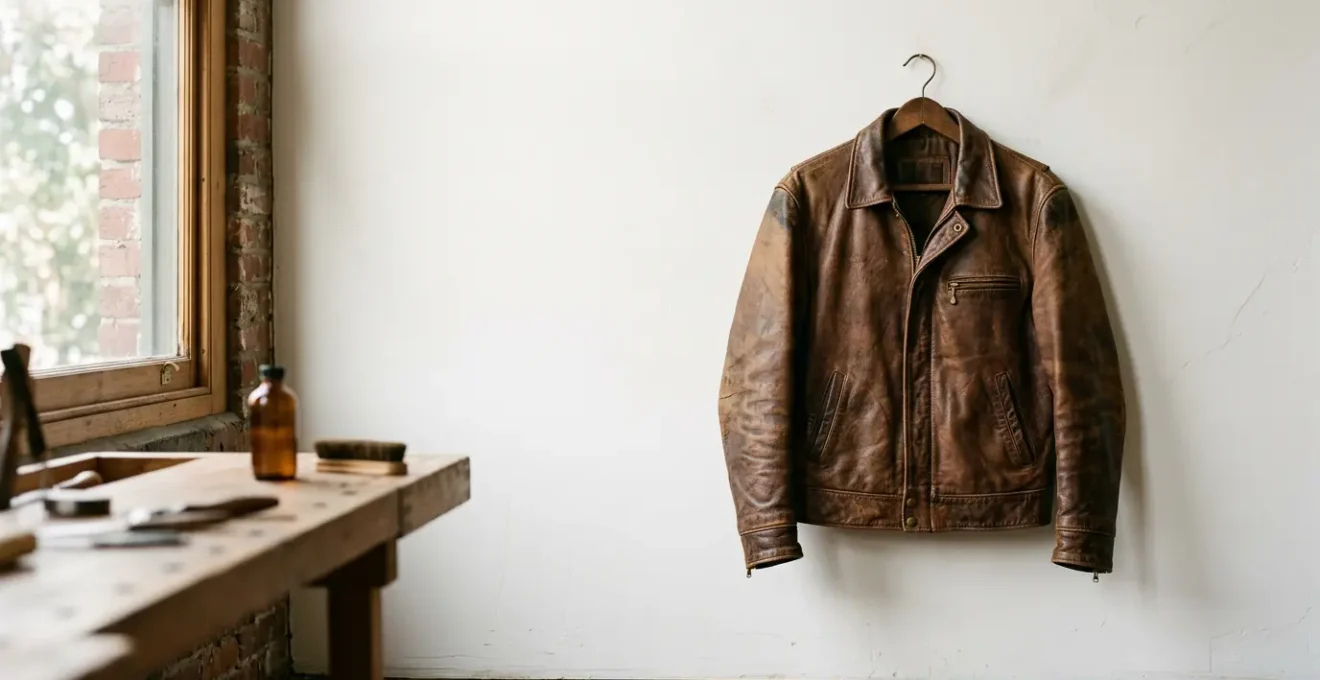
A quality leather jacket is a long-term asset; treating it as such is more economical and rewarding than repeatedly buying cheaper alternatives.
- The true cost of a jacket is measured in cost-per-wear over decades, not its initial price tag.
- Strategic maintenance focuses on preserving the material’s integrity through proper conditioning, storage, and proactive inspections.
- Understanding when to repair versus replace, and what defines quality stitching, is crucial for longevity.
Recommendation: Shift your mindset from simple ownership to active stewardship. By implementing a system of care, your jacket will not just survive, but evolve into a unique piece of personal armor.
A leather jacket is more than an article of clothing; for many, it’s a piece of armor, a second skin that tells a story. The desire to see this investment last a lifetime is natural. Yet, most advice on its care remains superficial, revolving around generic tips like wiping it with a damp cloth or applying a random conditioner. This approach misses the fundamental point: longevity isn’t achieved through occasional chores, but through a dedicated system of preservation.
This is not about simply cleaning a jacket. It’s about understanding the material science, mastering the art of storage, and developing an eye for structural integrity. The common wisdom tells you to protect it, but it rarely explains the philosophy of care that transforms a simple garment into a 20-year companion. The real secret lies not in what you do, but in the strategic mindset you adopt.
But if the real key wasn’t a list of tasks, but a deeper understanding of value, material, and structure? What if maintaining your jacket was less like laundry and more like managing a fine watch or a classic car? This guide will provide that system. By exploring principles from the worlds of fine footwear, tailoring, and workwear, we will build a complete framework for ensuring your leather jacket not only survives but thrives for decades, becoming a testament to quality and care.
This article provides a comprehensive system for extending the life of your leather jacket. Below, you will find a detailed breakdown of the key strategies, from initial purchase considerations to long-term preservation techniques.
Summary: How to Ensure Your Leather Jacket Becomes a 20-Year Heirloom
- Why Buying One $300 Pair of Boots Is Cheaper Than Four $80 Pairs?
- How to Polish Your Dress Shoes to a Mirror Shine in 15 Minutes?
- Plastic vs. Canvas Garment Bags: Which Protects Wool Better?
- The Moth Prevention Mistake That Could Eat Your Cashmere
- Repair or Replace: When Is a Cobbler Worth the Cost?
- Single vs. Double Stitch: Which Seam Holds Up in Workwear?
- How to Wash Your Dark Jeans to Prevent Fading for Years?
- How to Inspect a Garment’s Stitching to Guarantee It Lasts 5 Years?
Why Buying One $300 Pair of Boots Is Cheaper Than Four $80 Pairs?
The logic behind investing in quality footwear applies directly to a leather jacket: the true expense is revealed not by the initial price tag, but by the cost-per-wear over its lifetime. A man who views his wardrobe as armor understands that durability is the primary metric of value. A cheap, corrected-grain leather jacket may seem like a bargain, but it’s an economic fallacy. These garments often crack and peel within a few years, forcing a cycle of repeated replacement.
Consider the long-term arithmetic. As one case study shows, an $80 jacket replaced every three years costs a total of $533 over a 15-year period. In contrast, a single $300 full-grain leather jacket, properly cared for, will not only last that long but will also develop a rich patina, enhancing its character and value. The cost-per-wear plummets. When you factor in that high-end, full-grain leather pieces can retain up to 50% of their original price on the resale market, the cheaper jacket becomes an undeniable liability. The premium jacket is an asset.
This calculation of Total Cost of Ownership (TCO) is a core principle of asset preservation. It involves dividing the initial cost by the expected number of wears over its lifespan and adding projected maintenance expenses. For a premium jacket worn 45 times a year for 20 years, the cost can be as low as $0.33 per wear. The budget alternative, replaced multiple times, can easily exceed $1.78 per wear over the same period. The choice is clear: investing in quality from the start is the most fiscally responsible path to building a lasting wardrobe.
How to Polish Your Dress Shoes to a Mirror Shine in 15 Minutes?
The ritual of polishing dress shoes is about more than just a mirror shine; it’s a process of nourishing the leather and restoring its finish. For a leather jacket, the goal isn’t a reflective surface, but a deep, healthy luster that signals well-maintained material integrity. Applying a single, all-purpose product is a novice mistake. Just as fine shoes require different waxes and creams, a jacket’s longevity depends on a targeted application of specific care products.
Understanding the toolkit is the first step. A nourishing cream is the foundation, designed to restore the leather’s natural oils and prevent it from drying out and cracking. A pigmented polish is used more sparingly, like a targeted weapon, to restore color to high-wear areas like cuffs and seams. Finally, a finishing wax provides a protective barrier against the elements, best applied to areas of high exposure like the shoulders. Using the wrong product, or using it too frequently, can do more harm than good by clogging the leather’s pores.
This table outlines the distinct roles of key leather care products.
| Product Type | Purpose | Application Frequency | Best For |
|---|---|---|---|
| Nourishing Cream | Restore natural oils | Every 3-6 months | Full-grain leather health |
| Pigmented Polish | Color restoration | Annually or as needed | High-wear areas (elbows, cuffs) |
| Finishing Wax | Protection & luster | Twice yearly | Shoulders, back panel |
| Suede Protector Spray | Water resistance | Every 2-3 months | Suede & nubuck only |
The application process itself is a deliberate technique. After cleaning the surface, a lanolin-based conditioner should be worked into stress points. Hard waxes are reserved for specific areas to create dimensional highlights, not an all-over shine. Crucially, allowing a full 24 hours of drying time between conditioning and waxing is essential for proper absorption. This methodical approach ensures the jacket is protected and nourished, achieving a sophisticated luster that speaks of care, not a blinding, artificial shine.
Plastic vs. Canvas Garment Bags: Which Protects Wool Better?
The debate over garment bags for wool suits holds a critical lesson for leather jacket owners: breathability is non-negotiable. Wool, like leather, is a natural material that needs to breathe. Storing it in plastic is a death sentence, trapping moisture that leads to mildew and decay. While a canvas bag is superior for a suit, the principle translates directly to the long-term « hibernation » of your leather jacket. The most common and catastrophic storage mistake is sealing a jacket in a non-breathable container.
This paragraph introduces a complex concept. To well understand it, it is useful to visualize its main components. The illustration below breaks down this process.
As this image illustrates, every element of proper storage serves a purpose. The wide, shaped hanger prevents shoulder divots and maintains the garment’s structure. The breathable cotton bag shields from dust while allowing air circulation. And the cedar provides natural pest and moisture control. As leather experts warn, nearly 100% of jackets stored in plastic will eventually suffer moisture damage. This is not a risk; it is a certainty.
A 20-year preservation strategy demands a specific environment. The ideal closet is climate-controlled, maintaining a temperature between 60-70°F and a relative humidity of 45-55%. The jacket should hang on a wide-shouldered cedar hanger inside a breathable cotton bag, positioned away from direct sunlight or heat vents which can dry out and fade the leather. Adding untreated cedar blocks to the closet naturally repels pests and absorbs excess moisture and odors. This isn’t just storage; it’s creating a micro-environment engineered for preservation.
The Moth Prevention Mistake That Could Eat Your Cashmere
For a cashmere sweater, the visible threat is a moth. For a leather jacket, the enemies are often invisible and far more insidious: humidity, airborne pollutants, and chemical decay. A common mistake is to focus only on preventing physical damage while ignoring the environmental factors that slowly eat away at the leather’s structural integrity. This slow degradation is the « moth » that can consume your investment over time, and it is entirely preventable.
A prime example of this invisible threat is « red rot, » a form of irreversible chemical decay that affects vegetable-tanned leather. A case study documented a vintage jacket stored in a damp basement that developed this condition after only five years. The combination of high humidity and environmental pollutants accelerated the chemical breakdown of the leather’s structure, rendering it brittle and beyond repair. This demonstrates that climate control isn’t a luxury; it is the most critical component of 20-year preservation, protecting the very fibers of the material.
Guarding against these invisible threats requires a proactive, modern preservation kit. This isn’t about mothballs, but about precise environmental management. It’s a system designed to maintain equilibrium and catch any signs of deterioration early.
Checklist: Your Long-Term Leather Preservation System
- Humidity Control: Place silica gel packets in the storage area and replace them every 3 months to maintain a stable humidity level of 45-55%.
- Odor & Pest Management: Use untreated cedar blocks for natural, non-chemical odor absorption and pest deterrence.
- Bi-Annual Health Check: Conduct a thorough inspection every six months. Look for any signs of mold, dry patches, or fading from indirect light.
- Flexibility Test: Gently check the flexibility of the leather at key stress points like the shoulders, elbows, and along major seams.
- Preventive Conditioning: If any early signs of dryness are detected during your check-up, apply a targeted layer of lanolin-based conditioner to the affected area immediately.
This disciplined approach transforms jacket care from a reactive task to a proactive strategy. By controlling the environment and performing regular checks, you are not just preventing damage; you are actively managing the health of your asset.
Repair or Replace: When Is a Cobbler Worth the Cost?
The question of whether to repair or replace an item is a defining moment in an owner’s relationship with it. For an item of armor, retreat is not an option. Just as a man would take his fine boots to a skilled cobbler, a quality leather jacket deserves the attention of a leather specialist. The decision-making process, however, must be strategic. Some damage is terminal, while other « flaws » can be repaired to add character and extend the jacket’s life story.
A triage system is essential for making calculated maintenance decisions. Minor scuffs can often be buffed out at home with conditioner. More serious issues like a torn lining or a broken zipper require professional intervention but are almost always worth the cost, which typically ranges from $50 to $150. Even small tears in the leather itself can often be repaired invisibly by a specialist. The line is typically drawn at large tears (over 3 inches), widespread cracking from neglect, or advanced chemical decay like red rot. These conditions often signal that the material integrity is compromised beyond saving.
This guide helps determine the appropriate course of action for common types of damage.
| Damage Type | DIY Fix | Professional Repair | Terminal (Replace) |
|---|---|---|---|
| Minor Scuffs | ✓ Leather conditioner | – | – |
| Torn Lining | – | ✓ $50-100 | – |
| Broken Zipper | – | ✓ $75-150 | – |
| Small Tears | – | ✓ $100-200 | – |
| Large Tears (>3 inches) | – | – | ✓ |
| Advanced Red Rot | – | – | ✓ |
| Widespread Cracking | – | – | ✓ |
However, the decision isn’t always purely financial or practical. There is a philosophy of repair that values the history embedded in an object. As the experts at Taylor Stitch note, there’s a certain beauty in a well-executed repair. As they state in the Taylor Stitch Journal:
Some repairs, even if costly, add to the jacket’s story and character, like a Kintsugi philosophy for leather
– Taylor Stitch Leather Experts, Taylor Stitch Journal
A skillful repair becomes part of the jacket’s patina, a scar that tells a story of a battle won, reinforcing its status as personal armor.
Single vs. Double Stitch: Which Seam Holds Up in Workwear?
The heavy-duty demands of workwear teach a vital lesson: a garment is only as strong as its seams. While the quality of the leather itself is paramount, the stitching is the skeleton that holds the armor together. A single stitch, especially with low-quality thread, is a point of catastrophic failure waiting to happen. For a jacket intended to last 20 years, double-stitched or flat-felled seams at all major stress points are not a luxury, they are a minimum requirement.
This image captures the human element and precision required for high-quality seam construction.
The choice of thread is as important as the stitch itself. Cotton thread, while natural, will rot and break down over time, especially when exposed to moisture. The 20-year standard is a heavy-duty synthetic thread, typically polyester or nylon. According to industry quality control studies, heavy-duty synthetic thread can easily last over 15 years, outliving the weaker materials it might be holding together. Inspecting for this before purchase is a crucial act of due diligence.
A pre-purchase inspection should be as meticulous as reviewing a contract. You must check the stitch density, aiming for a minimum of 8-10 stitches per inch for robust construction. Verify the thread is synthetic by its slight sheen. Pay close attention to stress points: the armpits, pockets, and collar should all feature double stitching. Gently tugging on a seam should reveal no separation or give. Finally, look for evidence of reinforcement, such as bar-tacks at pocket corners and zipper ends. These small details are the hallmarks of a garment built for longevity, not for a single season.
How to Wash Your Dark Jeans to Prevent Fading for Years?
The goal with dark jeans is often to prevent fading and preserve their original, uniform color. With a high-quality leather jacket, the philosophy is the exact opposite. You are not preventing change; you are curating it. A well-cared-for jacket is expected to evolve, developing a unique patina—a subtle fading and darkening in high-contact areas—that reflects the wearer’s life. This process is a sign of quality, not a flaw to be corrected.
This embrace of aging is a core tenet of leather ownership. As the editorial team at Classy Leather Bags puts it, this transformation is a feature, not a bug. They observe in their guide:
The high-quality leather used in these jackets ages nicely, developing a distinct patina over time that adds to its character
– Classy Leather Bags Editorial Team, Ultimate Guide to Care and Maintenance
The goal of maintenance is to ensure this aging process is graceful, preventing the leather from drying out or cracking while allowing its character to emerge.
However, there is a difference between a desirable patina and unintentional damage or excessive color loss in a specific spot. In cases where color needs to be restored—for example, to repair a scuff or blend in a repair—a targeted approach is required. This is not an all-over dye job, but a precise, localized color restoration. The process involves selecting a matching pigmented cream, testing it on a hidden area, and applying it in thin, feathered layers to the affected spot only. This allows you to manage the jacket’s appearance without erasing the story its patina tells.
Key takeaways
- Invest, Don’t Spend: True value lies in cost-per-wear. A single high-quality jacket is a better long-term financial asset than a series of cheaper replacements.
- Storage Is Strategy: The single most important factor for 20-year longevity is proper storage—a breathable environment with controlled climate and structural support.
- Repair Is Character: Differentiate between terminal damage and repairable « scars. » Skillful repairs add to the jacket’s story and are a mark of a dedicated owner.
How to Inspect a Garment’s Stitching to Guarantee It Lasts 5 Years?
The five-year standard for a garment is a low bar. It accepts compromises: top-grain leather instead of full-grain, polyester linings, and single-stitched seams. This is the mindset of disposability. To build a piece of armor that lasts 20 years, you must adopt a far more rigorous inspection standard, one that scrutinizes every component for its potential to endure for decades, not just seasons. This is the ultimate synthesis of your knowledge as a discerning owner.
The difference between a 5-year and a 20-year garment is stark when you know what to look for. It’s in the choice of hardware—premium YKK or RiRi zippers versus unbranded alloys. It’s in the lining material, where silk or high-grade cotton replaces thin polyester. And it’s in the structural reinforcement at stress points, where triple-stitching signifies a commitment to longevity. This table codifies the difference between merely acceptable and truly exceptional.
| Component | 20-Year Standard | 5-Year Standard | Failure Indicators |
|---|---|---|---|
| Leather Quality | Full-grain only | Top-grain acceptable | Bonded/corrected grain |
| Hardware | YKK/RiRi zippers | Branded zippers | Unbranded/plastic |
| Lining | Silk/high-grade cotton | Polyester blend | Thin polyester |
| Stress Points | Triple-reinforced | Double-stitched | Single stitch only |
| Thread Type | Heavy polyester | Standard nylon | Cotton thread |
Achieving a 20-year lifespan requires moving from a pre-purchase inspection to a proactive, lifelong maintenance schedule. This is not a set-it-and-forget-it purchase. In the first five years, quarterly conditioning and monthly visual checks are sufficient. As the jacket ages, the focus shifts to structural health: bi-annual checks of seam integrity from years six to ten, followed by professional inspections of hardware and major seams as it crosses the 15-year mark. Budgeting for this preventive care is part of the ownership philosophy—an annual investment of $50-100 ensures the jacket remains in prime condition.
Your leather jacket is a long-term commitment. It is a dynamic object that will change with you over the years. By adopting this strategic framework of care—viewing it as an asset, understanding its material needs, and committing to its structural health—you ensure it will not just last, but become a richer, more meaningful piece of your personal story. Start treating it as the piece of armor it is, and it will serve you faithfully for decades to come.