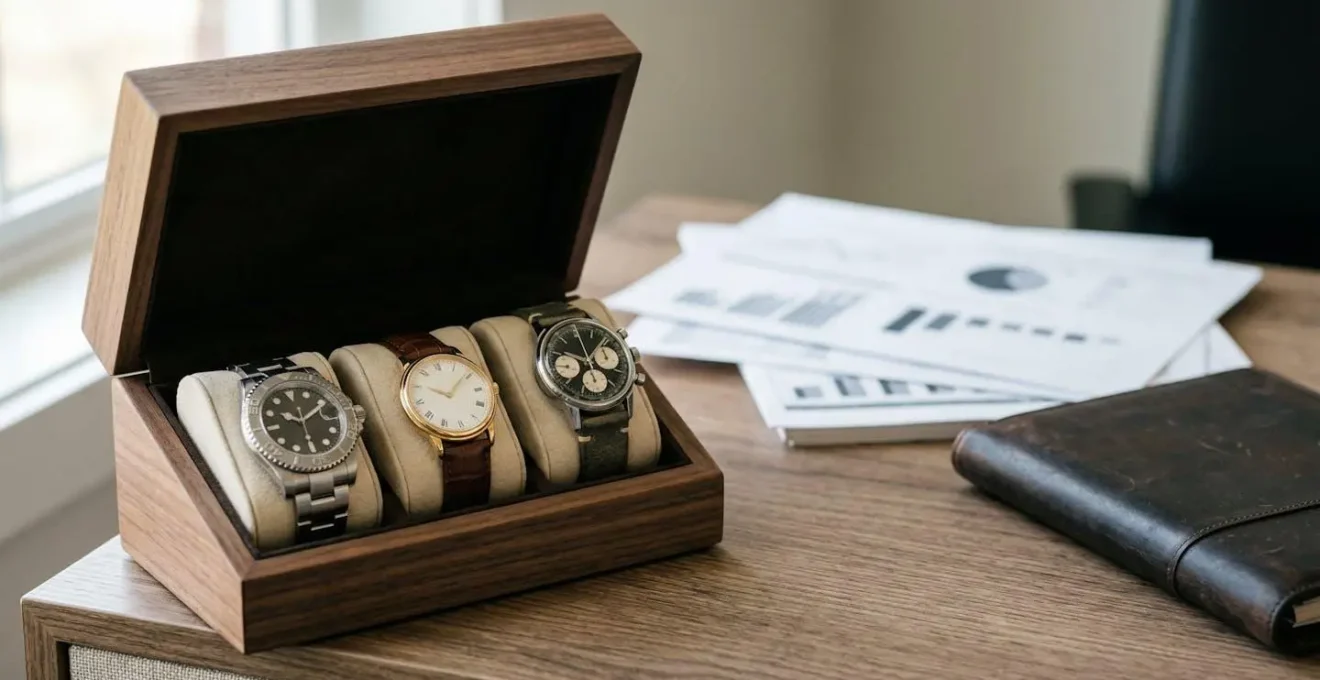
Acquiring luxury goods for value retention is an asset management discipline, not a shopping spree; success hinges on a portfolio-based financial framework.
- True value is found in intrinsic quality (e.g., full-grain leather, mechanical movements) and timeless design, which consistently outperform seasonal trends.
- Risk mitigation through rigorous authentication, diligent care, and proper storage is a non-negotiable component of protecting the asset’s future resale value.
Recommendation: Calculate an item’s true cost by amortizing its price over its projected lifespan (cost-per-wear/use), not by its initial purchase price.
For the discerning investor, diversifying a portfolio with tangible assets is a proven strategy. However, when entering the world of luxury goods, many apply a consumer mindset to what should be a disciplined investment analysis. The common advice—to buy certain brands or look for limited editions—scratches only the surface and often mistakes market hype for fundamental value. This approach is akin to buying stocks based on headlines rather than on a company’s balance sheet.
The key to building a collection of luxury goods that not only provides utility but also holds or increases its value lies in shifting perspective. One must move beyond the role of a consumer and adopt the mindset of a luxury asset manager. This involves understanding the economic principles that underpin value, mitigating risks associated with authenticity and condition, and applying financial metrics like amortization to every potential acquisition. It requires a framework that evaluates an item not for its brand prestige alone, but for its durability, timelessness, and long-term market performance.
This guide abandons platitudes and provides a financial framework for acquiring luxury assets. We will dissect the factors that separate a depreciating purchase from a appreciating investment, from the granular details of leather quality to the macroeconomic trends affecting the watch market. The objective is to equip you with the analytical tools to build a portfolio of tangible assets that stand the test of time, both physically and financially.
Summary: A Strategic Framework for Acquiring Value-Retentive Luxury Assets
- Why Is a Vintage Rolex a Better Investment Than a Savings Account?
- How to Spot a ‘Superfake’ Designer Bag Without a Professional?
- Full Grain vs. Genuine Leather: Which Briefcase Lasts a Lifetime?
- The ‘Seasonal Color’ Mistake That Kills Resale Value
- How to Store Leather Shoes to Prevent Cracking and Mold?
- Navy Blazer or Grey Suit: Which Should Be Your First Major Investment?
- How to Amortize the Cost of a $1000 Coat Over 10 Winters?
- Which ‘Buy It For Life’ Boots Are Worth the $400 Price Tag?
Why Is a Vintage Rolex a Better Investment Than a Savings Account?
In a low-interest-rate environment, the opportunity cost of holding cash in a savings account can be significant. While traditional equities offer growth potential, tangible assets like luxury watches present a unique proposition for portfolio diversification. The case of certain vintage Rolex models provides a compelling data point. These are not just timepieces; they are non-correlated assets whose value is driven by a distinct set of factors including brand heritage, scarcity, and sustained demand from a global collector base.
The financial performance can be striking. For example, certain Rolex Daytona models have demonstrated phenomenal appreciation. Analysis from HIM Business School highlights a specific model experiencing a 260% increase from an initial price of $11,300 to over $30,000 in a few years. This level of return fundamentally challenges the notion of a watch as a mere depreciating consumer good. It repositions it as a hard asset capable of significant capital appreciation.
However, a granular analysis is crucial. A broad study of the market shows that while luxury watches as a category outperformed fixed income and real estate, their average annual return (5.68%) still trailed U.S. stocks (12.85%). The key takeaway is that performance is highly concentrated in top-tier brands like Audemars Piguet and Patek Philippe, which matched stock market returns, while other brands saw negative performance. Therefore, successful watch investing requires the same diligence as stock picking: a focus on blue-chip assets with proven long-term performance.
A vintage Rolex is not simply a purchase; it’s an allocation of capital to an asset class with a unique risk-reward profile, one that has historically offered a hedge against inflation and a potential for substantial growth, far outstripping traditional cash savings.
How to Spot a ‘Superfake’ Designer Bag Without a Professional?
In asset management, mitigating risk is paramount. When investing in luxury goods like designer bags, the most significant risk is not market fluctuation but authenticity. The rise of « superfakes »—counterfeits so convincing they can deceive casual observers—has made due diligence a non-negotiable step in the acquisition process. Acquiring a counterfeit, even unknowingly, results in a 100% loss of the intended investment value. Therefore, developing a trained eye for key details is a critical risk management skill.
While professional authentication is the gold standard, an investor can perform a robust preliminary analysis by focusing on material and construction. Counterfeiters often cut corners on elements they assume buyers will overlook. Examine hardware like zippers, clasps, and chains; genuine articles have a specific weight, finish, and smoothness of operation that is expensive to replicate. Stitching is another crucial tell. Luxury brands invest in precision, and any inconsistency in spacing, angle, or thread quality is a major red flag.
The image above highlights the level of detail required. Note the uniform tension of the thread and the clean, consistent channels the stitches lie in. This precision is an indicator of value. Beyond visual inspection, simple research can uncover many fakes. A common tactic for counterfeiters is to create « fantasy » pieces—a bag in a color or material combination the brand never officially produced. A quick search of the brand’s official archives or reputable fan forums can quickly disqualify such items. Pay close attention to typography on labels and care tags; grammatical errors or incorrect fonts are an easy giveaway.
Ultimately, spotting a superfake is a process of systematic inspection. It’s about knowing where costs are cut in illicit production and focusing your scrutiny on those specific areas: material quality, hardware weight, stitching precision, and brand-specific details.
Full Grain vs. Genuine Leather: Which Briefcase Lasts a Lifetime?
An investor understands that the true value of an asset is often tied to its intrinsic quality and longevity, not its branding. In the world of leather goods, this principle is perfectly illustrated by the distinction between « Full Grain » and « Genuine » leather. These are not just marketing terms; they represent fundamentally different raw materials with vastly different performance and aging characteristics. A briefcase is a daily tool, and its ability to withstand wear and improve with age is a direct measure of its investment quality.
Full-grain leather is the highest grade available. It is made from the outermost layer of the hide and is left untreated, preserving the natural grain, pores, and markings. This makes it incredibly strong and durable. Over time, instead of wearing out, it develops a desirable patina—a soft sheen that enhances its character and value. In contrast, « genuine leather, » despite its misleading name, is typically a lower-quality product. It is often made from the inner layers of the hide, and its surface is sanded down to remove imperfections, then painted or coated to create a uniform appearance. This artificial surface is prone to cracking and peeling over time, and it cannot be repaired effectively.
The following table provides a clear financial and qualitative comparison for an investor deciding on a long-term asset.
| Characteristic | Full Grain Leather | Genuine Leather |
|---|---|---|
| Aging Process | Develops desirable patina | Cracks and peels over time |
| Durability | Lasts decades with care | 5-10 years typical lifespan |
| Surface Treatment | Natural, untouched grain | Corrected and painted |
| Price Point | Premium ($400-1000+) | Budget ($100-300) |
| Tanning Method | Often vegetable-tanned | Usually chrome-tanned |
| Repairability | Easily restored and repaired | Difficult to repair once damaged |
From an investment standpoint, the choice is unequivocal. While a full-grain leather briefcase requires a higher initial capital outlay, its superior durability and repairability mean it can last for decades, making its amortized cost per year significantly lower than that of a « genuine leather » piece that will need replacement. It is a classic case of buying a superior asset once versus an inferior one multiple times.
The ‘Seasonal Color’ Mistake That Kills Resale Value
In any market, a key to successful investing is distinguishing between fleeting trends and long-term fundamental value. This is especially true in luxury goods, where manufacturers use seasonal collections and hyped-up colorways to drive short-term sales. For the asset-minded buyer, chasing these trends is a significant financial error. While a brightly colored, of-the-moment handbag or watch dial might offer a short-term thrill, its value on the secondary market is almost guaranteed to plummet once the season ends.
The highest and most stable resale values are consistently found in items from a brand’s core collection, often referred to as « classic » or « permanent » pieces. These are typically offered in neutral, timeless colors like black, navy, beige, or metallic finishes. Brands manage the supply of these core items carefully and implement steady annual price increases, which creates a rising floor for the resale market. A classic black Chanel flap bag or a black-dial Rolex Submariner are not just accessories; they are index-like assets that track the brand’s long-term value appreciation.
Case Study: Scarcity and Timeless Design (Patek Philippe Nautilus 5711)
The power of a classic design combined with controlled scarcity is best exemplified by the Patek Philippe Nautilus 5711. Its discontinuation sent shockwaves through the market, demonstrating how a brand’s strategic decision can create immense value. According to analysis from HIM Business School, a Nautilus acquired for $23,000 in 2015 surged to over $100,000. This wasn’t due to a trendy color, but because it was a classic, iconic design whose supply was abruptly terminated, making existing pieces exponentially more desirable as long-term holdings.
An investor should view seasonal items with extreme skepticism. They are, by design, perishable goods from a value perspective. The prudent strategy is to allocate capital to timeless designs in classic colorways. These pieces function as a more stable store of value, are more liquid on the secondary market, and are the most likely to benefit from the brand’s overall appreciation over time.
How to Store Leather Shoes to Prevent Cracking and Mold?
An investment is only as good as its condition upon liquidation. For tangible assets like high-quality leather footwear, proper storage is not a matter of tidiness but of asset preservation. Leather is an organic material susceptible to environmental damage. Improper storage can lead to irreversible cracking, drying, deformation, and mold growth, effectively wiping out the item’s resale value. A $1,000 pair of Goodyear-welted shoes can be rendered worthless in a single season if neglected.
The primary enemies of leather are moisture, dryness, and light. Storing leather shoes in a sealed plastic box or bag is a common but catastrophic mistake. This traps moisture, creating a perfect breeding ground for mold and mildew. Conversely, storing them near a heat source or in direct sunlight will dry out the leather’s natural oils, leading to brittleness and cracking. The ideal storage environment is a cool, dry, and dark place with good air circulation. A closet is generally suitable, provided it is not overly humid.
Beyond the environment, the use of proper tools is essential. Unvarnished cedar shoe trees are the single most important investment for preserving leather footwear. Cedar naturally absorbs excess moisture and odor while the shape of the tree helps the shoe maintain its form, preventing the leather from creasing and collapsing as it dries. Before any long-term storage, the shoes must be thoroughly cleaned and conditioned to replenish the leather’s oils. Following a strict protocol is key to long-term value preservation.
Action Plan: Long-Term Leather Asset Preservation Protocol
- Thorough Cleaning: Remove all surface dirt and old polish with an appropriate leather cleaner to prepare the pores.
- Deep Conditioning: Apply a quality leather conditioner to deeply moisturize the hide, preventing it from drying out and cracking.
- Shape Maintenance: Insert unvarnished cedar shoe trees immediately after wear to absorb moisture and maintain the shoe’s structure.
- Breathable Storage: Place shoes in breathable fabric bags (never plastic) to protect from dust while allowing air to circulate.
- Environmental Control: Store in an environment with humidity below 60% and away from any direct light or heat sources.
Treating storage as an active part of your investment strategy ensures that when it is time to sell or pass on the asset, it is in optimal condition, thus realizing its maximum potential value.
Navy Blazer or Grey Suit: Which Should Be Your First Major Investment?
When building a portfolio of foundational wardrobe assets, the first major allocation of capital requires careful analysis. The choice between a navy blazer and a grey suit is a classic dilemma, but for the investor-minded individual, the decision should be driven by metrics of versatility and cost-per-wear. Both are valuable assets, but they serve different functions and offer different rates of return in terms of utility. The goal is to acquire the asset that provides the maximum number of high-value usage opportunities for the initial capital outlay.
A grey suit is a powerful, specialized tool. It excels in formal and conservative professional environments (finance, law) and is essential for specific occasions like important meetings or formal events. However, its utility is constrained. A suit is a single entity; while it can be varied with different shirts and ties, it is fundamentally perceived as « the grey suit. » Separating the jacket and trousers is often possible but can lead to uneven wear and may not always be stylistically successful.
The navy blazer, in contrast, is a master of versatility. It functions as a « bridge » garment, capable of being dressed up with grey flannel trousers and a tie or dressed down with chinos, jeans, or even tailored shorts. It can navigate a vast range of social and professional settings, from business casual to a smart weekend outing. This high degree of interchangeability means the number of distinct, appropriate outfits one can create is exponentially higher than with a suit. This directly impacts its cost-per-wear, driving it down significantly faster than a suit that may only be worn a few times a month.
The following table breaks down the investment case for each.
| Factor | Navy Blazer | Grey Suit |
|---|---|---|
| Versatility Score | 9/10 (dress up or down) | 7/10 (primarily formal) |
| Cost Per Wear (1st year) | Lower (more occasions) | Higher (formal only) |
| Professional Settings | Business casual, creative fields | Conservative (finance, law) |
| Outfit Combinations | 15+ distinct looks | 8-10 variations |
| Investment Range | $500-$1500 | $800-$2500 |
| Longevity Risk | Timeless style | Subject to fit trends |
For the first major investment, the navy blazer presents the superior case from a utility and ROI perspective. It is the more liquid asset in a wardrobe portfolio, offering a far greater return on the initial investment through its sheer versatility and the resulting low cost per wear.
How to Amortize the Cost of a $1000 Coat Over 10 Winters?
A $1,000 price tag on a coat can seem prohibitive if viewed as a simple expense. However, an investor reframes this as a capital expenditure on a long-term asset. The concept of amortization—spreading the cost of an asset over its useful life—is the correct financial model to apply. A high-quality coat is not a single-season purchase; it is a piece of functional equipment designed to provide service for a decade or more. Its true cost is not the initial price but the cost per year, or even per wear.
The calculation is simple but powerful: Cost / Years of Service = Annual Cost. A $1,000 coat with a conservative 10-year lifespan has an annual cost of $100. If worn 50 times each winter, the cost-per-wear is just $2. This contrasts sharply with a $200 coat that may only last two seasons, resulting in the same $100 annual cost but with inferior performance, materials, and aesthetic value. The more expensive coat, when properly amortized, often proves to be the better value.
This long-term perspective is validated by the broader market, which continues to show robust growth. In fact, the luxury watch market is projected to grow from $53.69 billion in 2024 to $134.53 billion by 2032, indicating sustained confidence in high-value tangible goods. When making such a purchase, the key is financial discipline. As investor Kevin O’Leary advises, this is a cash-flow-positive activity. It should not be financed with debt.
The real rule is — never borrow money to buy a watch, ever. Just buy a watch you can afford
– Kevin O’Leary, Investment advice on luxury purchases
By amortizing the cost, the investor can accurately assess the long-term value proposition. The focus shifts from the intimidating initial outlay to the manageable annual cost and the exceptionally low cost-per-wear. This financial framework transforms a seemingly extravagant purchase into a rational, long-term investment in quality and durability.
Key Takeaways
- Treat luxury acquisitions as a form of asset management, applying financial discipline and a portfolio approach rather than a consumer mindset.
- Prioritize intrinsic value—determined by material quality, construction, and timeless design—over transient branding and seasonal hype to ensure long-term value retention.
- Calculate an item’s true cost through cost-per-wear amortization, and actively mitigate risk through authentication and diligent care to protect your tangible assets.
Which ‘Buy It For Life’ Boots Are Worth the $400 Price Tag?
The « Buy It For Life » (BIFL) ethos is compelling for an investor, as it implies an asset with an almost infinite lifespan and, therefore, an exceptionally low amortized annual cost. In the context of a $400 pair of boots, this promise is typically tied to superior materials and, most importantly, a specific method of construction: the Goodyear Welt or Stitchdown. These methods, which stitch the sole to the upper, allow the boots to be resoled multiple times, dramatically extending their functional life far beyond cheaper, cemented-sole footwear.
However, the prudent investor must recognize that « Buy It For Life » refers to an item’s functional utility, not necessarily its financial value as a appreciating asset. The market for tangible goods is subject to the same forces of supply and demand, and even « safe » assets can experience volatility and price corrections. Believing that a high price tag and durable construction are a guarantee of positive financial returns is a dangerous oversimplification.
A cautionary tale comes from the luxury watch market, often considered the pinnacle of BIFL investing. Even this sector is not immune to market corrections.
Market Volatility in ‘Safe’ Assets: The ChronoPulse Index Correction
After a period of unprecedented growth, the secondary watch market faced a significant downturn. According to the ChronoPulse Watch Index, prices began to fall after peaking in March 2022. The data is stark: the Rolex Index has dropped 19% from its peak, while the Patek Philippe Index is down more than 40%. This demonstrates that even the most coveted, « blue-chip » tangible assets are not immune to market volatility and speculative bubbles. « Buy It For Life » does not mean « Value Goes Up Forever. »
Therefore, a $400 pair of Goodyear-welted boots is worth the price tag if the buyer’s primary goal is to acquire a durable, repairable, and long-lasting piece of footwear, resulting in a low cost-per-wear over a decade. It is a sound investment in personal utility. However, it should not be confused with a financial instrument guaranteed to appreciate. The investor must factor in market risk and purchase the asset for its quality and function first, with any potential resale value being a secondary consideration.
Frequently Asked Questions About Investing in Luxury Goods
Should I stick to just established brands like Rolex?
While Rolex and Patek Philippe are excellent blue-chip choices for stability, a diversified portfolio might include assets from emerging independent watchmakers or under-the-radar models. These can carry higher risk but also offer the potential for greater percentage gains as they gain market recognition.
What construction method ensures boots can be resoled?
Look for boots made with either Goodyear Welt or Stitchdown construction. Both of these methods involve stitching the sole to the upper of the boot, which allows a cobbler to easily remove the old sole and attach a new one. This dramatically extends the boot’s life compared to cemented construction, which is essentially disposable and cannot be repaired.
How do I calculate true cost per wear?
The most accurate formula for true cost per wear is: (Purchase Price + Estimated Total Maintenance Costs – Estimated Final Resale Value) / (Number of Wears per Year x Number of Years of Use). This provides a comprehensive view of the asset’s lifetime cost, factoring in all financial variables.