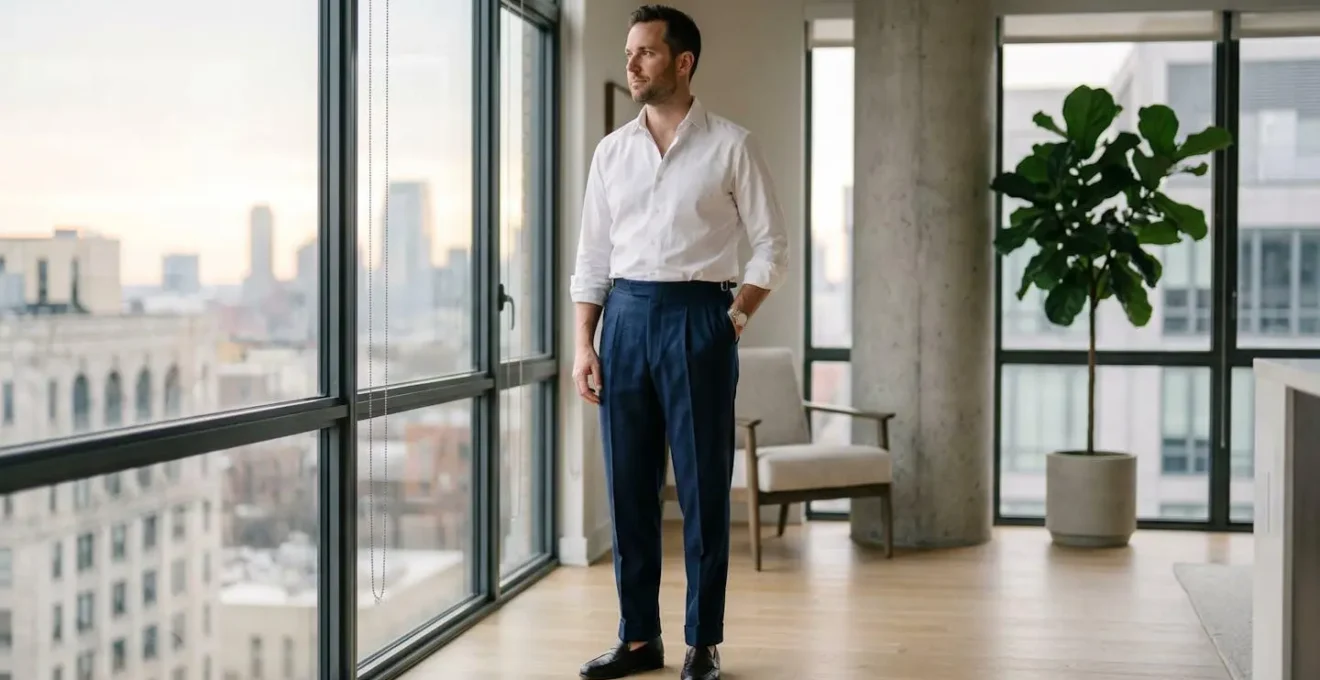
The fear of looking dated in high-waisted trousers is misplaced; the key isn’t avoiding a vintage cut, but mastering modern principles of proportion and architectural elegance.
- Success lies in managing the overall silhouette—pairing a high waist with a tapered leg and an unstructured jacket.
- Authenticity comes from integrating one trend piece at a time and mastering ‘sprezzatura’, or deliberate imperfection.
Recommendation: Shift your mindset from following rules to building a silhouette. Start by finding a pair of pleated trousers that sit at your natural waist and lay flat when you stand.
The high-waisted trouser is undeniably back, striding confidently from the runways into the modern man’s wardrobe. Yet, for every style enthusiast intrigued by its return, there’s a nagging fear: the spectre of looking less like a contemporary icon and more like a cherished grandfather. Many articles will give you a simple checklist: tuck in your shirt, wear a belt, choose the right shoes. While correct, this advice barely scratches the surface and misses the fundamental point.
The real challenge isn’t about the trousers themselves, but the context in which they are worn. The ultra-low-rise tyranny of the 2000s conditioned our eyes to a specific silhouette. Re-adopting a higher waistline requires more than just a new pair of pants; it demands a complete recalibration of proportion and an understanding of sartorial history. But what if the secret to modernizing this classic piece wasn’t about slavishly following vintage rules, but about understanding the principles that made it timeless in the first place, and then artfully breaking them?
This guide moves beyond the basics. We will deconstruct the comeback of pleated trousers, explore the cyclical nature of trends, and reveal the critical mistakes that make you look like a mannequin. Most importantly, we will delve into the Italian concept of ‘sprezzatura’—the art of effortless style—to show you how to truly own the look. By focusing on the ‘why’ behind the ‘how’, you’ll learn to use the high-waist as a tool for architectural elegance, crafting a look that is both classic and unequivocally modern.
This article provides a comprehensive roadmap, from understanding the trend’s origins to mastering the subtle details that define truly personal style. Below, you will find a guide to each crucial element.
Summary: A Modern Guide to Classic Trousers
- Why Are Pleated Pants Making a Comeback in Modern Menswear?
- Why Do Certain Men’s Fashion Trends Return Every 20 Years?
- The ‘Full Runway Look’ Mistake That Makes You Look Like a Mannequin
- How to Master ‘Sprezzatura’ and Look Effortlessly Stylish?
- Why Are Shoulder Pads Disappearing from Modern Jackets?
- How to Use a Silk Scarf to Elevate a Simple Jacket and Jeans Combo?
- Earth Tones or Pastels: Which Trend Palette Suits Pale Skin Best?
- When to Buy a Winter Coat to Get the Best Selection and Price?
Why Are Pleated Pants Making a Comeback in Modern Menswear?
The return of the pleated pant is not merely a nostalgic whim; it’s a direct response to a collective style fatigue. For years, menswear was dominated by the ultra-slim, restrictive silhouette. The comeback of pleats signals a significant shift towards what Mr Porter Style Director Olie Arnold calls « a more relaxed and functional offering. » This isn’t just about aesthetics; it’s a movement towards comfort, elegance, and a more forgiving shape. The pleats themselves add a small amount of extra fabric, allowing for greater freedom of movement and a more graceful drape—a welcome change from the painted-on trousers of the last decade.
This trend has been building steadily; high-waisted trousers have been featured by major designers for over three seasons, cementing their place as a modern staple, not a fleeting fad. The key to wearing them today is understanding that modern pleats are different. They are part of a trouser that is tailored and often tapered, creating an elegant line that elongates the leg rather than adding bulk. The higher waistline acts as a new visual anchor, redefining the wearer’s proportions for a more statuesque and put-together appearance.
Choosing the right style is crucial. Not all pleats are created equal, and the direction they face can subtly alter your silhouette. To get it right:
- Forward-facing (British) pleats: These point inwards towards the fly and create a cleaner, more continuous line, which can have a slimming effect. They are ideal if you have a fuller midsection.
- Reverse (Italian) pleats: These face outwards towards the pockets, offering a more relaxed feel and easier access to pockets. This style is synonymous with the ‘sprezzatura’ vibe.
- Fit is paramount: The pleats should lie flat when you are standing. If they pull open, the trousers are too tight, and you should size up to maintain the intended drape.
- Modern cut: Always pair pleated trousers with a tapered leg. This avoids the baggy, triangular shape of 80s and 90s versions and ensures the look is contemporary. The waistband should sit at your natural waist, typically around the navel, for the proportions to work correctly.
Why Do Certain Men’s Fashion Trends Return Every 20 Years?
The cyclical nature of fashion is often dismissed as arbitrary, but the 20-year rule has a strong basis in cultural psychology and generational shifts. Each new generation of young adults, upon gaining cultural and economic influence, tends to look back not to their parents’ style—which often feels too close and dated—but to their grandparents’ era. This two-generation gap provides enough distance for a style to feel fresh, romantic, and ripe for reinterpretation. What was once the uniform of a past generation becomes a source of inspiration, free from recent associations.
The revival of the high-waisted trouser is a perfect example of this phenomenon. It represents a conscious rejection of the casual, low-slung, and often sloppy aesthetic that defined the early 2000s. Today’s style enthusiasts are rediscovering the masculine elegance of mid-century icons like Marlon Brando or Cary Grant, whose style has been re-injected into the modern consciousness through streaming services and archival fashion accounts. However, this is not a simple copy-and-paste revival. The modern interpretation is crucial; today’s high-waisted trousers feature lighter fabrics, a more tapered leg, and are worn with a contemporary sensibility that distinguishes them from their historical counterparts.
As this side-by-side comparison shows, the core concept remains, but the execution is entirely different. The silhouette management is updated for today’s tastes. The older version might be paired with a boxy jacket and heavy leather shoes, while the modern look favors an unstructured blazer, a simple knit, or even a high-quality t-shirt and clean sneakers. It’s this thoughtful re-contextualization that prevents the trend from becoming a costume and instead transforms it into a powerful statement of personal style.
The ‘Full Runway Look’ Mistake That Makes You Look Like a Mannequin
One of the quickest ways to nullify personal style is to adopt a ‘full runway look.’ Wearing a single designer’s head-to-toe outfit, exactly as presented, transforms you from a person with style into a walking advertisement. It communicates a lack of confidence and creativity, suggesting you’re borrowing a personality rather than expressing your own. True style is about curation—selecting individual pieces that speak to you and integrating them into your existing wardrobe to create a look that is uniquely yours.
High-waisted trousers, being a statement piece, are particularly susceptible to this mistake. When paired with other overtly « trendy » or period-specific items, the entire outfit can feel like a costume. The goal is to ground the trend with timeless, familiar basics. A pair of well-fitting pleated trousers can look incredibly sharp with a simple white t-shirt, a worn-in denim jacket, or a classic navy blazer. This high-low mix creates a contextual dissonance that is intentional and interesting, rather than the flat harmony of a pre-packaged look.
As style writer Chris Gove wittily noted in a FashionBeans interview, « The high-waisted trouser hasn’t stopped Simon Cowell from taking over pop music. However baggy and bootcut is not an advisable way for anyone else to wear. » This highlights the importance of modern interpretation over slavish imitation. The key is to filter trends through your own personal lens.
Your Action Plan: The One-Trend Rule
- Isolate the Trend: Incorporate only one major statement piece per outfit, such as the high-waisted trousers. Let that be the focus.
- Ground with Basics: Pair the trend piece with classic, familiar items from your wardrobe, like a white tee, a simple knit sweater, or a denim jacket.
- Inject Personality: Add personal ‘imperfections’ that make the look your own—a vintage watch, a well-worn leather belt, or casually rolled sleeves.
- Build Interchangeably: Focus on building a core wardrobe where most pieces work together. This makes integrating a new trend piece seamless.
- Filter, Don’t Follow: Develop your core silhouette and color palette first. Then, filter new trends through that framework, adopting only what truly enhances your style.
How to Master ‘Sprezzatura’ and Look Effortlessly Stylish?
The concept of ‘sprezzatura’ is the perfect antidote to the rigid, mannequin-like perfection we just discussed. It is the secret ingredient that transforms a well-dressed man into a stylish one. First defined in 1528, it is a quintessentially Italian art form.
A certain nonchalance, so as to conceal all art and make whatever one does or says appear to be without effort and almost without any thought about it.
– Baldassare Castiglione, The Book of the Courtier (1528)
In modern menswear, sprezzatura translates to deliberate imperfection. It’s the practice of looking perfectly put-together, and then intentionally introducing a minor, almost careless flaw. This small act of rebellion against sartorial rigidity breathes life and personality into an outfit. It’s the difference between looking ‘dressed up’ and looking ‘well-dressed’. It suggests that you are so comfortable in your clothes and your own skin that you don’t need to strive for immaculate perfection.
Mastering sprezzatura requires practice. The ‘imperfections’ must feel authentic, not contrived. An overly calculated « undone » button can look just as try-hard as a perfectly symmetrical tie knot. The key is to start with small, subtle gestures and find what feels natural to you. It’s about a mindset of ease, not a checklist of actions, but a few classic examples can help you begin:
- Leave the buttons on your button-down collar unfastened.
- Fasten only one buckle on a pair of monk-strap shoes.
- Wear your tie with a slightly asymmetrical or loosened knot.
- Roll your shirt sleeves to slightly different lengths.
- Tuck a pocket square into your jacket pocket without precise, sharp folds.
- Mix formal and casual pieces, like a tailored blazer with a pair of quality jeans.
The final, and most important, step is to practice these combinations until they feel like second nature. The goal is to forget you’re even doing it—that is the essence of true sprezzatura.
Why Are Shoulder Pads Disappearing from Modern Jackets?
The decline of the heavily padded shoulder in menswear is directly linked to the rise of concepts like sprezzatura and the overall shift towards a more natural, comfortable silhouette. For decades, particularly in the 1980s, the padded shoulder was a symbol of power and status—an artificial way to broaden a man’s frame. Today, that kind of overt structural enhancement can look dated and stiff. Modern elegance is about projecting confidence from within, not manufacturing it with foam and canvas.
This movement has been championed by Italian tailoring, specifically the Neapolitan school. The « Neapolitan Shoulder Revolution » pioneered the unstructured jacket, stripping away padding, lining, and heavy canvassing to create a garment that is light, breathable, and moves with the body. The hallmark of this style is the spalla camicia, or « shirt shoulder. » This construction technique features a soft, natural shoulder line with little to no padding, allowing the jacket to drape over the shoulder like a well-made shirt. This creates a silhouette that is sophisticated and hints at structure without ever feeling restrictive.
This softer shoulder is the perfect partner for high-waisted trousers. A rigid, boxy jacket creates a jarring contrast with the higher waistline, resulting in a top-heavy and unbalanced look. An unstructured jacket, however, creates a fluid, continuous line from the shoulder to the waist, complementing the architectural elegance of the trousers. To identify quality soft-shoulder construction, look for jackets where the shoulder follows your natural line without extending past it, and ensure it moves easily with your body. Opt for breathable fabrics like linen or cotton blends and look for high armholes, which improve both mobility and drape.
How to Use a Silk Scarf to Elevate a Simple Jacket and Jeans Combo?
A silk scarf is one of the most effective tools for injecting personality and a touch of sprezzatura into an otherwise simple outfit. It’s a small detail that can have a major impact, elevating a standard jacket and jeans from ordinary to exceptionally stylish. The key, as with all powerful accessories, is restraint and thoughtful execution. The goal is to add a point of interest, not to overwhelm the look. Italian style icons have mastered this, using scarves and pocket squares to add a pop of color that creates distinction without looking forced.
The modern way to wear a scarf is with a sense of casualness. Overthinking the knot or choosing a fabric that is too shiny or flamboyant can quickly steer the look into garish territory. The art lies in making it seem like an afterthought, even though it’s a deliberate choice. A simple, loosely looped knot is often all that is needed. The scarf can serve as a color anchor, picking up on a subtle color in your socks, pocket square, or even the watch on your wrist, tying the whole look together cohesively.
For those new to wearing scarves, it’s best to start with subtle options and classic techniques:
- Start with muted patterns: Begin with small geometric prints or a subtle paisley. Solid navy or burgundy are also foolproof starter options.
- Master the simple knot: The ‘Parisian’ knot, where the scarf is folded in half, looped around the neck, and the loose ends are pulled through the loop, is a classic for a reason. Wear it loosely.
- Choose the right fabric: A blend of wool and silk offers a beautiful texture and drape without the excessive shine of pure, cheap silk.
- Practice asymmetry: Allow the ends of the scarf to hang at slightly different lengths. This subtle imperfection is a hallmark of sprezzatura.
By starting with these foundational techniques, you can begin to experiment with more confidence, eventually using the scarf as a signature element of your personal style.
Earth Tones or Pastels: Which Trend Palette Suits Pale Skin Best?
Choosing the right color palette is just as important as getting the silhouette right. While trends may dictate certain colors each season, the most stylish men understand that the best colors are the ones that complement their own skin tone. For men with paler or fairer skin, this choice can be particularly impactful. The wrong color can wash you out, while the right one can bring warmth and definition to your complexion.
Generally, there is a clear winner between earth tones and pastels for fairer skin. Pastels—light blues, pale pinks, mint greens—often lack the necessary contrast and can blend in with pale skin, making you appear washed out. While a single pastel piece can sometimes work, a full pastel-based outfit is a difficult proposition. Earth tones, on the other hand, provide a natural and flattering contrast. Colors like olive green, rust, camel, chocolate brown, and deep burgundy have a richness and depth that stands out against fair skin without being overpowering.
These tones create a warm, sophisticated, and grounded look. They are incredibly versatile and form the backbone of a timeless wardrobe. An olive green field jacket, a camel topcoat, or rust-colored corduroy trousers are pieces that not only look great against pale skin but also work seamlessly with each other. They evoke a sense of rugged elegance and are far less susceptible to the whims of fast fashion than a palette of bright pastels. When in doubt, building your core wardrobe around this earthy spectrum is a strategy that will always pay dividends.
Key Takeaways
- Modernizing high-waisted trousers is about mastering silhouette and proportion, not just following rules.
- Authentic style comes from integrating one trend piece at a time and adding personal, ‘imperfect’ touches (sprezzatura).
- Building a wardrobe around timeless principles like flattering color palettes and strategic investment is more effective than chasing trends.
When to Buy a Winter Coat to Get the Best Selection and Price?
Shifting from how to wear clothes to how to acquire them, strategic shopping is the final pillar of building a superior wardrobe. A great winter coat is a significant investment, and timing your purchase can make all the difference in terms of selection, quality, and value. Many assume the best time to buy is during the January sales, but this is often a misconception. While prices may be lower, the selection is typically picked over, with limited sizes and less desirable styles remaining.
The optimal time to shop for a winter coat is actually in late summer or early autumn, around August and September. This is when retailers release their full fall/winter collections. You get the best selection of styles, sizes, and colors, and many stores offer early-season promotions to kick-start sales. Buying at this time ensures you have the coat for the entire season, maximizing its use from the very first cold day.
More importantly, this approach aligns with a ‘strategic investor’ mindset. As highlighted by a cost-per-wear investment strategy, the true value of a garment is not its price tag, but its price divided by the number of times you wear it. A timeless, high-quality $500 coat worn 100 times over five years has a cost-per-wear of just $5. In contrast, a trendy, lower-quality $200 coat bought on sale and worn only 20 times before it goes out of style or falls apart costs $10 per wear. Adopting this mindset transforms shopping from a simple transaction into a long-term wardrobe-building strategy, prioritizing timelessness and quality over fleeting bargains.
By understanding not just the ‘what’ but the ‘why’ of these principles, from silhouette management to strategic acquisition, you can incorporate any classic piece, including the high-waisted trouser, with confidence and authentic style. The next step is to begin curating your own wardrobe with this informed perspective.