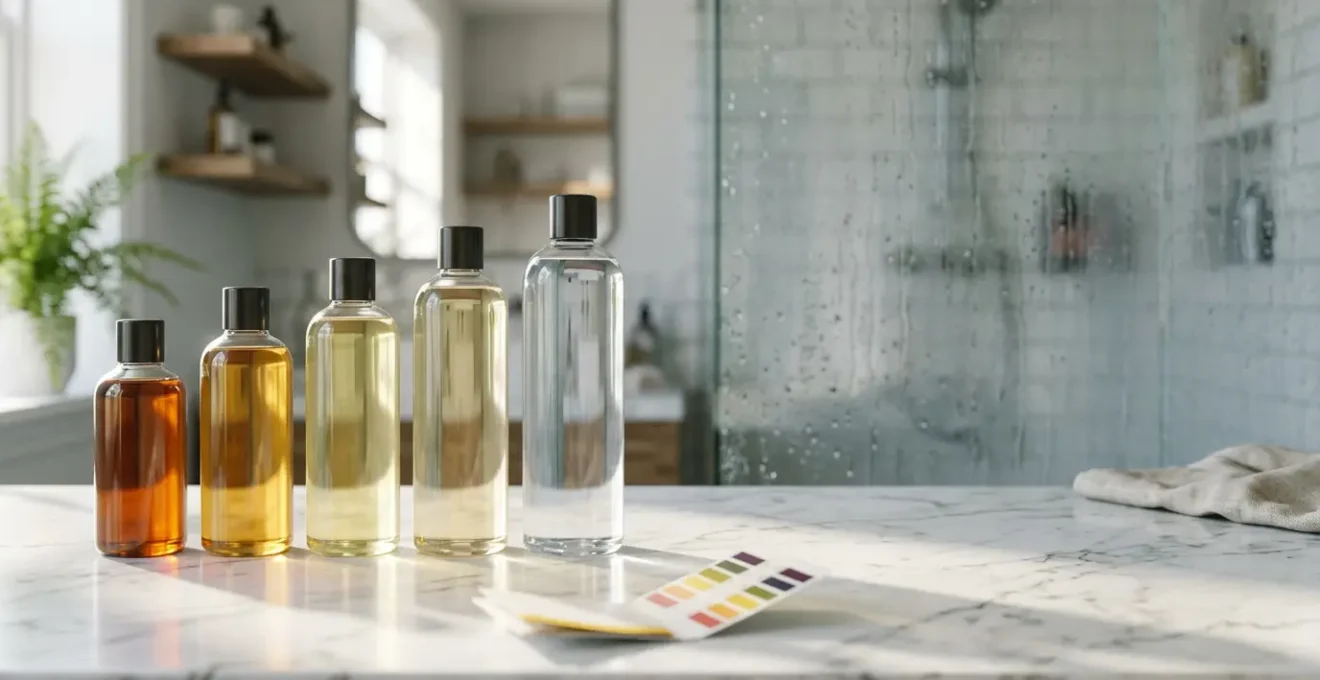
The solution to persistent dandruff and oil isn’t washing more; it’s washing smarter by respecting your scalp’s natural pH level.
- Aggressive, high-pH shampoos strip the scalp’s protective « acid mantle, » triggering a vicious cycle of oil overproduction and irritation.
- The goal is not to « sterilize » the scalp but to support its delicate ecosystem with pH-balanced cleansers and conditioners.
Recommendation: Shift your focus from simply « cleaning » your hair to actively « balancing » your scalp’s environment for long-term health.
You wash your hair every day, perhaps even using a specialized anti-dandruff formula, yet the flakes and grease return with a vengeance. This frustrating cycle leads many men to believe they have an inherently « bad » scalp, when the reality is often the opposite: their well-intentioned routine is the root of the problem. The common advice to « buy a sulfate-free shampoo » or « just wash less » only scratches the surface of a much deeper biological principle.
The truth is that your scalp is a delicate, living ecosystem, protected by a fine, slightly acidic film known as the acid mantle. This mantle is your first line of defense against the bacteria and fungi that can lead to dandruff and inflammation. But what if the very act of cleaning is systematically destroying this defense? What if the problem isn’t a single ingredient, but the entire cycle of stripping and over-correction that we can call the « pH shock cycle »? The real key to resolving chronic scalp issues lies not in the marketing claims on a bottle, but in understanding the fundamental science of your scalp’s pH.
This guide moves beyond simplistic advice. As a trichologist, my goal is to empower you with the knowledge to diagnose your own situation and build a routine that works *with* your body’s natural biology, not against it. We will deconstruct the process of cleansing, conditioning, and styling, revealing the critical pH-related mistakes that sabotage scalp health and how to correct them for good.
This article provides a detailed, science-backed approach to understanding and managing your scalp’s health. Below, you will find a breakdown of the key topics we’ll explore to help you build a truly effective hair care regimen.
Summary: A Scientific Approach to Scalp Health and Shampoo Selection
- Why Does Over-Washing Your Hair Cause More Oil Production?
- How to Wash Your Beard Without Stripping Natural Oils?
- Parabens vs. Sulfates: Which Ingredient Should You Actually Avoid?
- The Blow-Drying Mistake That Is Thinning Your Hair
- Collagen or Biotin: Which Supplement Actually Thickens Hair?
- SLS vs. Coco-Betaine: What Is the Difference in Cleaning Power?
- Pomade or Clay: Which Product Controls Thick, Unruly Hair?
- Why Are Sulfates Damaging Your Hair and Should You Switch Now?
Why Does Over-Washing Your Hair Cause More Oil Production?
The persistent belief that a « squeaky clean » feeling equates to a healthy scalp is the primary driver of this counterproductive cycle. Your scalp naturally produces an oily substance called sebum, which forms the critical acid mantle. This mantle maintains a healthy pH level, typically between 4.5 and 5.5, which is hostile to harmful bacteria and fungi. However, most common shampoos are alkaline (with a pH above 7) to effectively dissolve dirt and oil. When you use such a product, especially daily, you’re not just cleaning; you’re chemically stripping away your entire protective layer.
This aggressive cleansing triggers a state of panic in your sebaceous glands. In a desperate attempt to restore the protective barrier you just obliterated, they go into overdrive, producing even more sebum. This phenomenon is known as reactive seborrhea. You perceive this as your hair getting greasy faster, which prompts you to wash it again, thus perpetuating the vicious « pH shock cycle. » Essentially, the more aggressively you try to control the oil, the more your scalp fights back. The solution is not more washing, but smarter, gentler washing that respects this delicate biological balance.
Action Plan: Breaking the pH Shock Cycle
- Pre-wash detangle: Gently comb through dry hair to reduce mechanical stress and breakage on hair fibers, which are more vulnerable when wet.
- Thoroughly saturate with lukewarm water: Use lukewarm, not hot, water. Hot water aggressively lifts the hair cuticles, increasing vulnerability to pH shifts and damage.
- Scalp-first application: Apply shampoo directly to the scalp where sebum and buildup accumulate. Let the suds run down the lengths during rinsing; there’s no need to scrub the ends.
- Double cleanse when needed: For heavy product use, a gentle two-step wash is effective. The first removes surface debris and product, while the second can properly cleanse the scalp.
- Conditioner on mid-lengths to ends only: Apply conditioner where it’s needed most—on the older, more porous parts of your hair. Avoid the roots to prevent weighing down the hair and clogging follicles.
Breaking this cycle requires a paradigm shift from harsh stripping to gentle balancing, allowing your scalp to self-regulate its oil production as it was designed to.
How to Wash Your Beard Without Stripping Natural Oils?
The skin on your face is just as susceptible to pH disruption as your scalp, yet many men subject their beards to the same harsh cleansers designed for scalp hair, or worse, use generic body soap. While the hair itself may be coarse, the underlying facial skin is delicate. Treating your beard with a high-pH shampoo can lead to the same issues seen on the scalp: dryness, flaking (beardruff), itchiness, and irritated skin beneath the hair.
The principle of maintaining the acid mantle is paramount here. Research confirms that facial skin under beards maintains a similarly acidic pH to the scalp, thriving in that 4.5-5.5 range. Using a dedicated, pH-balanced beard wash is not a marketing gimmick; it’s a dermatological necessity. These formulations use milder surfactants that cleanse grime and food particles without completely stripping the natural sebum that keeps both the skin and the beard hair conditioned and healthy.
When washing, focus on massaging the cleanser into the skin beneath the beard with your fingertips. This not only cleanses effectively but also stimulates blood flow. Rinse thoroughly with lukewarm water and gently pat dry. Applying a few drops of a quality beard oil immediately after washing helps lock in moisture and replenish any lost lipids, reinforcing the protective barrier and keeping your beard soft and manageable.
Ultimately, a healthy beard starts with healthy skin, and that begins with respecting its natural, acidic environment.
Parabens vs. Sulfates: Which Ingredient Should You Actually Avoid?
The « free-from » aisle has created significant confusion, with « paraben-free » and « sulfate-free » often used interchangeably. From a trichologist’s perspective focused on scalp irritation and the pH shock cycle, these two ingredients play vastly different roles. Parabens are preservatives used to prevent the growth of bacteria and mold in cosmetic products. While controversies exist regarding their potential endocrine-disrupting effects, they are not a primary cause of the immediate scalp irritation and dryness that concerns us here.
Sulfates, particularly Sodium Lauryl Sulfate (SLS), are a different story. They are highly effective, inexpensive surfactants responsible for the rich, satisfying lather many people associate with being clean. However, this potent cleansing power is precisely the problem. SLS is an aggressive, high-pH agent that strips the acid mantle with ruthless efficiency. It is the primary trigger for the reactive seborrhea cycle. As The Eco Well Research highlights in their Analysis of SLS Safety Studies, the issue is well-documented.
24-hour exposure to 1-2% (w/w) solutions of SLS can cause more water loss through the skin and mild, but reversible, skin inflammation. Irritation goes up with the SLS concentration and the length of exposure.
– The Eco Well Research, Analysis of SLS Safety Studies
Therefore, for someone struggling with dandruff, grease, or scalp sensitivity, the choice is clear. While the paraben debate is complex, the negative impact of harsh sulfates like SLS on the scalp’s pH and barrier function is immediate and scientifically established. If you have to choose one ingredient to avoid for the sake of your scalp’s health, it should unequivocally be harsh sulfates.
Choosing a shampoo with milder, gentler surfactants is one of the most impactful changes you can make to break the cycle of irritation.
The Blow-Drying Mistake That Is Thinning Your Hair
The damage caused by an imbalanced pH doesn’t end in the shower. One of the most common and damaging mistakes is applying high heat to hair when it’s in its most vulnerable, alkaline state. After washing, especially with a high-pH shampoo, the cuticles of your hair shaft are raised and open. In this state, the hair is porous and structurally weak. Blasting it with a blow dryer on a high heat setting causes a phenomenon called « flash drying. »
Flash drying forces the water inside the hair cortex to boil and turn to steam, creating damaging microscopic bubbles within the hair fiber. This leads to brittleness, split ends, and chronic breakage that can be mistaken for hair thinning. Furthermore, you’re essentially « baking » the hair in an alkaline state, preventing the cuticles from closing properly and locking in moisture. This leaves hair looking dull, frizzy, and feeling rough. The real mistake isn’t using a blow dryer; it’s using it on hair that hasn’t been returned to its healthy, acidic pH.
The solution is a two-fold process. First, always use a pH-balancing conditioner after shampooing. The acidic nature of the conditioner helps to neutralize the alkalinity of the shampoo, smoothing the cuticles and sealing the hair shaft. Second, applying a pH-balancing leave-in spray or heat protectant before drying acts as a final buffer. This ensures the hair’s surface is acidic and the cuticles are flat before any heat is applied, drastically reducing potential damage and improving the final look and feel of your hair.
By managing your hair’s pH throughout your entire routine, you transform the blow dryer from a tool of destruction into an effective styling aid.
Collagen or Biotin: Which Supplement Actually Thickens Hair?
The market for hair supplements is booming, with collagen and biotin positioned as miracle cures for thinning hair. While both nutrients play roles in the body, their effectiveness for thickening hair is often overstated and misses a more fundamental point: you cannot grow healthy plants in toxic soil. Similarly, no supplement will be effective if your scalp—the « soil » for your hair—is an inflamed, imbalanced environment. A disrupted pH creates precisely this toxic environment.
When the scalp’s acid mantle is compromised, it can no longer effectively defend against microbes. This can lead to low-grade, chronic inflammation. This inflammation not only causes common symptoms like redness, itching, and sensitivity, but it also directly impairs the hair follicle’s ability to receive nutrients and function optimally. In fact, an epidemiological study of 317 patients found that 32% of patients with hair loss disorders also complain of a sensitive scalp, highlighting the strong link between inflammation and hair health issues.
Case Study: The Link Between pH, Inflammation, and Scalp Sensitivity
A disrupted pH can weaken the scalp’s protective barrier, making it more sensitive and prone to irritation. Redness, soreness, and discomfort are common symptoms of a pH imbalance, often caused by inflammation from bacterial or fungal activity. This sensitivity can further lead to a cycle of scratching, which worsens the problem, damages follicles, and can impede healthy hair growth.
Therefore, before spending money on expensive supplements, the first and most crucial step is to restore the health of your scalp’s ecosystem. This means eliminating harsh cleansers, re-establishing a healthy pH with balancing conditioners, and reducing inflammation. Only when the scalp environment is optimized can the follicles make full use of the nutrients you consume, whether from your diet or a supplement.
Focus on healing the scalp first. A healthy, balanced scalp is the only true foundation for strong, thick hair.
SLS vs. Coco-Betaine: What Is the Difference in Cleaning Power?
Moving away from harsh sulfates like SLS doesn’t mean you have to sacrifice the feeling of a clean scalp. The world of cosmetic chemistry offers a wide spectrum of surfactants with varying degrees of cleansing power and gentleness. Understanding these alternatives is key to selecting a product that cleans effectively without causing pH shock. One of the most common and effective milder surfactants used in modern formulations is Cocamidopropyl Betaine.
Unlike SLS, which is an anionic surfactant (negatively charged), Cocamidopropyl Betaine is amphoteric, meaning it can be either negatively or positively charged depending on the pH of the solution. This unique property makes it incredibly versatile and gentle. It cleanses effectively but is significantly less likely to strip the skin’s natural oils or disrupt the acid mantle. More importantly, it is often used in combination with other surfactants to reduce the overall harshness of a formula. As explained in a Comparative Analysis of Surfactants, its role is often synergistic.
Cocamidopropyl betaine is an amphoteric surfactant that boosts foam and reduces the harshness of anionic surfactants like SLS when blended together.
– Surfactant Chemistry Research, Comparative Analysis of Surfactants
A well-formulated shampoo might even contain a small amount of a stronger surfactant for cleansing power, but it will be balanced with gentler co-surfactants like Cocamidopropyl Betaine or Sodium Cocoyl Glycinate to create a final product that is both effective and mild. When reading an ingredient list, look for products that feature these gentler options high up on the list, and be wary of those where SLS or SLES (Sodium Laureth Sulfate) are among the top three ingredients.
The goal isn’t to eliminate all surfactants, but to choose formulations that use a smart, balanced blend of gentle cleansers.
Pomade or Clay: Which Product Controls Thick, Unruly Hair?
For men with thick, unruly hair, styling products like pomades and clays are essential for control. However, the choice between them has significant implications for your scalp’s pH and overall health. The critical distinction lies not just in their texture or hold, but in their base: oil-based versus water-based. Traditional, oil-based pomades offer incredible hold and shine but are notoriously difficult to wash out. This creates a serious problem within a pH-conscious routine.
To remove heavy, waxy buildup from an oil-based product, you often have to resort to a powerful, alkaline clarifying shampoo. This action, while necessary for cleaning, completely undoes all the work of maintaining your scalp’s acid mantle. You are forced back into the pH shock cycle, stripping your scalp to remove the product, which then leads to dryness, irritation, and reactive oil production. Furthermore, if not removed properly, this heavy buildup can trap sweat, bacteria, and dead skin cells on the scalp, creating an environment ripe for inflammation and follicle blockage.
Water-based pomades and modern styling clays, on the other hand, are designed to be rinsed out easily with a gentle, pH-balanced shampoo. They provide excellent hold and texture without creating a waterproof barrier on your hair and scalp. This makes them far more compatible with a routine focused on long-term scalp health.
The following table from an analysis of styling products illustrates the key differences in washability and scalp impact.
| Aspect | Water-Based Products | Oil-Based Products |
|---|---|---|
| Removal | Rinses with regular shampoo | Requires clarifying shampoo |
| pH Impact | Minimal disruption | May require alkaline cleanser |
| Buildup Risk | Low | High with repeated use |
| Scalp Health | Maintains acid mantle | Can trap bacteria if not removed |
| Best For | Daily use, pH-conscious routine | Special occasions, strong hold needs |
For daily use, choosing a water-based product is a non-negotiable part of a holistic, pH-balanced hair care strategy.
Key Takeaways
- Your scalp’s primary defense is its « acid mantle, » a naturally acidic layer (pH 4.5-5.5) that fights off harmful microbes.
- Harsh, alkaline shampoos (high pH) strip this mantle, triggering a « pH shock cycle » where the scalp overproduces oil to compensate, leading to chronic greasiness and irritation.
- The only effective long-term solution is a holistic, pH-conscious routine: gentle cleansers, balancing conditioners, and mindful styling choices that respect your scalp’s natural biology.
Why Are Sulfates Damaging Your Hair and Should You Switch Now?
By now, it’s clear that sulfates, particularly SLS, are primary antagonists in the quest for a balanced scalp. Their role as aggressive, alkaline detergents is the main catalyst for the pH shock cycle. But why are they so prevalent, and why is switching away from them so critical for someone with a problematic scalp? The answer lies in cost and perception. Sulfates are cheap to produce and create a voluminous lather that consumers have been conditioned to equate with effective cleaning. This perception, however, is a dangerous fallacy for sensitive or reactive scalps.
The damage is not just theoretical. For the man dealing with persistent dandruff, the irony is that the very product marketed to solve his problem is often a major contributor to it. A staggering research analyzing commercial shampoos revealed that a staggering 80.77% of anti-dandruff shampoos have a pH above the ideal 5.5, meaning they are alkaline and disruptive to the acid mantle. This single statistic explains why so many find themselves trapped, thinking their condition is untreatable when, in fact, their « treatment » is perpetuating the problem.
Switching to a sulfate-free or, more accurately, a *gently formulated* and pH-balanced shampoo is not a trend; it’s a necessary intervention to stop the cycle of damage. By removing the primary aggressor, you give your scalp the chance to heal. The acid mantle can reform, inflammation can subside, and your sebaceous glands can finally stop overcompensating. This allows your scalp to return to its natural state of equilibrium, effectively resolving issues like greasiness and many forms of flaking from the source, rather than just masking the symptoms.
Your journey to a healthy scalp starts now. By assessing your current products through the lens of pH and switching to a routine that nurtures your scalp’s ecosystem, you can finally reclaim control and achieve lasting comfort and health.
Frequently Asked Questions About Sulfates and Hair Health
What are the key symptoms that indicate I should switch from sulfate shampoo?
Harsh surfactants penetrate the skin barrier, weakening its defences over time. This compromises your skin’s ability to retain moisture, leading to chronic dryness, flakiness, and accelerated ageing. If your scalp feels tight, itchy, or gets greasy less than 24 hours after washing, it’s a strong sign that your shampoo is too harsh.
Is SLES really better than SLS for my hair?
SLES (Sodium Laureth Sulfate) is similar to SLS but has been processed (ethoxylated) to make it a larger molecule, which is thought to make it slightly milder and less irritating than SLS. However, it is still a potent surfactant that can lead to dryness and irritation with prolonged use, especially for those with sensitive skin. While it’s a marginal improvement, it’s not a truly gentle alternative.
How long before I see improvements after switching to sulfate-free?
There is an adjustment period. Most users report improvements in scalp comfort, such as reduced itching and tightness, within 2-4 weeks. Visible benefits, like less oil production and a reduction in flakiness, are typically noticeable after 6-8 weeks as the scalp’s acid mantle fully restores and oil production normalizes.