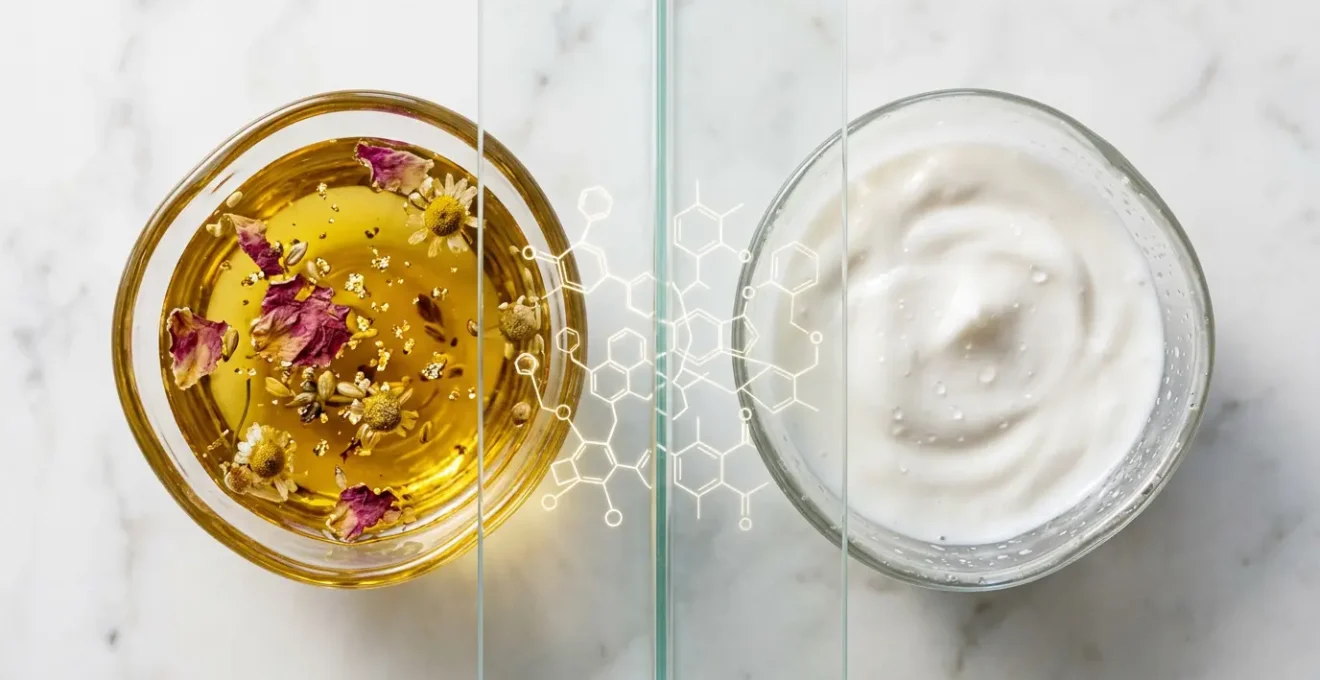
Face oils and moisturizers are not interchangeable; they perform fundamentally different chemical functions for your skin.
- Moisturizers (creams) primarily use humectants and emollients to add water and lipids to your skin, actively hydrating it.
- Face oils are primarily occlusives that create a barrier to seal that water and prevent it from escaping (Transepidermal Water Loss).
Recommendation: For optimal skin health, use a moisturizer first on damp skin to hydrate, then apply a suitable oil to lock in that moisture and protect your lipid barrier.
Walking down the men’s grooming aisle can feel like a high-stakes chemistry exam you didn’t study for. Bottles of face oil—jojoba, argan, squalane—sit next to an ever-expanding array of moisturizers, creams, and lotions. The common advice is often an oversimplification: « oils for dry skin, creams for oily skin. » While not entirely wrong, this guidance misses the fundamental science of how these products interact with your skin on a molecular level. You might be diligently applying moisturizer twice a day, only to find your skin still feels tight and dehydrated, or using an oil that promises a healthy glow but leaves you with clogged pores.
The confusion arises from treating these products as competitors when they are, in fact, partners in a system. The real key to effective skincare isn’t choosing one over the other; it’s understanding their distinct chemical roles. A moisturizer’s primary job is to deliver water (hydration) and beneficial lipids into the skin. A face oil’s primary job is to create a protective, occlusive seal to prevent that water from evaporating. They address two different parts of the same problem: maintaining a healthy, resilient lipid barrier.
This guide will move beyond the marketing and into the lab. We will deconstruct the function of your skin’s barrier, explain the precise chemical jobs of moisturizers and oils, and provide a clear protocol for how to use them correctly. By understanding the science, you can stop guessing and start building a routine that delivers tangible, predictable results, regardless of your skin type.
To navigate this complex topic, we have structured this guide to address the most critical questions, from the fundamentals of skin hydration to the specifics of product selection and application. The following sections will provide a clear, science-based roadmap to mastering your skincare routine.
Summary: Face Oil vs. Moisturizer: A Chemist’s Guide
- Why Is Your Skin Dry Even Though You Moisturize Twice a Day?
- How to Layer Oils and Creams for Maximum Absorption?
- Jojoba vs. Argan Oil: Which Is Best for Acne-Prone Skin?
- The ‘Natural’ Oil That Is Clogging Your Pores Secretly
- Night vs. Day: When Should You Apply Heavy Face Oils?
- Why Does Over-Washing Your Hair Cause More Oil Production?
- When to Switch Your Moisturizer Routine for Winter Dryness?
- Why Does Your Beard Itch After 3 Days of Growth and How to Stop It?
Why Is Your Skin Dry Even Though You Moisturize Twice a Day?
The feeling of persistent dryness despite regular moisturizing is a classic sign of a compromised lipid barrier. Your skin’s outermost layer, the stratum corneum, is a wall made of skin cells (corneocytes) held together by a lipid mortar of ceramides, cholesterol, and fatty acids. When this mortar is depleted, it becomes porous, allowing water to escape in a process called Transepidermal Water Loss (TEWL). Most standard moisturizers are rich in humectants (like glycerin or hyaluronic acid), which are excellent at drawing water into the skin. However, if your barrier is weak, that water evaporates almost as quickly as it’s delivered.
You aren’t just lacking water; you’re lacking the structural components to hold that water in. True hydration requires a two-pronged approach: replenishing water with humectants and repairing the barrier with emollients and lipids. Emollients soften the skin, while specific lipids like ceramides are the literal building blocks of your skin’s protective wall. Applying a simple, humectant-based lotion to a damaged barrier is like trying to fill a leaky bucket—the effort is constant, but the results are temporary.
Case Study: The Impact of Lipid Supplementation
A recent 28-day study provides clear evidence for this principle. When subjects used a multivesicular emulsion fortified with physiological lipids (MVE + GL), their skin barrier integrity demonstrably improved. The results showed a 25% increase in water content within the stratum corneum. More importantly, the levels of key barrier components, AP(18) and NP(18) ceramides, increased by 19% and 24% respectively. This illustrates that directly supplementing the skin with the lipids it’s missing is critical for restoring its ability to retain moisture effectively.
Therefore, if your skin remains dry, the problem isn’t necessarily your moisturizer’s hydrating power but its lack of barrier-repairing ingredients. The solution is to incorporate products that specifically contain ceramides, fatty acids, and cholesterol to rebuild the lipid mortar, effectively patching the leaks in your skin’s defenses.
How to Layer Oils and Creams for Maximum Absorption?
Properly layering skincare is not a matter of preference; it’s a rule of chemistry governed by molecular size and product function. The golden rule is to apply products from the thinnest consistency to the thickest, or from water-based to oil-based. A moisturizer contains water and is designed to penetrate the skin to deliver hydration. A face oil is composed of larger lipid molecules and is primarily occlusive, meaning its main job is to form a seal on the surface. An oil can penetrate a moisturizer to some extent, but a moisturizer cannot effectively penetrate a layer of oil.
Applying oil before your cream is like wearing a raincoat underneath your shirt—it prevents the essential elements from getting where they need to go. By applying your moisturizer first, you allow its humectants to draw water into the epidermis. Following up with a face oil then locks that hydration in, creating a barrier that slows down TEWL and protects the skin from environmental aggressors. This synergy ensures you receive both the hydrating benefits of the cream and the protective, sealing benefits of the oil.
To understand this process, it helps to visualize the absorption at a microscopic level. The following illustration depicts how different product layers interact with the skin’s surface.
As this visualization shows, water-based serums penetrate deeply, followed by the cream which delivers moisture and lipids into the mid-layers of the epidermis. The oil forms the final, protective film on top. For this sequence to be effective, timing is also a factor. Allowing each layer a moment to absorb ensures it can perform its function without being diluted or blocked by the next.
Your Science-Based Layering Protocol
- Apply water-based serums with active ingredients on clean, damp skin for optimal penetration.
- Layer moisturizer while skin is still slightly damp – the water molecules act as carriers for humectants.
- Wait 30-60 seconds for the moisturizer to partially absorb and feel slightly tacky, not fully dry.
- Apply face oil last as an occlusive seal. Gently press 2-4 drops into the skin; oils can penetrate moisturizers, but not the other way around.
- For a morning routine, wait 2-3 minutes before applying sunscreen to allow the oil to set, preventing it from interfering with the SPF’s film formation.
Jojoba vs. Argan Oil: Which Is Best for Acne-Prone Skin?
For men with acne-prone skin, the idea of adding oil to their face can seem counterintuitive and risky. However, choosing the *right* oil can have a profound balancing and anti-inflammatory effect. The choice between two popular options, jojoba and argan, comes down to their distinct chemical structures and how they interact with your skin’s specific needs. Jojoba oil is technically not an oil but a wax ester, making its molecular structure remarkably similar to human sebum. Argan oil, on the other hand, is a traditional triglyceride oil rich in specific fatty acids.
This structural difference dictates their function. Because jojoba oil mimics sebum, it can help regulate your skin’s own oil production. When applied, it can signal to your sebaceous glands that there is sufficient oil on the surface, potentially down-regulating overproduction. This makes it an excellent choice for oily skin that needs balancing. Argan oil’s strength lies in its high concentration of linoleic acid, an omega-6 fatty acid. Studies have shown that acne-prone skin is often deficient in linoleic acid, which can lead to thicker, stickier sebum that clogs pores. By topically replenishing linoleic acid, argan oil helps to create a less hospitable environment for P. acnes bacteria and reduces inflammation.
The following table, based on data from sources like a comparative analysis by Gisou, breaks down the key scientific properties of each oil to help guide your decision.
| Property | Jojoba Oil | Argan Oil |
|---|---|---|
| Chemical Structure | Wax ester (97%), mimics human sebum | Triglyceride oil, high linoleic acid |
| Comedogenic Rating | 2 (low) | 0 (non-comedogenic) |
| Key Fatty Acids | Gadoleic acid (71%), Erucic acid (14%) | Linoleic acid (37%), Oleic acid (43%) |
| Anti-inflammatory | Moderate (vitamin E) | High (gamma-tocopherol) |
| P. acnes Response | Sebum regulation effect | Hostile environment via linoleic acid |
| Best For | Oily skin needing balance | Inflamed acne-prone skin |
In summary, if your primary concern is excess oiliness and blackheads, jojoba oil is a strategic choice for sebum regulation. If you struggle with red, inflamed pimples and pustules, argan oil’s potent anti-inflammatory and linoleic acid content make it the superior option.
The ‘Natural’ Oil That Is Clogging Your Pores Secretly
In the world of « natural » skincare, not all oils are created equal, and some popular choices can be disastrous for breakout-prone individuals. The most notorious culprit is coconut oil. While lauded for its benefits in cooking and hair care, its application on the face is a different story. The reason lies in its comedogenic rating—a scale from 0 to 5 that measures an ingredient’s likelihood of clogging pores. According to dermatological assessments, coconut oil scores a 4 out of 5, making it highly likely to cause blockages and lead to blackheads and pimples for most skin types.
Another seemingly healthy oil that can cause issues is olive oil. Its problem isn’t necessarily comedogenicity but its extremely high concentration of oleic acid, a monounsaturated omega-9 fatty acid. While beneficial in our diet, high levels of oleic acid on the skin can be problematic for those with an already oily complexion. It can disrupt the delicate balance of the skin’s lipid barrier, leading to irritation and increased water loss.
Clinical Insight: The Olive Oil Paradox
Clinical observations have revealed a paradoxical effect of olive oil on the skin. Its high oleic acid content, which can reach up to 83%, has been shown to disrupt the skin’s natural lipid barrier in individuals with oily or acne-prone skin. This disruption can increase transepidermal water loss and cause irritation. This is a prime example of how an ingredient’s « natural » or « healthy » reputation in one context (like diet) does not automatically translate to a benefit in topical skincare, especially for reactive skin types.
The key takeaway for men, particularly those with oily or combination skin, is to be discerning about the oils they use. Instead of reaching for kitchen-grade oils, opt for formulations specifically chosen for their non-comedogenic properties and beneficial fatty acid profiles, such as those high in linoleic acid (like argan or grapeseed oil) or those that mimic sebum (like jojoba or squalane).
Night vs. Day: When Should You Apply Heavy Face Oils?
The timing of your face oil application is a strategic decision rooted in your skin’s circadian rhythm. Heavier, more occlusive oils are unequivocally best applied at night. The primary reason for this is that your skin’s metabolic processes shift after dark. During the day, your skin is in defense mode, fending off UV radiation and pollution. At night, it switches to repair and regeneration mode. This nocturnal repair phase has a significant side effect: increased skin permeability.
Scientific studies confirm this phenomenon. In fact, research in the International Journal of Cosmetic Science reveals that Transepidermal Water Loss (TEWL) peaks at night, with skin permeability increasing by up to 25%. This means your skin loses more water while you sleep, but it’s also more receptive to absorbing the beneficial ingredients you apply. Applying a rich face oil before bed creates an occlusive shield that dramatically reduces this natural nighttime water loss, sealing in both your moisturizer and your skin’s own moisture. This supercharges the skin’s natural recovery process, allowing you to wake up with a more hydrated, plump, and resilient complexion.
Conversely, using a heavy oil during the day can be counterproductive and even damaging, as explained by dermatology experts.
Heavy oils applied during the day can be oxidized by UV radiation, creating free radicals that can damage skin cells.
– Dr. Elyse Love, MD, Goop Beauty Expert Interview
This oxidation process can negate the antioxidant benefits of the oil and contribute to premature aging. If you wish to use an oil in the morning, opt for a very lightweight, fast-absorbing option like squalane or grapeseed oil, and always apply a broad-spectrum sunscreen over it as the final step in your routine.
Why Does Over-Washing Your Hair Cause More Oil Production?
The frustrating cycle of washing your hair only to have it feel greasy again by the next day is a direct result of disrupting your scalp’s delicate ecosystem. Your scalp is skin, and like the skin on your face, it maintains a protective barrier known as the acid mantle, which has a naturally acidic pH of around 5.5. This acidity is crucial for keeping the cuticle of the hair shaft smooth and for managing the scalp’s microbiome. The problem arises when we use harsh, alkaline shampoos, particularly those containing aggressive sulfates.
These powerful detergents strip the scalp of its natural sebum, providing a temporary feeling of « squeaky clean. » However, this action also drastically raises the scalp’s pH. This sudden shift from acidic to alkaline sends a panic signal to the sebaceous glands. In a desperate attempt to restore the stripped protective barrier and bring the pH back to normal, these glands go into overdrive, producing even more oil than before. This phenomenon is known as reactive seborrhea.
The effect is not just anecdotal; it is a measurable biological response. A study in Experimental Dermatology demonstrates that when the scalp pH increases from its natural 5.5 to a more alkaline 7.4 with certain shampoos, it can trigger up to a 40% increase in sebum production as the skin tries to overcompensate. The solution is to break the cycle by switching to a pH-balanced, sulfate-free shampoo. This cleanses the hair and scalp gently without stripping the acid mantle, allowing your sebaceous glands to normalize their production over time.
When to Switch Your Moisturizer Routine for Winter Dryness?
The annual shift to colder weather is a clear signal to re-evaluate your skincare routine. Winter brings a double-threat to your skin’s hydration: cold, dry air outside and dry, heated air inside. Both conditions drastically reduce ambient humidity, accelerating Transepidermal Water Loss (TEWL) and depleting the skin’s natural supply of ceramides, the essential lipids that form the backbone of your skin barrier. The first sign that you need to make a switch is often a feeling of tightness, flakiness, or a dull appearance, even when using your regular moisturizer.
The key to winter-proofing your skin is to transition from a lightweight lotion to a richer cream that is specifically formulated for barrier repair. While a summer moisturizer might focus on light hydration with humectants, a winter moisturizer must be an emollient powerhouse, rich in ceramides, cholesterol, and fatty acids. These ingredients don’t just add moisture; they actively rebuild the « mortar » between your skin cells, fortifying the barrier against the harsh environment. As a clinical evaluation in the CosmoDerma journal found, ceramide-containing lotions can reduce TEWL by an impressive 47% after 24 hours in low-humidity conditions.
Case Study: The Impact of Indoor Heating
The danger is not just outdoors. A 2024 study highlighted the dramatic effect of indoor heating on skin health, finding it can reduce ambient humidity to below 30%. This caused the stratum corneum of participants to lose up to 25% of its water content within a single 8-hour workday. However, participants using lipid-rich moisturizers containing a specific 3:1:1 ratio of ceramides, cholesterol, and fatty acids showed 60% better moisture retention compared to those using standard formulas with only humectants. This demonstrates the critical importance of a comprehensive, lipid-focused formula in combating winter dryness.
Therefore, make the switch as soon as you feel the first signs of seasonal dryness. Don’t wait for your skin to become chapped or irritated. Proactively introducing a ceramide-rich cream and a protective face oil will maintain your barrier’s integrity throughout the winter months, keeping your skin comfortable and healthy.
Key Takeaways
- Function over Form: Moisturizers are formulated to add hydration to the skin, while oils are designed to seal it in and prevent water loss.
- Layering is Law: Always apply products from thinnest to thickest. Water-based serums first, followed by cream moisturizer, and sealed with a face oil.
- Not All Oils Are Equal: Choose oils based on their fatty acid profile. Jojoba mimics sebum for oily skin, while Argan’s linoleic acid fights inflammation. Avoid high-oleic, pore-clogging oils like coconut on the face.
Why Does Your Beard Itch After 3 Days of Growth and How to Stop It?
The notorious « three-day itch » is a rite of passage for many men growing a beard, but its cause is a combination of mechanical irritation and skin dryness. When you shave, the razor cuts each hair at a sharp angle. As the stubble begins to grow, these newly sharpened tips can curl back and physically poke and scrape the surface of your skin. This constant, low-grade friction causes micro-abrasions and triggers an inflammatory response, resulting in redness and a persistent itch.
This mechanical irritation is explained clearly by dermatologists who deal with the consequences of shaving daily.
Shaving cuts the hair at an angle, creating a sharp point that curls back and physically pokes the skin, causing micro-abrasions.
– Dr. Robert Anolik, MD, NYU Grossman School of Medicine Dermatology
The problem is compounded by a second factor: dehydration. The emerging hairs act like tiny wicks, drawing your skin’s natural oils (sebum) away from the surface and up the hair shaft. This depletes the skin’s lipid barrier, leading to dryness and making it even more susceptible to irritation from those sharp hair tips. The solution, therefore, requires a two-part strategy: soften the hair and fortify the skin.
To stop the itch, first apply a lightweight, non-comedogenic oil like jojoba or squalane immediately after cleansing. Massaging the oil into the stubble helps to soften the sharp ends of the hair and lubricate the skin, reducing friction. Second, follow up with a ceramide-rich moisturizer. This replenishes the lipids that the hair is wicking away, repairing the skin barrier and reducing dryness-related irritation. Using a gentle exfoliant, such as a cleanser with a low concentration of salicylic acid (0.5%), a few times a week can also help prevent the hair tips from becoming trapped and turning into ingrown hairs.
Armed with this chemical understanding of how moisturizers hydrate and oils seal, you are now equipped to move beyond the confusing marketing claims. You can analyze your own skin’s needs—whether it’s barrier repair, sebum regulation, or protection from the elements—and build an intelligent, effective routine that delivers measurable and lasting results.