In summary:
- Your hair is an engineering material, weakest when wet. Its structural integrity depends on managing physical forces, not just using products.
- Mechanical stress from friction (rough towels) and tension (improper combing) is the primary cause of preventable breakage.
- Temperature is a critical factor; hot water swells the hair’s protective cuticle, making it vulnerable, while excessive heat from blow-drying causes internal damage.
- True hair resilience is built from within through diet and maintained from the outside by respecting the hair’s physical limits.
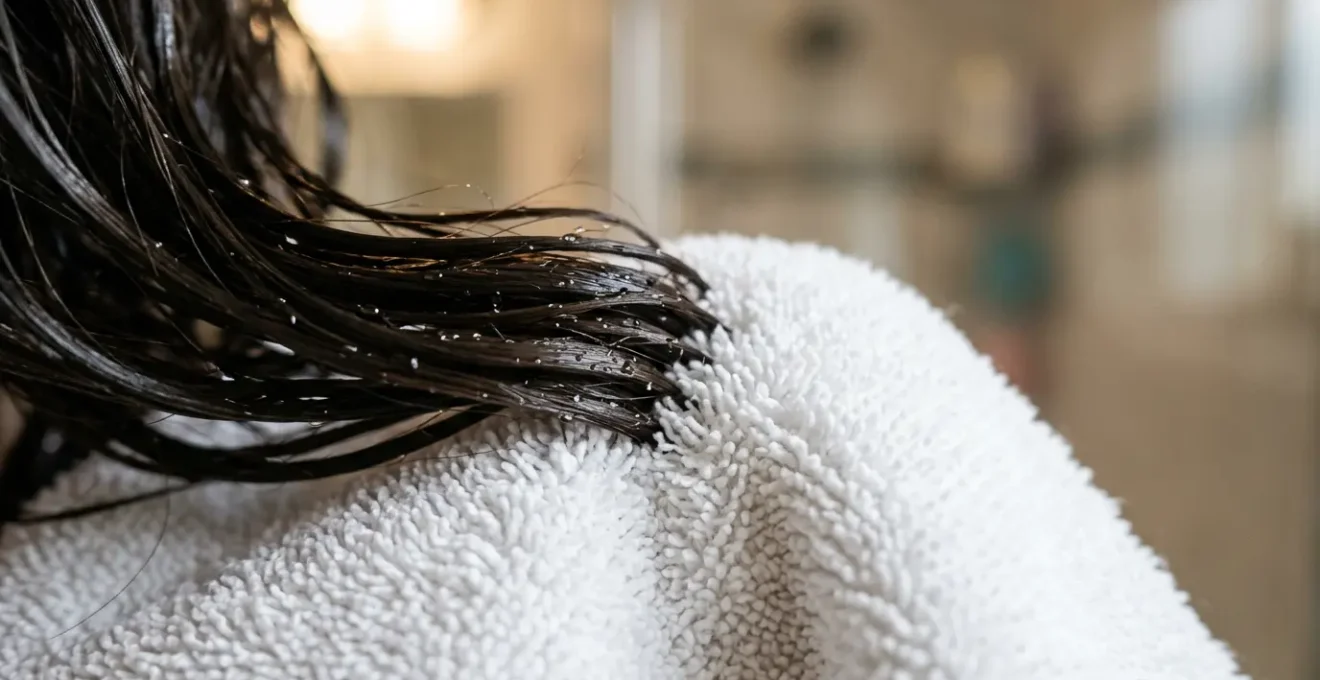
The sight is all too familiar for many men: a collection of small, broken hair fragments littering the bathroom sink or the towel after a shower. The immediate thought often jumps to hair loss or thinning, a genuine concern. The common advice is to simply « be more gentle, » use a different towel, or switch to a high-end conditioner. While not entirely wrong, this advice barely scratches the surface of the problem. It treats hair like a piece of fabric to be handled with care, but it misses the fundamental point.
To truly stop breakage, you must stop thinking like a consumer and start thinking like a physicist. Your hair is a complex biopolymer, a structural material with its own tensile strength, vulnerabilities, and breaking points. The damage you see is not a random occurrence; it is the predictable result of specific physical forces—friction, tension, and thermal shock—exceeding the hair fiber’s structural limits, a process known as mechanical damage.
This guide will not rehash generic tips. Instead, we will deconstruct the process of hair breakage from an engineering perspective. We will analyze the forces at play, from the microscopic damage caused by a cotton towel to the internal shockwaves created by a blow-dryer on soaking wet hair. By understanding the physics of why your hair breaks, you can implement a protocol that truly protects its integrity and puts an end to the daily worry of finding those snapped strands.
This comprehensive guide will examine the core components of hair strength, the treatments that work, the tools that don’t, and the environmental factors you control. By following this structured approach, you will learn to preserve the hair you have by managing the forces that threaten it.
Summary: A Physicist’s Guide to Eliminating Hair Breakage from Towel Drying and Mechanical Stress
- Cuticle vs. Cortex: Where Does Hair Strength Actually Come From?
- Keratin or Argan Oil: Which Treatment Fixes Brittle, Snapping Hair?
- Comb or Brush: Which Tool Causes Less Stress on Thinning Hair?
- The Hot Water Habit That Weakens Hair Fiber Instantly
- Air Dry vs. Blow Dry: Which Method Preserves Hair Density Best?
- The Blow-Drying Mistake That Is Thinning Your Hair
- Protein vs. Fat: What Should Be the Priority for Weight Maintenance?
- How to Choose a Shampoo Based on Your Scalp pH Level?
Cuticle vs. Cortex: Where Does Hair Strength Actually Come From?
To understand why hair breaks, we must first understand its architecture. A single hair fiber is not a monolithic thread; it’s a composite material with two key components governing its strength: the cortex and the cuticle. The cortex, the inner core of the hair shaft, is made of long, twisted keratin fibers. This is where the hair’s tensile strength—its ability to resist being pulled apart—originates. Think of it as the steel rebar inside a concrete pillar.
The cuticle is the outer layer, composed of overlapping, transparent scales like shingles on a roof. Its primary job is not to provide strength, but to protect the cortex from external threats like moisture, chemicals, and physical friction. When the cuticle is healthy and flat, it creates a smooth, low-friction surface. However, when it’s damaged or lifted, it exposes the vulnerable cortex and snags easily, leading to breakage.
The critical vulnerability occurs when hair is wet. Through a process called hygral expansion, the hair shaft absorbs water and swells. This process temporarily weakens the keratin bonds in the cortex and lifts the cuticle scales. In fact, wet hair is up to 70% more fragile than dry hair. When you rub a wet head of hair with a rough cotton towel, you are applying a high-friction force to a structurally compromised material, causing the lifted cuticle scales to chip, crack, and eventually break off, exposing the cortex to fracture.
Therefore, preventing breakage is fundamentally an exercise in cuticle preservation. Every action, from washing to drying, should be aimed at keeping this protective layer intact and sealed, especially during its most vulnerable wet state.
Keratin or Argan Oil: Which Treatment Fixes Brittle, Snapping Hair?
When hair is already showing signs of mechanical damage, such as brittleness and snapping, men often turn to treatments. The two most common categories are protein-based treatments (like keratin) and oil-based lubricants (like argan oil). From a material science perspective, they serve two fundamentally different functions and are not interchangeable.
Keratin treatments work on the principle of internal reinforcement. Hydrolyzed keratin proteins are small enough to penetrate gaps in the cuticle and bond with the existing hair structure, essentially acting as a « spackle » for the damaged areas. This directly patches the protective shield and can, to an extent, reinforce the weakened cortex. This is a corrective action, best suited for hair that is already visibly damaged and snapping easily.
Argan oil, and other similar oils, functions as a surface lubricant. It does not penetrate deeply or rebuild the hair’s structure. Instead, it coats the hair shaft, filling in the microscopic roughness of the cuticle and drastically reducing the coefficient of friction between hair strands and external objects like towels or combs. This is a preventative measure, ideal for reducing the daily mechanical stress that leads to damage in the first place.
This table breaks down their distinct roles in managing hair integrity:
| Treatment Type | Primary Function | Best For | Application Timing |
|---|---|---|---|
| Keratin Treatment | Internal reinforcement – patches damaged cuticle | Severely damaged, snapping hair | Weekly protein treatment |
| Argan Oil | Surface lubricant – reduces friction | Prevention on healthy hair | Daily on damp hair before drying |
Ultimately, for a man concerned with ongoing breakage, a dual strategy is most effective: using a weekly keratin treatment to repair existing structural weaknesses while applying a lightweight oil daily to prevent future mechanical damage.
Comb or Brush: Which Tool Causes Less Stress on Thinning Hair?
The choice of tool for detangling and styling wet hair is not a matter of preference but of physics. A brush and a comb apply forces to the hair in drastically different ways, with significant consequences for a structurally weakened, wet hair fiber.
A typical brush consists of many fine, flexible bristles packed closely together. When pulled through hair, this dense field of bristles creates immense friction and tension. If a bristle snags on a tangle, the other bristles continue to pull on the surrounding hairs, creating a tearing force that rips through the knot and fractures the hair shaft. As the StyleCraze Hair Care Guide notes, « A brush will tear the hair, while a comb will only detangle without causing unnecessary damage. »
A wide-tooth comb, by contrast, operates on a principle of low-impact separation. The wide spaces between the teeth allow hair to pass through with minimal friction. When a tooth encounters a tangle, it isolates the knot without applying tension to the surrounding strands. This allows you to gently work the tangle out from the ends upward, a technique that minimizes stress on the root and the shaft.
Professional hair education platform Sam Villa advocates for this method, noting that for men with shorter styles, finger-combing is the gold standard. Using your fingers to style and detangle damp hair provides the ultimate feedback, allowing you to feel a snag instantly and work it out with zero friction or tension. This is the least mechanically stressful method possible. For longer hair, starting at the ends with a wide-tooth comb and gradually moving toward the roots is the only scientifically sound approach to detangling wet hair without causing breakage.
Therefore, for any man worried about thinning or breakage, brushes should be strictly reserved for use on completely dry hair. When hair is damp or wet, only fingers or a wide-tooth comb should be used to prevent catastrophic fiber failure.
The Hot Water Habit That Weakens Hair Fiber Instantly
One of the most damaging and overlooked habits in a man’s grooming routine is washing hair with hot water. While it may feel relaxing, from a material science standpoint, you are performing a procedure that instantly compromises your hair’s structural integrity. The temperature of the water directly impacts the state of the hair cuticle.
Hot water causes a rapid and significant thermal reaction. As dermatological research confirms, the hair cuticle swells and lifts when exposed to high temperatures. This action, designed to release dirt and oil, also turns your hair’s smooth, protective shield into a rough, open surface. Each overlapping scale stands up, maximizing the surface area for friction and creating countless snag points. Towel drying hair that has just been washed in hot water is the equivalent of sanding a delicate material with coarse-grit sandpaper; damage is not just possible, it is inevitable.
Conversely, cool or lukewarm water minimizes this swelling effect. A final rinse with cool water has an even more beneficial effect: it causes the cuticle to contract and lie flat, effectively « sealing » the hair shaft. This creates a smoother, more resilient surface right before the most dangerous step: drying. A sealed cuticle can better withstand the mechanical stress of blotting and patting with a towel.
Your Action Plan: Temperature Protocol for Hair Protection
- Wash hair with lukewarm water (not hot) to minimize initial cuticle opening.
- Apply shampoo and conditioner at this moderate temperature.
- Before exiting the shower, rinse hair with cool water for a brief 15-30 seconds.
- This cool rinse contracts and seals the cuticle, creating a natural layer of protection.
- Gently pat hair dry immediately after the cool rinse, while the cuticle is in its most protected state.
Adopting this simple temperature protocol fundamentally changes the physical state of your hair before it even encounters a towel, dramatically reducing its susceptibility to friction-induced breakage.
Air Dry vs. Blow Dry: Which Method Preserves Hair Density Best?
The debate between air drying and blow drying is often oversimplified. From a physics perspective, both methods introduce different types of risk to the hair fiber. The optimal method is not one or the other, but a hybrid approach that minimizes the drawbacks of both.
Pure air drying eliminates the risk of heat damage and mechanical friction from a dryer. However, it introduces another risk: prolonged hygral fatigue. This is the stress placed on the hair’s internal structure (the cortex) from being in a swollen, wet state for an extended period. The longer the hair is saturated with water, the more pressure is exerted on the delicate proteins within, which can lead to a different kind of weakness over time. This is mainly a concern for those with thick hair that takes hours to dry.
Blow drying is fast, but it carries the obvious risk of thermal damage. High heat can boil the residual water on and inside the hair shaft, causing it to erupt as steam, creating bubbles and cracks in the cuticle. It also involves friction from directing a chaotic blast of air onto the hair. However, it significantly reduces the time the hair spends in its weakened, swollen state.
The scientifically superior method is the « 80% rule, » a hybrid approach that minimizes both risks. This involves using a high-absorbency microfiber towel to gently pat and blot the hair until it is about 70-80% dry. At this point, the majority of the water has been removed without friction, and the hair is no longer saturated. The final 20-30% of drying can then be done via natural air drying. This approach, recommended by experts at Turbie Twist, minimizes both mechanical damage from friction and the risk of hygral fatigue. Their findings suggest this hybrid method can reduce breakage by up to 50% compared to aggressive towel drying.
| Method | Time Required | Damage Risk | Best For |
|---|---|---|---|
| Pure Air Dry | 30 min – 2 hours | Low mechanical, risk of hygral fatigue | Thick, healthy hair |
| Blow Dry Only | 5-10 minutes | High heat damage potential | Time-pressed styling |
| 80% Towel + Air | 20-30 minutes | Minimal overall damage | All hair types |
| T-shirt Plopping | 10-15 minutes | Zero friction damage | Curly or fragile hair |
For the man concerned with preserving hair density, abandoning the all-or-nothing approach in favor of this two-stage drying protocol offers the most effective protection against the full spectrum of drying-related damage.
The Blow-Drying Mistake That Is Thinning Your Hair
For men who use a blow-dryer for speed or styling, a single common mistake can cause catastrophic damage at a microscopic level, leading directly to thinning and breakage. This error is applying high heat to soaking wet hair. While it may seem efficient, you are essentially flash-boiling the water trapped within and on the hair fiber.
As the professional education team at Sam Villa explains, this creates a violent physical reaction. The rapid heating causes water to turn into steam, expanding in volume explosively. This process is so powerful that it creates what they describe as « steam bubbles that erupt through the cuticle. »
The biggest error is blow-drying soaking wet hair. This flash-heats the water inside and on the hair shaft, causing steam bubbles to erupt through the cuticle.
– Sam Villa Professional Education Team, Sam Villa Hair Tutorials
These micro-explosions create permanent cracks and holes in the hair’s protective outer layer, leaving the inner cortex exposed and fragile. A hair fiber with a compromised cuticle is exponentially more likely to snap from any subsequent mechanical stress, be it combing, styling, or even sleeping on a pillow. This damage is cumulative; each time you make this mistake, you are creating more weak points along the hair shaft.
To use a blow-dryer safely, you must first remove the bulk of the water mechanically (by blotting) and then follow a strict thermal protocol. This ensures you are merely evaporating a fine layer of moisture, not boiling trapped water.
Your Action Plan: Safe Blow-Drying Protocol for Men
- Always towel dry your hair by patting until it’s at least 50-70% dry before introducing heat.
- Apply a heat protectant spray or serum to damp (not soaking) hair. These products form a film that helps distribute heat more evenly.
- Use a concentrator nozzle on your dryer to direct airflow precisely and prevent chaotic air from creating friction and tangles.
- Keep the dryer in constant motion. Never hold it in one spot for more than a second or two.
- Maintain a minimum distance of 6 inches between the dryer’s nozzle and your hair to reduce heat intensity.
- Finish with the « cool shot » button. This blast of cool air helps to seal the cuticle, locking in the style and adding a protective finish.
By treating the blow-dryer as a powerful tool that requires a precise operating procedure, you can gain the benefits of styling without inflicting irreversible structural damage on your hair.
Key takeaways
- Wet hair is a fragile material, not a resilient fabric. Its strength drops significantly when saturated with water, making it highly susceptible to physical forces.
- Effective hair care is a form of materials management. The goal is to minimize friction, control thermal shock, and reduce tension at all stages of washing and drying.
- Internal health dictates external resilience. The structural integrity of your hair fiber is directly synthesized from your dietary intake of proteins and essential fats.
Protein vs. Fat: What Should Be the Priority for Weight Maintenance?
While the title suggests a focus on weight, the principles of nutrient priority have a direct and profound impact on the structural integrity of your hair. The materials used to construct each hair fiber are synthesized directly from your diet. For hair strength, the debate isn’t about protein *or* fat; a deficit in either creates a specific, critical vulnerability.
Protein is the absolute bedrock of hair structure. Hair is approximately 95% keratin, a type of protein. If your dietary protein intake is insufficient, your body cannot synthesize enough keratin to build strong, resilient hair fibers. The resulting strands are thinner, more porous, and inherently weaker. In fact, nutritional research has demonstrated that hair lacking adequate dietary protein becomes up to 40% more susceptible to mechanical breakage from simple acts like towel drying or combing.
Fats, specifically essential fatty acids like omega-3s, play a different but equally crucial role. They are vital for the production of sebum, the natural oil secreted by your scalp. Sebum is your body’s own high-performance conditioner. It coats the hair shaft, providing a natural lubricant that reduces friction and a waterproof seal that helps protect the cuticle. A lack of healthy fats in the diet leads to a dry scalp and brittle, unlubricated hair that is prone to static and friction-based damage.
Case Study: Dietary Impact on Hair Resilience in Men
Research conducted by the Wimpole Clinic on men’s hair health revealed a fascinating link between diet and breakage. Dr. Umear Ahmad’s team observed that men on highly restrictive diets, whether low-fat or unbalanced high-protein regimens, often experienced a noticeable increase in hair brittleness. Their key finding was that a balanced intake of both high-quality protein (for keratin synthesis) and essential omega-3 fatty acids (for robust sebum production) created the most resilient hair fibers, best equipped to withstand the daily mechanical stresses of grooming.
Therefore, for a man concerned with breakage, « dieting » should never involve restricting these two core building blocks. Prioritizing lean proteins and healthy fats is not just for body composition; it is a direct investment in the material strength of every hair on your head.
How to Choose a Shampoo Based on Your Scalp pH Level?
The final, and perhaps most fundamental, layer of protection for your hair is not a product you apply after washing, but the very product you use to wash it. The chemical properties of your shampoo, specifically its pH level, set the stage for either resilience or damage. Your scalp and hair have a naturally acidic protective layer, known as the acid mantle, which typically has a pH between 4.5 and 5.5.
This acidic environment is critical for keeping the hair’s cuticle scales tightly closed and flat. A sealed cuticle forms a strong, smooth barrier that protects the inner cortex. Many common soaps and harsh shampoos are highly alkaline, with a pH of 8 or higher. When you use an alkaline product, it causes an immediate chemical reaction: it neutralizes the acid mantle and forces the cuticle scales to swell and open up. This is the same physical effect as using hot water, but induced chemically.
Washing your hair with an alkaline shampoo leaves your hair in a state of maximum vulnerability. The cuticle is open, rough, and ready to be snagged and torn by towel friction. Choosing a pH-balanced shampoo is therefore a non-negotiable first step in any anti-breakage regimen. These formulas are specifically designed to cleanse the hair and scalp without disrupting the natural acid mantle, ensuring the cuticle remains as sealed as possible throughout the washing process.
This simple choice of cleanser determines the baseline integrity of your hair before any other physical forces are even applied. It is the foundation upon which all other protective measures are built.
Your Action Plan: pH-Balanced Hair Care Selection Guide
- When selecting a shampoo, actively look for labels that state « pH-balanced » or specify a pH range of 4.5 to 5.5.
- Avoid harsh detergent-based shampoos and traditional bar soaps for washing hair, as they are typically highly alkaline (pH 8-10).
- If you use daily styling products, consider washing every other day to reduce chemical and mechanical stress, but always with a pH-balanced formula.
- Apply shampoo to wet hair, massage the scalp gently for one minute to cleanse, and then rinse thoroughly.
- Always follow shampooing with a conditioner. Conditioners are acidic and help to ensure the cuticle is fully resealed after cleansing.
- For an extra layer of protection, consider sulfate-free formulas, which are generally gentler on the hair cuticle.
By implementing a pH-balanced cleansing routine, you ensure that you are starting your grooming process with hair that is chemically stable and physically prepared to withstand the stresses that follow.